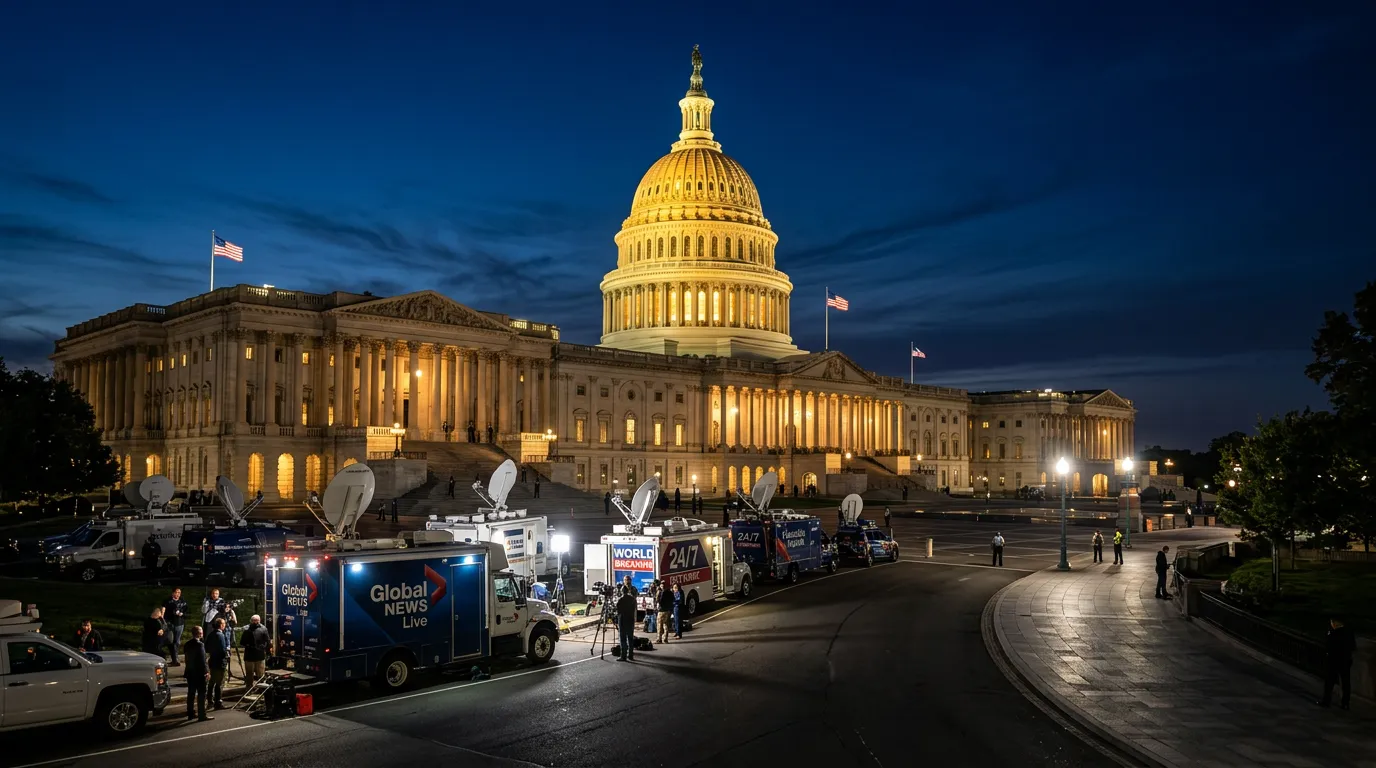
Donald Trump spoke for one hour and 48 minutes on Tuesday night, the longest State of the Union address in American history, surpassing Bill Clinton's 2000 record by 20 minutes. He opened by declaring that "our nation is back, bigger, better, richer and stronger than ever before" and that America has entered "the golden age." He closed with a militaristic case for potential action against Iran that his own foreign policy base has historically opposed. In between, he attacked Democrats, honored hockey players, dismissed the Supreme Court's tariff ruling, ignored the Minneapolis ICE shooting deaths, and claimed without evidence that election cheating "is rampant."
The length itself was the first signal. A president confident in his agenda delivers focused remarks. A president who needs to project dominance talks for nearly two hours, covering every topic with enough volume that the highlights reel writes itself. The speech was less a policy blueprint than a campaign rally relocated to the House chamber, nine months before midterm elections.
The Economic Disconnect
Trump's economic message leaned hard on optimism, asserting that "the roaring economy is roaring like never before" and pointing to stock market gains, lower gas prices, and declining mortgage rates. The claims are selectively true. The S&P 500 has risen under his second term, and gas prices are lower than their 2024 peak. Mortgage rates have fallen from their 2024 highs, though they remain elevated by pre-pandemic standards.
What the speech did not address is the gap between his economic messaging and public perception. February polling showed that only 39% of Americans approved of Trump's economic handling, a figure that would alarm any administration entering a midterm year. Consumer confidence indices have been falling since October, driven by persistent grocery price inflation and uncertainty about trade policy. The Supreme Court's tariff ruling, delivered four days before the address, created additional economic volatility that the president addressed with a single word: "unfortunate."
That restraint toward the Court was itself notable. Trump has publicly attacked judicial decisions throughout his career, often in aggressive terms. His muted language on the tariff ruling suggests either a calculated decision to avoid elevating the loss or an awareness that the Section 122 workaround he signed hours after the ruling is legally vulnerable and further attacks on the Court could complicate future proceedings.
The Iran Escalation
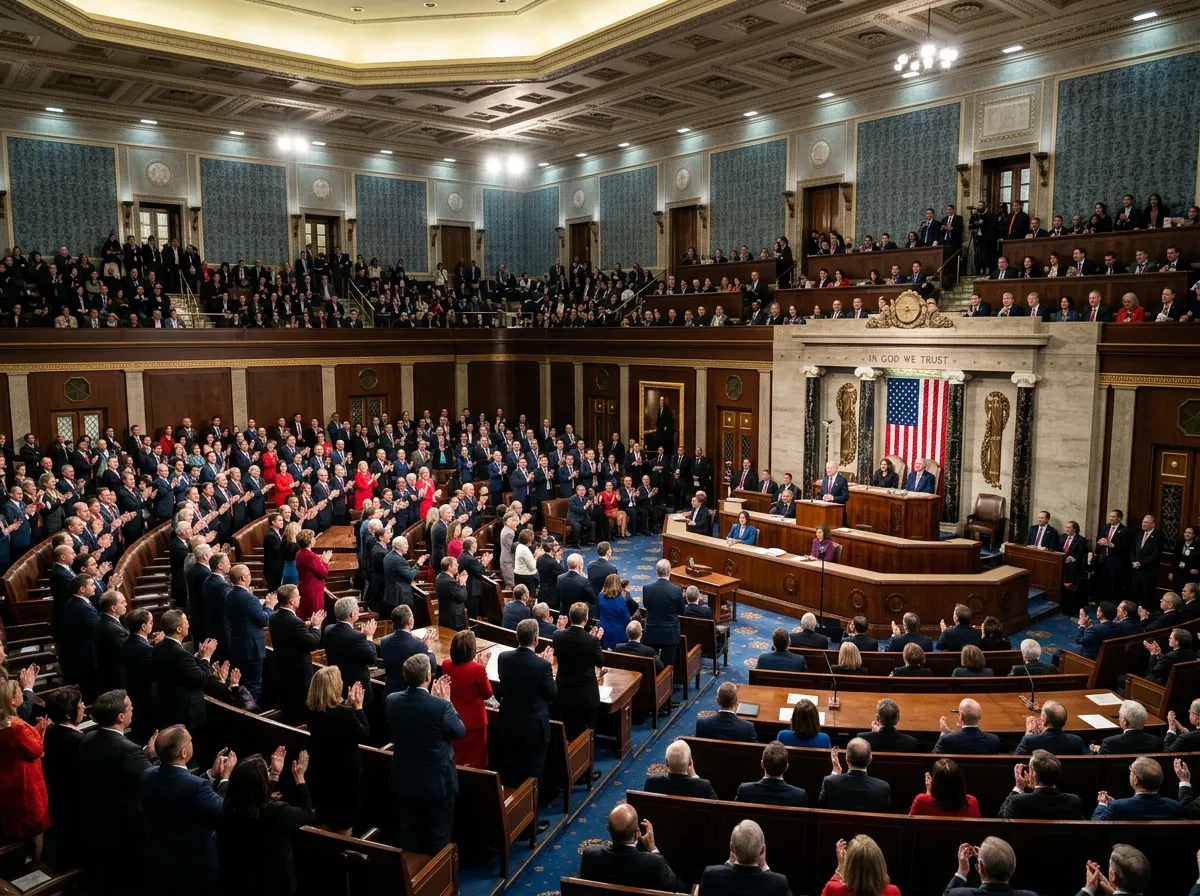
The most consequential section of the speech was also the most underreported in initial coverage. Trump dedicated roughly 15 minutes to Iran, building a case for potential military action that went further than any previous public statement from his administration. He claimed Iran killed 32,000 protesters during recent unrest, accused the regime of rebuilding its nuclear program, and stated: "I will never allow the world's number one sponsor of terror to have a nuclear weapon."
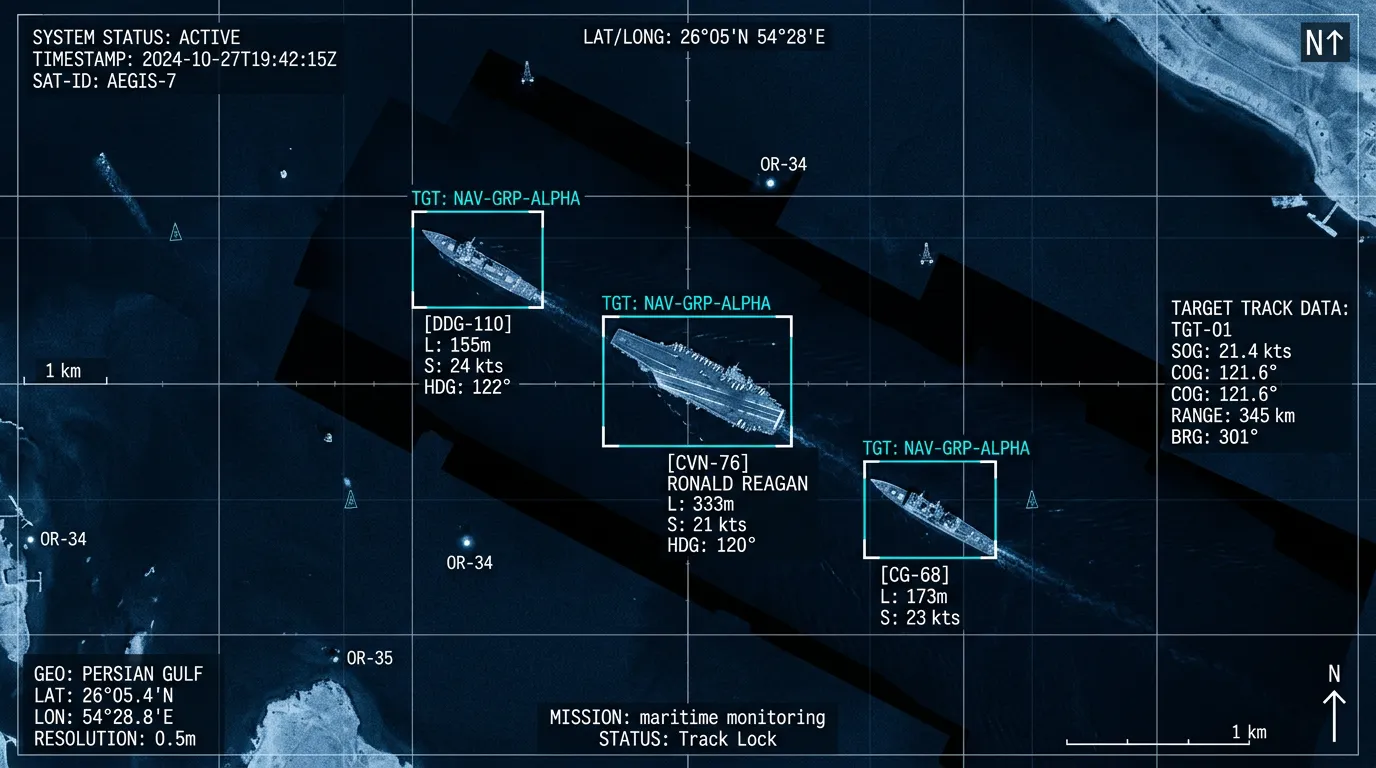
That language matters because of what is already happening in the region. The US has built up the largest military presence in the Middle East in decades, with two carrier strike groups now operating near Iranian waters. The Geneva nuclear talks between US and Iranian negotiators had shown signs of progress, but administration officials have privately characterized those talks as a final diplomatic window before military options are considered.
The speech's Iran section was structured not as a warning but as a predicate. By publicly cataloging Iran's alleged offenses, Trump was establishing the rhetorical groundwork that typically precedes military action, or at minimum, a dramatic escalation of sanctions and covert operations. The 2002 State of the Union's "axis of evil" framing performed a similar function for the Iraq War, and the rhetorical parallels are difficult to miss.
The domestic political complication is real. Trump's base, particularly the populist wing that opposes foreign military entanglements, has been skeptical of Middle East intervention. His speech attempted to thread the needle by framing potential action against Iran as defensive, focused on nuclear nonproliferation rather than regime change. Whether that framing holds under the scrutiny of an actual military operation is an open question.
What Was Missing
State of the Union addresses are defined as much by their omissions as their content, and this speech had several conspicuous gaps.
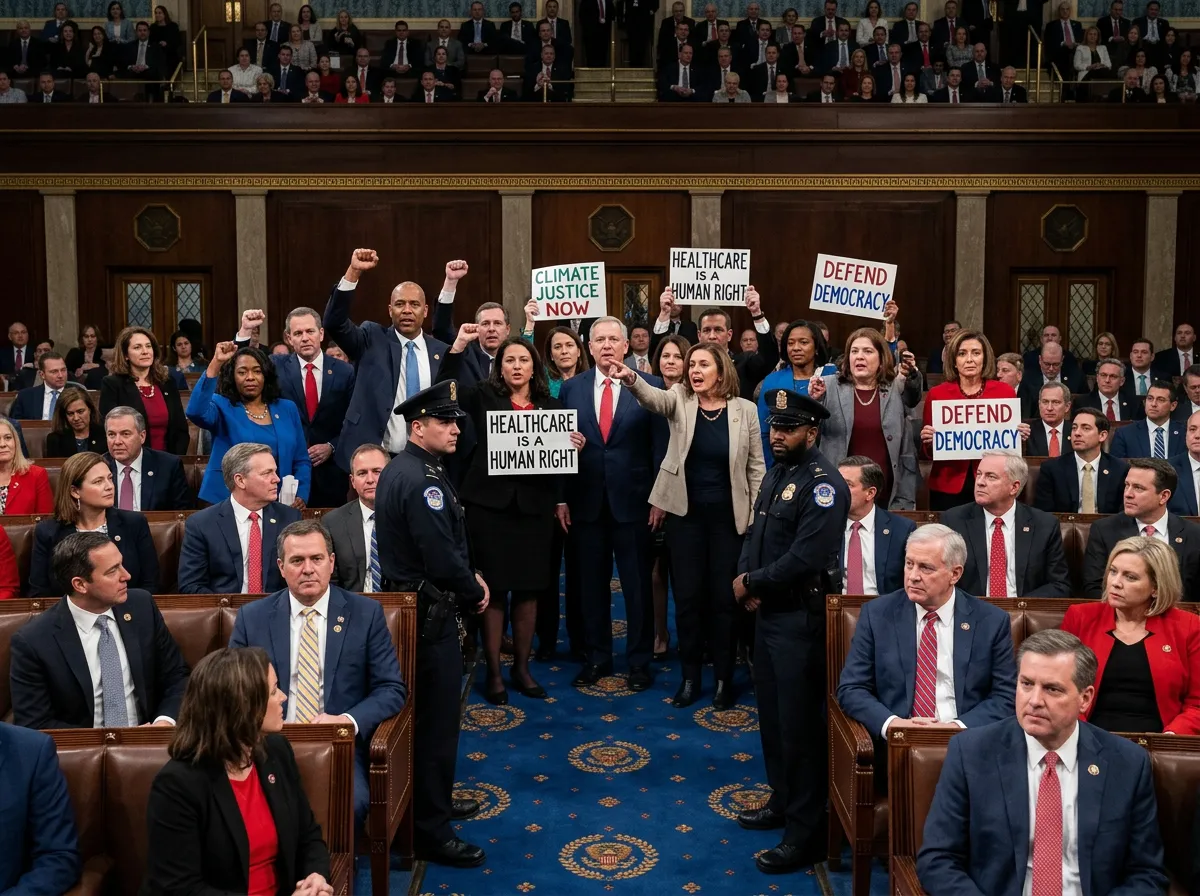
Trump made no mention of the Minneapolis ICE enforcement incident in which federal agents killed two US citizens. The omission was striking given the significant portion of the speech devoted to immigration enforcement and condemnation of "criminal aliens." Rep. Rashida Tlaib interrupted the speech to note that "Alex wasn't a criminal," referencing one of the deceased. Rep. Al Green was escorted from the chamber after holding a sign reading "Black People Aren't Apes," a reference to a video Trump had reposted on his Truth Social account depicting the Obamas.
The speech also avoided any discussion of the DHS funding standoff that has been simmering since early February, the ongoing recovery from the Blizzard of 2026 that left hundreds of thousands without power, and the rising cost of housing in metro areas where his base is concentrated.
The election integrity section deserves separate attention. Trump asserted that "cheating is rampant in our elections" and called for photo ID requirements, despite repeated court rulings finding no evidence of widespread voter fraud. He threatened unspecified executive actions, a vague warning that carries real weight nine months before midterms. Election administrators in swing states have already reported increased threats and harassment, and presidential rhetoric that questions election legitimacy compounds those pressures regardless of whether specific executive orders follow.
The State of the Union as Campaign Event
Every modern State of the Union doubles as political programming, but Trump's approach treats the format more explicitly as a campaign event than any predecessor's. The patriotic tribute segments, honoring the Olympic hockey team and a World War II veteran, were calibrated for shareable clips. The attack lines against Democrats, including "Democrats are destroying this country" and "these people are crazy," were aimed at the base rather than the chamber. Even the length served a purpose: the sheer volume of material ensures that media coverage will focus on the moments that generate the most engagement, which are almost always the most confrontational.
The calculation behind this approach is that midterm elections are won through base mobilization, not persuasion of swing voters. Whether that calculation is correct will be tested in November. Trump's approval rating sits in the low 40s, comparable to where it was before the 2018 midterms, which produced a Democratic wave in the House. The difference is that redistricting has made the current map more favorable to Republicans, and Democratic enthusiasm indicators have not yet reached 2018 levels.

What to Watch
The speech set up three specific confrontations that will define the next six months. The Iran section created a public expectation of action, either diplomatic or military, that the administration will need to deliver on or explain away. The tariff language, muted as it was, left the Section 122 legal battle as an unresolved question with a July 24 deadline. And the election integrity rhetoric, combined with threatened executive action, will test whether Republican election officials in swing states push back or accommodate.
The most useful measure of this speech's significance will not be the polling bump it produces, which historical data suggests will be minimal, but whether the Iran section was a performance or a predicate. The language used Tuesday night closely mirrors the rhetorical groundwork that preceded the 2003 Iraq invasion. If the Geneva talks fail to produce a framework agreement by late spring, the State of the Union may be remembered as the moment the administration began making its public case for military action. That outcome would reshape the midterm election landscape more than any other single issue, and it would test whether Trump's populist coalition can absorb a major foreign policy shift that many of its members have explicitly opposed.