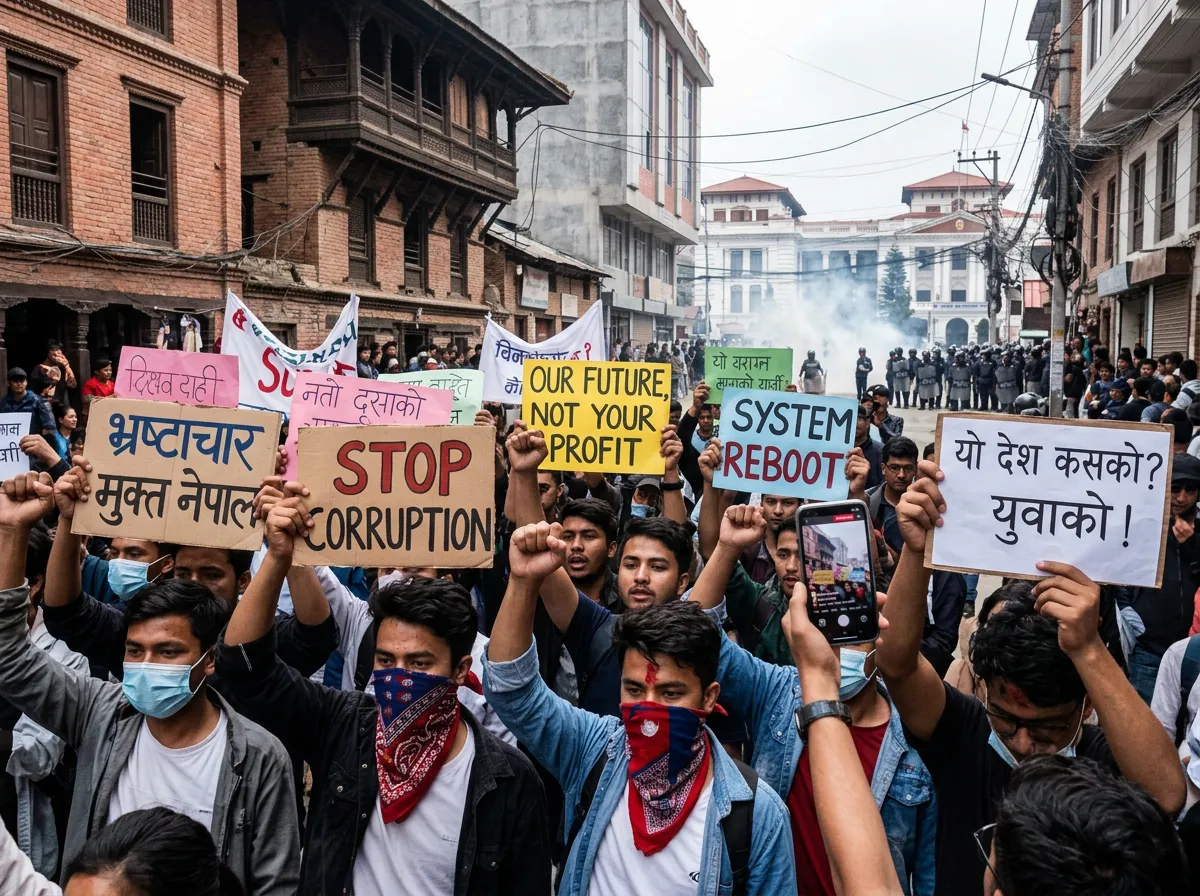
Six months ago, thousands of young Nepalis filled the streets of Kathmandu to demand an end to the corruption that has defined their country's politics for decades. Dozens were killed when police opened fire on protesters. Government buildings were set ablaze. A social media ban intended to suppress the uprising backfired, turning a protest against corruption into a full-scale popular revolt that forced the dissolution of parliament and new elections.
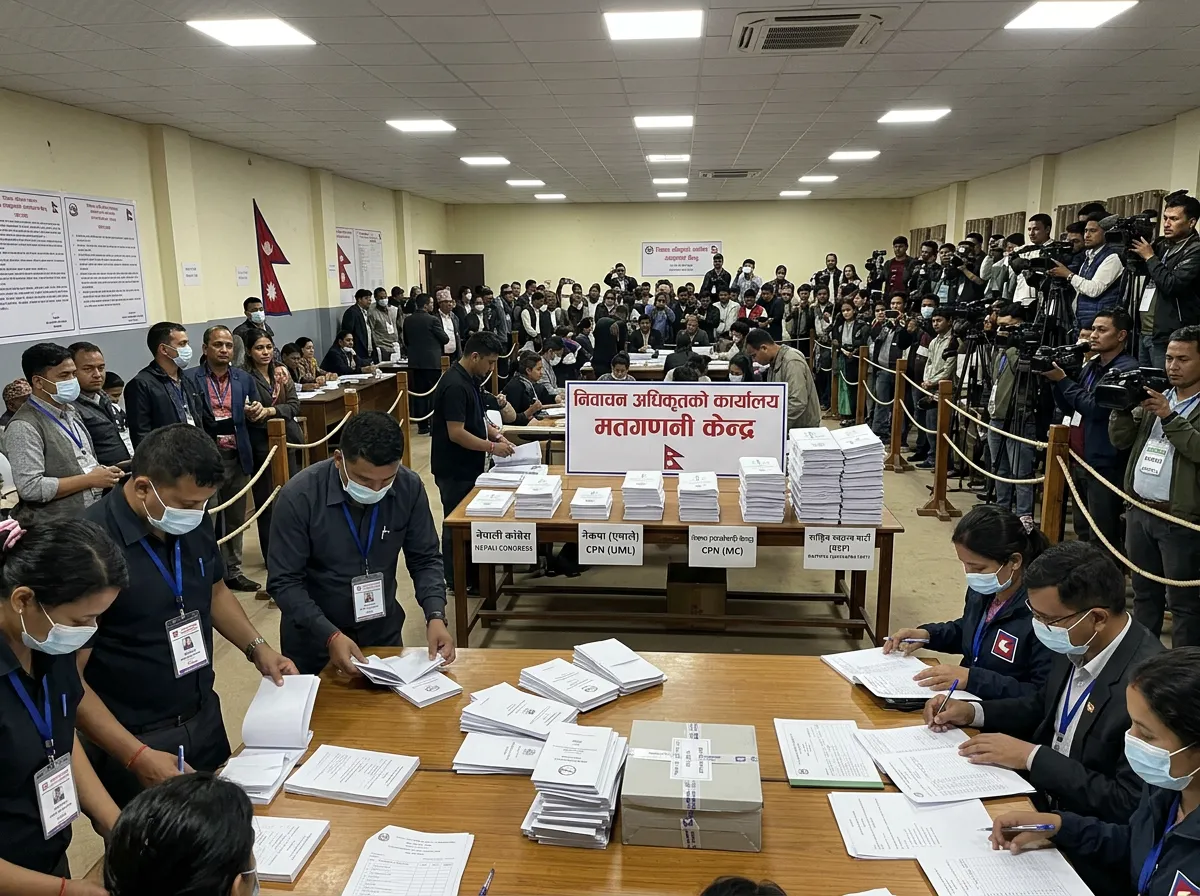
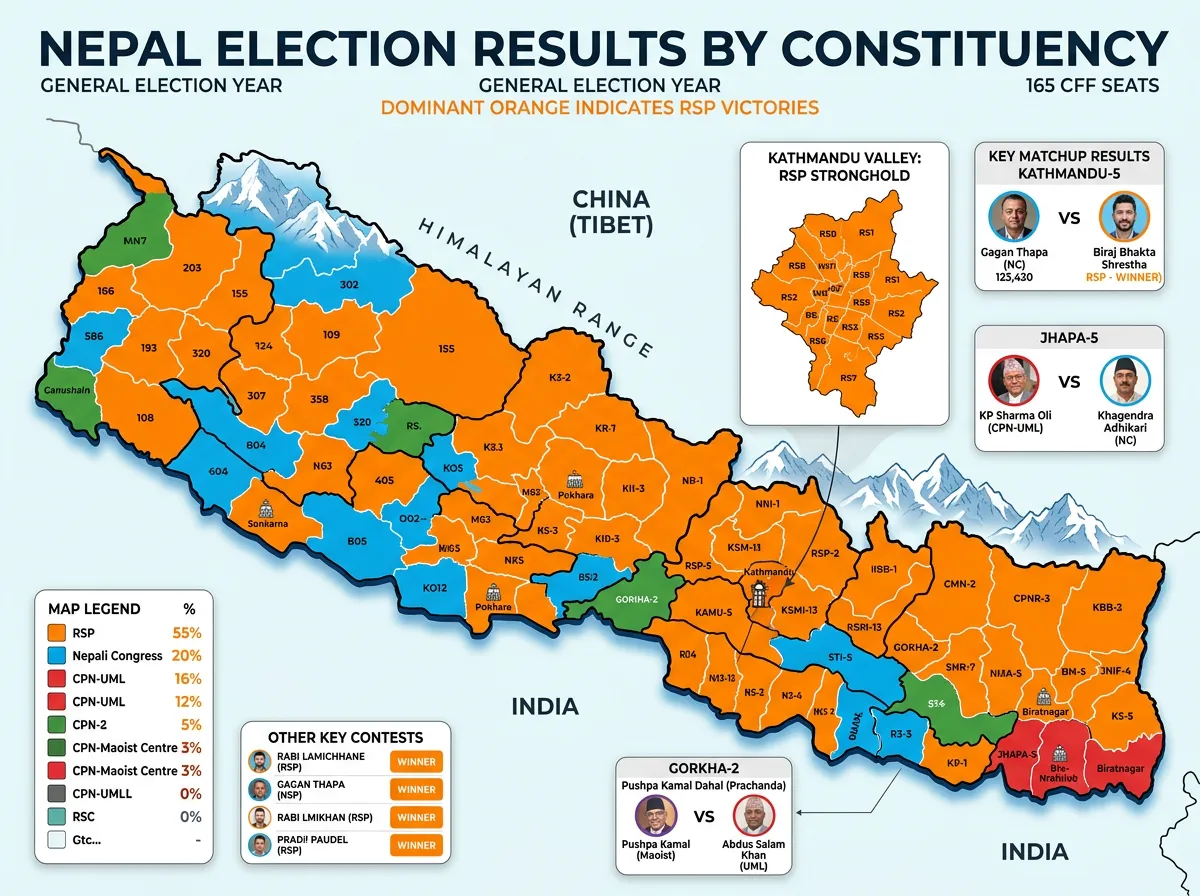
On Sunday, the results of those elections delivered a verdict so decisive it stunned even the movement's own leaders. The Rastriya Swatantra Party (RSP), a centrist party formed less than four years ago and led by 35-year-old rapper-turned-politician Balendra Shah, won 117 of 165 directly elected parliamentary seats and led in eight more. Shah himself defeated former Prime Minister K.P. Sharma Oli by a margin of 68,348 to 18,734 votes in the Jhapa-5 constituency, a nearly 4-to-1 humiliation of one of Nepal's most powerful political figures.
From Hip-Hop to Parliament: The Balendra Shah Story
Balendra Shah, known universally in Nepal as "Balen," took one of the more improbable paths to national leadership in recent memory. Before entering politics, he was a rapper and civil engineer who gained a following for music that criticized corruption, inequality, and the disconnect between Nepal's political class and its young population. His lyrics didn't just describe frustration; they channeled it into a political identity that resonated with a generation locked out of traditional power structures.
Shah first entered public life as an independent candidate for Mayor of Kathmandu in 2022, winning in an upset that signaled the depth of dissatisfaction with established parties. As mayor, he earned a reputation for pragmatic governance, tackling garbage collection and illegal construction with the same confrontational energy he'd brought to his music. When the 2025 protests erupted, Shah emerged as the leading voice calling for systemic reform, and the RSP consolidated around his candidacy.
The RSP's platform is deliberately centrist in a political landscape defined by a rivalry between the center-right Nepali Congress and the center-left Communist Party of Nepal (Unified Marxist-Leninist). The party campaigns on anti-corruption, economic modernization, and youth employment, issues that cross ideological lines and speak directly to the grievances that fueled the 2025 protests. By refusing the ideological positioning that has defined Nepal's two dominant parties, the RSP offered voters something neither legacy party could: a clean break.
The Numbers Behind the Landslide
The scale of the RSP's victory goes beyond impressive into historically unprecedented territory for Nepal's multiparty democracy. With 117 of 165 directly elected seats won and leads in eight more, the RSP is on track to control roughly 75% of the directly elected parliamentary seats. The party also led with approximately 51% of the 110 seats allocated through proportional representation, per Al Jazeera's reporting.
The old guard was decimated. The Nepali Congress and CPN-UML, which have alternated power since Nepal's transition to multiparty democracy in 1990, were reduced to single-digit seat counts in the directly elected categories. Multiple senior leaders from both parties lost their constituencies, including Oli, whose defeat by Shah was the most symbolic result of the night. Former Prime Minister Sher Bahadur Deuba of the Nepali Congress also lost his seat.
The results exceeded what even optimistic RSP supporters had predicted. Pre-election polling, notoriously unreliable in Nepal, had suggested the RSP would win a plurality but fall short of a majority, requiring a coalition government. Instead, Shah's party won a mandate that gives it the ability to govern alone, a rare feat in Nepal's fragmented political landscape.
A Gen Z Revolution That Actually Changed Something
The 2025 protests in Nepal followed a pattern familiar from youth uprisings around the world: economic frustration, social media mobilization, confrontation with state security forces, and a demand for generational change. What makes Nepal's case unusual is that the protests actually translated into durable political change, an outcome that has eluded similar movements in other countries.
The comparison to other popular protest movements is instructive. Sudan's 2019 revolution removed Omar al-Bashir but led to military rule and civil war. Hong Kong's 2019-2020 protests were crushed by Beijing's National Security Law. Sri Lanka's 2022 uprising ousted President Gotabaya Rajapaksa but produced only marginal political reform. Thailand's youth-led democracy movement achieved incremental gains but left the military establishment largely intact.
Nepal's trajectory diverged for several reasons. The existing democratic framework, however dysfunctional, provided a mechanism for channeling protest energy into electoral politics rather than revolutionary violence. The RSP was already organized before the protests, giving the movement a political vehicle that didn't need to be built from scratch. And Shah's personal credibility, established during his tenure as Kathmandu's mayor, gave voters a candidate they could trust with governance, not just with slogans.
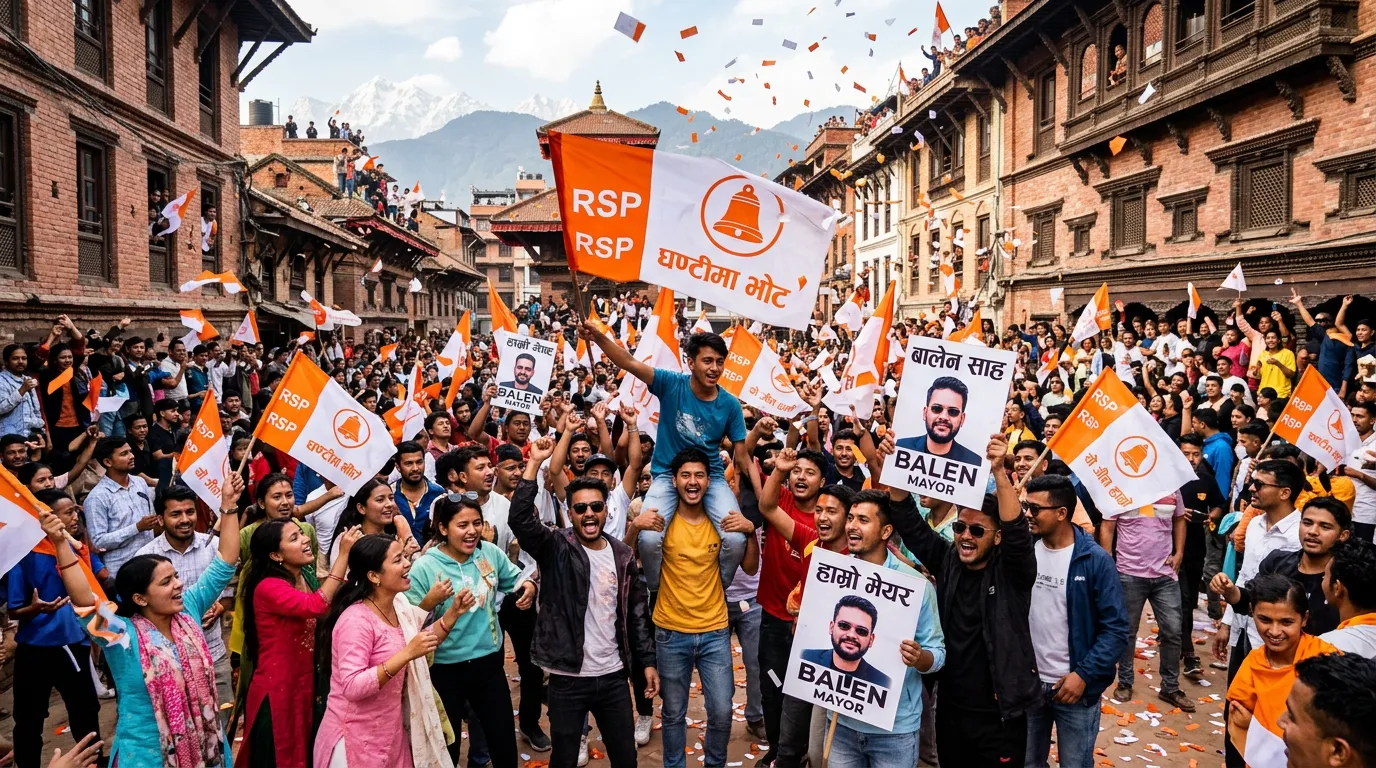
The restraint shown by the RSP after its victory adds another layer to the story. Party officials asked supporters to refrain from victory rallies or public celebrations, out of respect for the dozens killed during last year's protests. "We celebrate by governing well, not by dancing in the streets," an RSP spokesperson told NPR. That instinct, prioritizing the dead over the victory, signals a political maturity that will be tested by the enormous challenges ahead.
What Nepal's Election Means for South Asia
Nepal's election carries implications beyond its borders. The country, wedged between China and India, has long been a site of strategic competition between its two giant neighbors. Both Beijing and Delhi maintained relationships with Nepal's traditional ruling parties, and the RSP's rise introduces uncertainty into those dynamics.
India's Prime Minister Narendra Modi congratulated Shah on his victory, a diplomatic overture that signals Delhi's willingness to work with Nepal's new government. China, which cultivated close ties with Oli's CPN-UML, faces a less certain path. The RSP's platform does not explicitly favor either neighbor, but its emphasis on economic modernization and anti-corruption could align more naturally with Indian investment frameworks than with Chinese Belt and Road infrastructure projects.
The election also offers a counter-narrative to recent electoral trends that have favored populist strongmen and far-right movements globally. Shah is populist in the sense that his appeal bypasses traditional party structures and speaks directly to ordinary citizens' grievances, but his platform is substantively centrist, pro-institution, and focused on governance rather than ideology. In an era when anti-establishment movements often veer toward authoritarianism, Nepal's RSP offers an alternative path: channeling popular anger into democratic renewal rather than democratic erosion.
What Happens Next
Shah's RSP has the parliamentary majority to govern alone, but governing Nepal will test whether electoral dominance translates into effective administration. The country faces severe economic challenges, including a youth unemployment rate above 20%, heavy dependence on remittances from workers abroad, and infrastructure gaps that limit growth outside the Kathmandu Valley.
The most immediate test will be whether Shah can deliver on anti-corruption promises without destabilizing the bureaucratic structures that keep the country functioning. Nepal's civil service is deeply intertwined with the patronage networks of the old parties, and dismantling corruption without paralyzing governance requires surgical precision rather than blunt-force disruption.
Based on Shah's track record in Kathmandu, the early indicators are cautiously positive. His mayoral administration showed a willingness to make practical improvements while pushing structural reforms incrementally. If he governs the country the way he governed the capital, Nepal could become a rare example of a protest movement that produced not just a change in leadership but a genuine transformation in how a country is governed. The RSP's landslide gives Shah the mandate. Whether Nepal's Gen Z revolution is remembered as a turning point or a false start depends entirely on what he does with it over the next 12 months.