President Trump spoke with Vladimir Putin by phone on Saturday morning, then sat down with Ukrainian President Volodymyr Zelenskyy at Mar-a-Lago that afternoon, compressing what would normally require months of diplomatic groundwork into a single day. Trump told reporters the Putin call was "good and very productive." The Kremlin confirmed the conversation took place. Neither side disclosed what was actually discussed. Hours later, Zelenskyy arrived at the Florida resort with a delegation of senior advisors for a meeting that lasted into the evening. No public statements followed.
The choreography was deliberate. By speaking with Putin first, Trump entered the Zelenskyy meeting carrying whatever positions, demands, or signals the Russian president had communicated. Whether that sequencing represents skillful shuttle diplomacy or something more troubling depends on what was said in both conversations, and neither has been made public. What is clear is that the administration is pushing aggressively for a negotiated resolution to a war now approaching its fourth year, with outcomes that will shape European security for decades.
The Day's Choreography
Fiona Hill, a former senior director for European and Russian affairs on the National Security Council who now serves as a senior fellow at the Brookings Institution, told the Financial Times that the day's structure carried diplomatic significance beyond its content. "The sequencing matters enormously," Hill said. "Speaking to Putin first and then meeting Zelenskyy face-to-face creates an information asymmetry. Trump knows what Putin said. Zelenskyy doesn't. That dynamic gives the mediator leverage, but it also creates risk if the mediator's interests aren't perfectly aligned with a fair outcome."
The timing coincided with continued Russian military operations. Overnight, before the diplomatic contacts began, Russia launched a drone attack on Ukrainian cities that killed several civilians and struck critical infrastructure. Moscow's willingness to pursue warfare and negotiation simultaneously is consistent with its established strategy: talks are a parallel track to fighting, not a replacement for it. Zelenskyy referenced the attacks in a social media post before departing for Mar-a-Lago, writing that "Russia negotiates while its drones kill."
What Each Side Wants
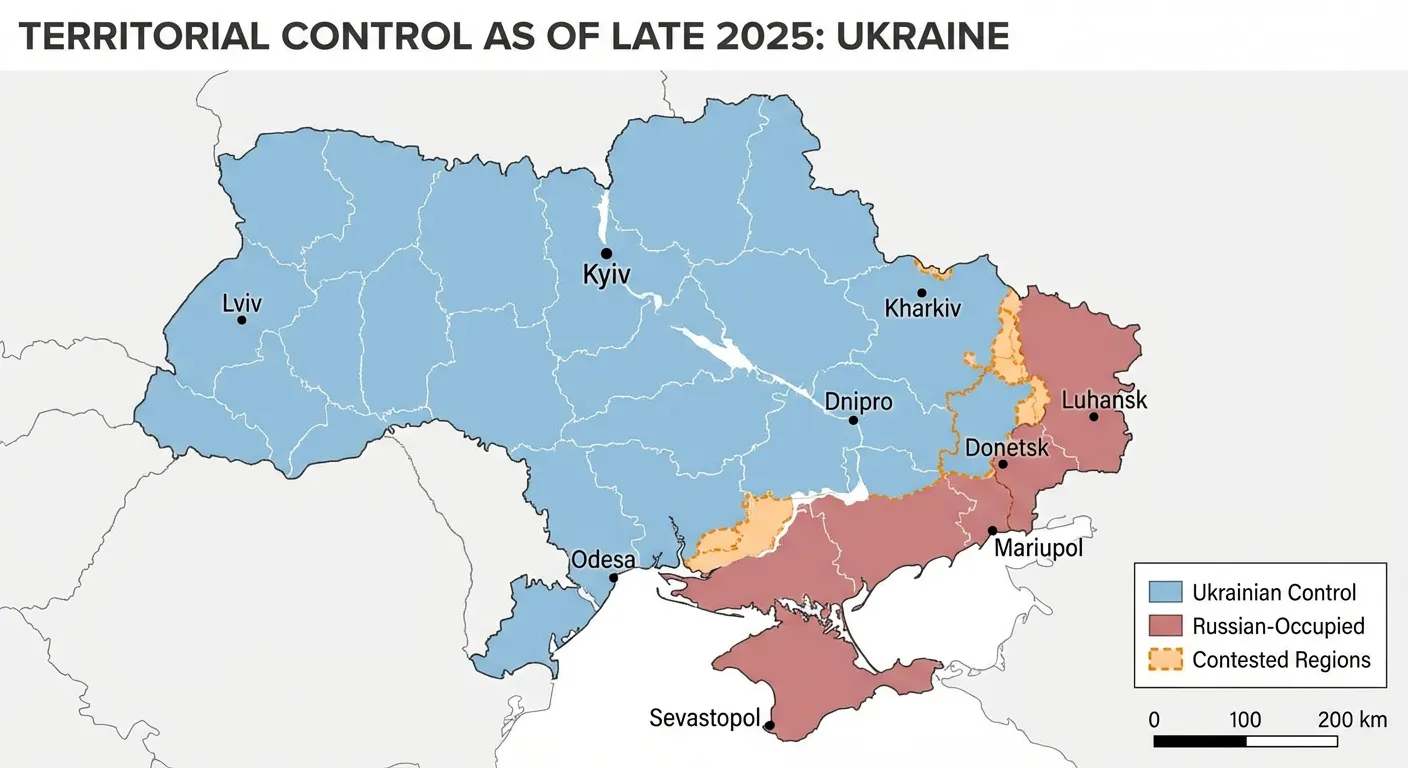
The gap between Russian and Ukrainian positions remains vast. Russia has demanded recognition of its territorial annexations across four Ukrainian oblasts, Ukrainian "neutrality" meaning permanent exclusion from NATO, strict limits on the size and capability of Ukraine's military, and the lifting of Western sanctions. These terms would ratify the largest land grab in Europe since World War II and leave Ukraine permanently vulnerable to future aggression.
Ukraine has refused to cede any territory and insists on security guarantees robust enough to deter Russia from attacking again. Zelenskyy's "peace formula," presented at multiple international forums, calls for full territorial restoration, war crimes accountability, and a security architecture that would make future Russian aggression prohibitively costly. Western analysts broadly agree that a deal will land somewhere between these positions, but the distance between them is not a negotiating gap. It is a chasm.
Michael Kofman, a senior fellow in the Russia and Eurasia Program at the Carnegie Endowment for International Peace, told PBS NewsHour that "the fundamental problem hasn't changed. Russia believes time is on its side and that Western support for Ukraine will erode. Ukraine believes any deal that rewards Russian aggression invites more of it. Both are probably right, which is why this war has proven so resistant to negotiation."
The Diplomatic Gamble
Trump has promised to end the war quickly, a commitment he made during his campaign and has repeated in office. His approach involves direct personal engagement with both leaders, a departure from the Biden administration's strategy of supporting Ukraine militarily while avoiding direct communication with Putin. Supporters argue that only Trump's willingness to talk to both sides gives diplomacy a genuine chance. Previous Western approaches, they contend, failed because they excluded Russia from serious discussion.

Critics worry that Trump's eagerness for a deal, combined with his publicly expressed skepticism about continued Ukraine support and past praise for Putin, could lead him to pressure Zelenskyy into terms that serve American domestic politics more than Ukrainian security. European allies have watched the day's events with particular anxiety. A settlement that weakens NATO's eastern flank or establishes the principle that territorial conquest can succeed in 21st-century Europe would have consequences far beyond Ukraine's borders.
Zelenskyy faces an agonizing calculation. Ukraine cannot win outright against a larger adversary willing to absorb enormous casualties. But accepting a deal that rewards Russian aggression would validate the invasion and leave Ukraine vulnerable indefinitely. Western support has been essential to Ukraine's survival, but its permanence is not guaranteed. A negotiated settlement while Ukraine retains leverage may be preferable to continued fighting with uncertain long-term backing from Washington.
What to Watch
Two concrete events will clarify whether Saturday's conversations were substantive or theatrical. First, a follow-up round of direct talks between U.S. and Russian officials is expected in January, and whether that meeting produces a framework proposal or more vague communiques will signal how serious both sides are. Second, a scheduled delivery of long-range ATACMS missiles to Ukraine in early 2026 will test whether the administration treats arms transfers as leverage in negotiations or continues them as baseline support. If both proceed on their current tracks, the war enters a phase where diplomacy and escalation run in parallel, with Ukrainian civilians enduring infrastructure damage that has left millions without reliable heat and electricity while the political calendar narrows the window for any deal before spring fighting resumes.
Sources
- Trump said he had 'good and very productive' call with Putin - ABC News, December 2025
- Face the Nation Full Transcript 12-28-2025 - CBS News, December 2025
- PBS News Weekend: December 28, 2025 - PBS News, December 2025
- Trump's Ukraine Diplomacy: What the Mar-a-Lago Meeting Means - Financial Times, December 2025