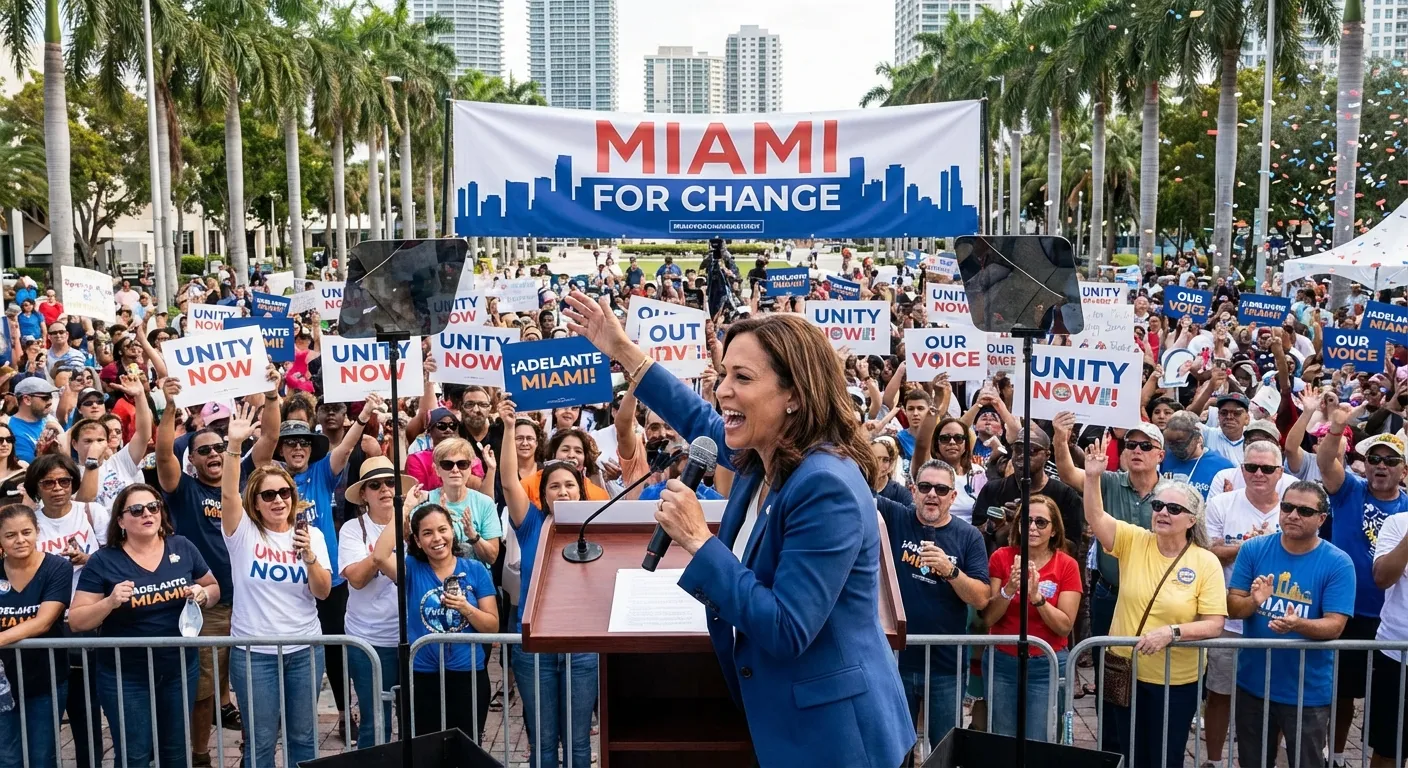
In 129 years of municipal government, Miami had never elected a woman as mayor. That changed on Saturday when Eileen Higgins, a former Miami-Dade County Commissioner, defeated Republican Alex Diaz de la Portilla with 54% of the vote in a race that drew 47% voter turnout, roughly fifteen points above the city's norm for municipal elections. The result also snapped a 28-year Republican hold on the office, making it arguably the most consequential mayoral contest in the city's recent political history.
The margin was decisive enough to avoid a recount but tight enough to underscore just how competitive South Florida's political terrain has become. Higgins' campaign raised $4.2 million, outpacing her opponent by nearly two to one, with notable support from local labor unions and national women's political organizations including Emily's List. The result drew immediate attention from analysts tracking whether Florida's urban centers are diverging politically from the state's rightward trajectory.
A Coalition Built on Kitchen-Table Issues
Higgins won by running on problems that cut across partisan lines. Housing affordability topped her platform, a strategic choice in a city where median rent in Miami-Dade County has surged 38% since 2020, according to Zillow market data. Her proposal to create a $200 million affordable housing trust fund, financed through impact fees on luxury development, resonated with working-class voters who have watched their neighborhoods transform into playgrounds for remote workers and crypto entrepreneurs.
Climate resilience served as her second pillar. Miami faces some of the most immediate sea-level rise threats of any major American city, with Army Corps of Engineers projections suggesting 10 to 17 inches of additional rise by 2040. Higgins proposed accelerating the city's stormwater infrastructure overhaul and pursuing federal resilience funding more aggressively than her predecessors, pointing to the $3.5 billion in FEMA hazard mitigation grants that Florida left partially untapped in 2024.
Transportation completed her three-issue framework. Miami consistently ranks among the ten worst cities in America for traffic congestion, according to the Texas A&M Transportation Institute's annual Urban Mobility Report. Higgins campaigned on expanding the city's limited public transit options, including a proposed light rail extension connecting Wynwood to the Health District, and creating more pedestrian-friendly corridors in the urban core.
Breaking Two Barriers Simultaneously
The gender milestone carries significance beyond symbolism. Susan MacManus, a political science professor emerita at the University of South Florida, told the Miami Herald that Higgins' victory "reflects a generational shift in South Florida's political culture that has been building for a decade." Women now lead several of Florida's largest municipalities, but Miami had been a conspicuous holdout, lagging decades behind Boston, San Francisco, Phoenix, and Houston in electing its first woman mayor.
The partisan dimension is equally notable. Florida has trended decisively Republican in statewide races since 2018, and the state's GOP enjoys supermajorities in both legislative chambers. But municipal races tell a different story, with Democrats remaining competitive in urban centers where concerns about housing costs, infrastructure, and climate change align with their traditional strengths.
De la Portilla entered the race with significant liabilities. Ethics investigations stemming from his time in the state legislature dogged his campaign, and he struggled to distance himself from unpopular state-level Republican positions on abortion and education policy. Michael Binder, director of the University of North Florida's Public Opinion Research Lab, noted that "local Republican candidates in Florida's cities are increasingly caught between their state party's direction and the priorities of their own constituents." Binder's pre-election polling had shown Higgins leading by single digits throughout October, suggesting the outcome reflected a genuine preference shift rather than low Republican turnout.
The Challenges Waiting on Day One
Higgins inherits a city experiencing the contradictions of rapid growth. Miami's economy has boomed since the pandemic, attracting tech workers, hedge funds, and remote professionals drawn by low taxes and year-round warmth. That influx generated $1.8 billion in new construction permits in 2024 alone. It has also strained housing supply, overwhelmed aging water and sewer infrastructure, and contributed to traffic that routinely turns a fifteen-minute drive into an hour-long ordeal.
Her first major test comes with the city's 2026 budget negotiations, where she will need to balance campaign promises against fiscal realities. Miami's pension obligations have grown faster than revenues, consuming an increasing share of the operating budget. The affordable housing trust fund she proposed requires new revenue streams that the city commission, where Republicans retain influence, may resist approving.
She has also pledged to work across party lines with Miami-Dade County's Republican leadership and Governor DeSantis' administration in Tallahassee. That relationship could prove contentious given the state government's track record of preempting local progressive policies on issues ranging from minimum wage to rent control to environmental regulation.
What Happens Next
Miami's election of its first woman mayor represents a genuine inflection point, and Higgins has already outlined specific benchmarks for her first year. She has committed to submitting the $200 million affordable housing trust fund ordinance to the city commission within 90 days and to hiring Miami's first chief resilience officer by March 2026. The light rail feasibility study for the Wynwood-Health District corridor is scheduled to begin in the second quarter.
History offers instructive precedents. When Houston elected Annise Parker as its first woman mayor in 2009, Parker used her first year to overhaul the city's pension system and expand flood mitigation spending, both of which became signature accomplishments across her three terms. Boston's Michelle Wu, elected in 2021, secured a fare-free bus pilot program within her first six months. In each case, early concrete wins built the political capital needed for larger structural changes. Higgins will be measured by the same standard: whether the housing trust fund reaches the commission floor, whether the resilience office secures its first federal grant, and whether transit planning moves from proposal to funded study. Those milestones, more than any election-night symbolism, will determine whether her administration delivers lasting results for a city that can no longer afford incremental approaches to housing, climate, and infrastructure.
Sources
- NPR: Democrat wins Miami mayor's race for the first time in nearly 30 years - NPR, December 2025
- Zillow: Miami-Dade County rent trends and housing data - Zillow
- Southeast Florida Regional Climate Compact: Unified Sea Level Rise Projection - Southeast Florida Regional Climate Compact
- Texas A&M Transportation Institute: 2025 Urban Mobility Report - Texas A&M University, 2025
- The 19th: Eileen Higgins will be Miami's first-ever woman mayor - The 19th, December 2025