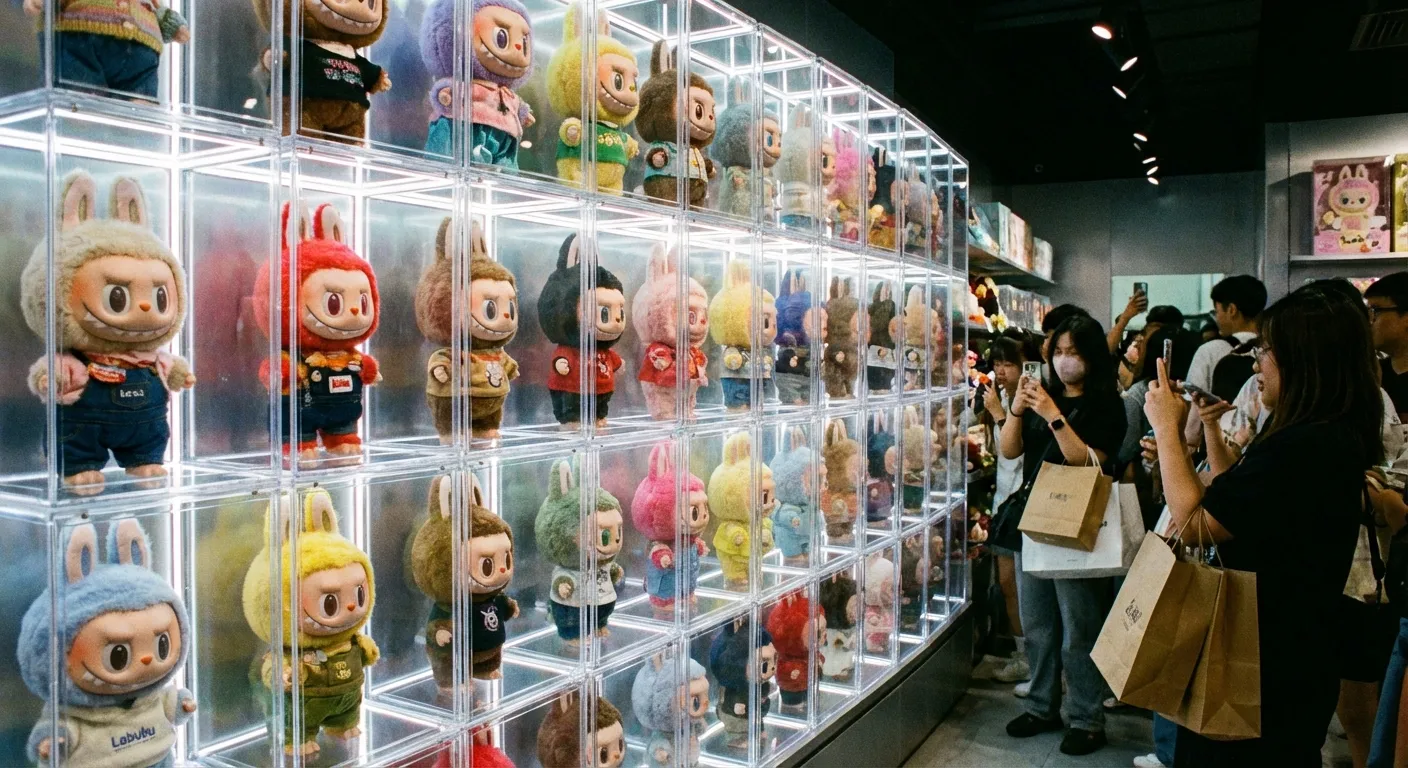
A life-size Labubu plush sold for $170,000 at auction in Shenzhen earlier this year. The buyer, whose identity was not disclosed, acquired what is essentially a stuffed animal with an oversized head, pointy ears, and a mouth full of sharp teeth arranged in a permanent, slightly menacing grin. If that transaction sounds absurd, it is only the most visible peak of a collecting phenomenon that has generated hours-long retail lines across Asia, a secondary market where limited editions trade for 10 to 50 times their retail price, and revenue that pushed Pop Mart, the Chinese company behind the brand, to a $30 billion market valuation.
Labubu was created by Hong Kong artist Kasing Lung as part of his "The Monsters" character universe. The design deliberately subverts conventional toy aesthetics. Where most plush characters deploy wide eyes and soft curves to signal approachability, Labubu leads with teeth. The first reaction from many newcomers is some variant of "that's creepy." The second, apparently, is "I need one."
The Ugly-Cute Formula
The Labubu phenomenon sits at the intersection of design theory and consumer psychology. Zoe Fraade-Blanar, co-author of "Superfandom: How Our Obsessions Are Changing What We Buy and Who We Are," told Vox that Labubu exemplifies what designers call the "ugly-cute" or "kimo-kawaii" aesthetic. "The slight wrongness is what makes it memorable," Fraade-Blanar explained. "In a market flooded with conventionally cute products, the character that makes you look twice has an automatic advantage. Labubu's teeth are doing marketing work that no ad campaign could replicate."
The blind box format amplifies the appeal. Labubu figures are sold in sealed packaging that conceals which specific variant is inside. Each series contains common figures, uncommon variants, and rare "secret" editions that appear in roughly one of every 144 boxes. The format turns every purchase into a small gamble, and that uncertainty triggers the same dopamine response that makes slot machines compelling. Collectors who pull a rare variant experience a rush that reinforces repeat buying. Those who don't keep trying.
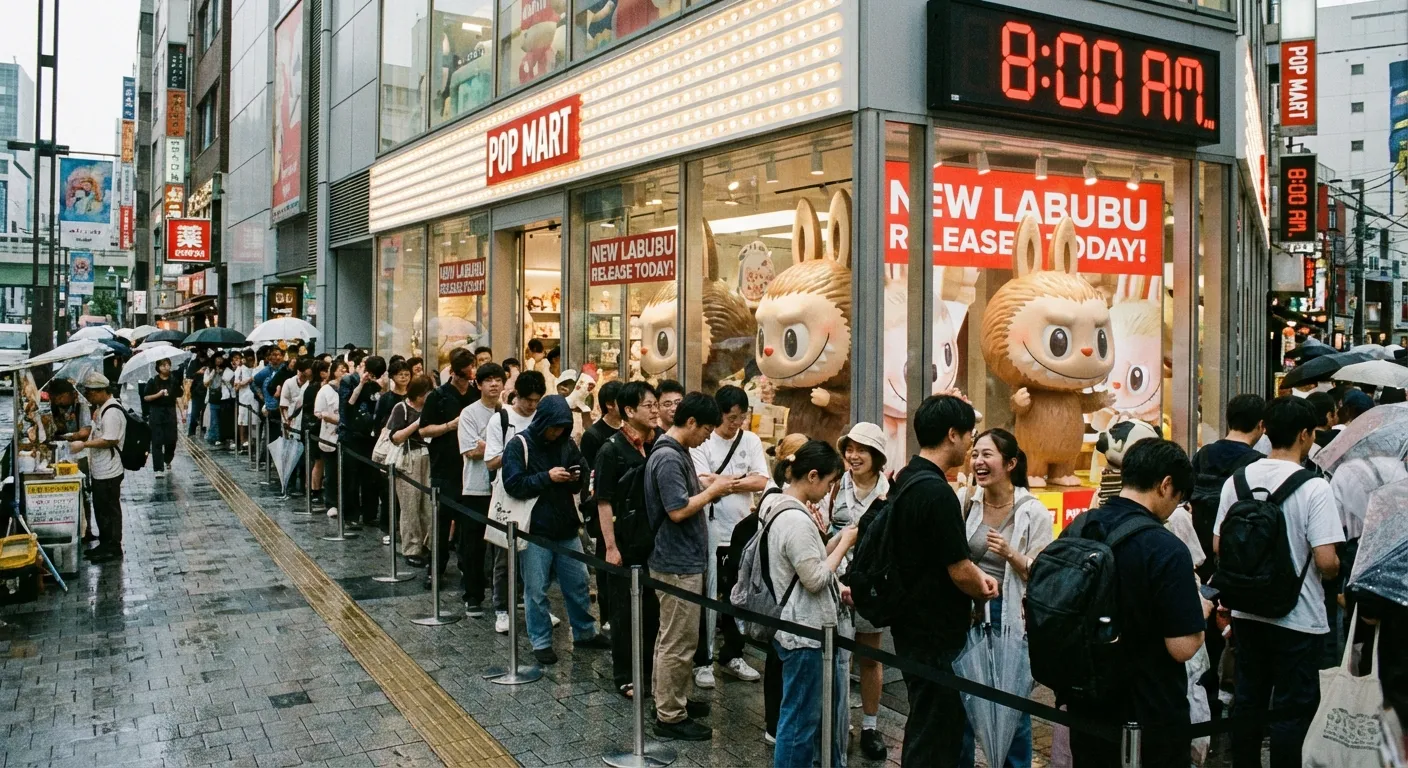
Pop Mart has proven remarkably skilled at maintaining demand without completely frustrating its customer base. New series launch at controlled intervals. Production quantities ensure sell-outs without creating the kind of permanent scarcity that would drive collectors away entirely. The company expanded from its Chinese base into international markets through flagship stores in cities including London, Los Angeles, and Sydney, introducing Labubu to audiences who had never encountered the character.
The Resale Gold Rush
Where scarcity meets obsession, secondary markets emerge. Labubu has spawned a robust resale economy on platforms including StockX, Mercari, and dedicated collectibles exchanges. Certain limited edition figures appreciate so rapidly after release that buying them has become closer to speculation than shopping. A "Macaron" Labubu that retailed for $13 was trading at over $1,500 within weeks of its release. The "Zingy Lime" variant from the same series peaked above $2,000.
This dynamic has attracted a class of buyer with no personal interest in the character. Resellers purchase boxes in bulk, keep the rare pulls, and flip the rest. In some cases, entire store allocations have been purchased by coordinated groups who list sealed boxes at premiums before even opening them. Pop Mart has responded with purchase limits at physical stores, though enforcement varies.
Liang Wenjie, a toy industry analyst at Shanghai-based iResearch, told Bloomberg that the Labubu resale market mirrors patterns seen in sneaker culture and trading cards. "The product becomes a financial instrument," Liang said. "The emotional connection that drives genuine collectors creates the demand that speculators exploit. It's the same dynamic in every collectibles boom."
Cultural Roots of the Craze
The Labubu phenomenon is not happening in a cultural vacuum. The "kidult" market, adults purchasing toys, collectibles, and character merchandise, has grown into a multi-billion dollar global category. NPD Group data shows that adult spending on toys increased 19 percent between 2019 and 2024, driven largely by millennials and Gen Z consumers who treat aesthetic objects as identity markers rather than childish indulgences.
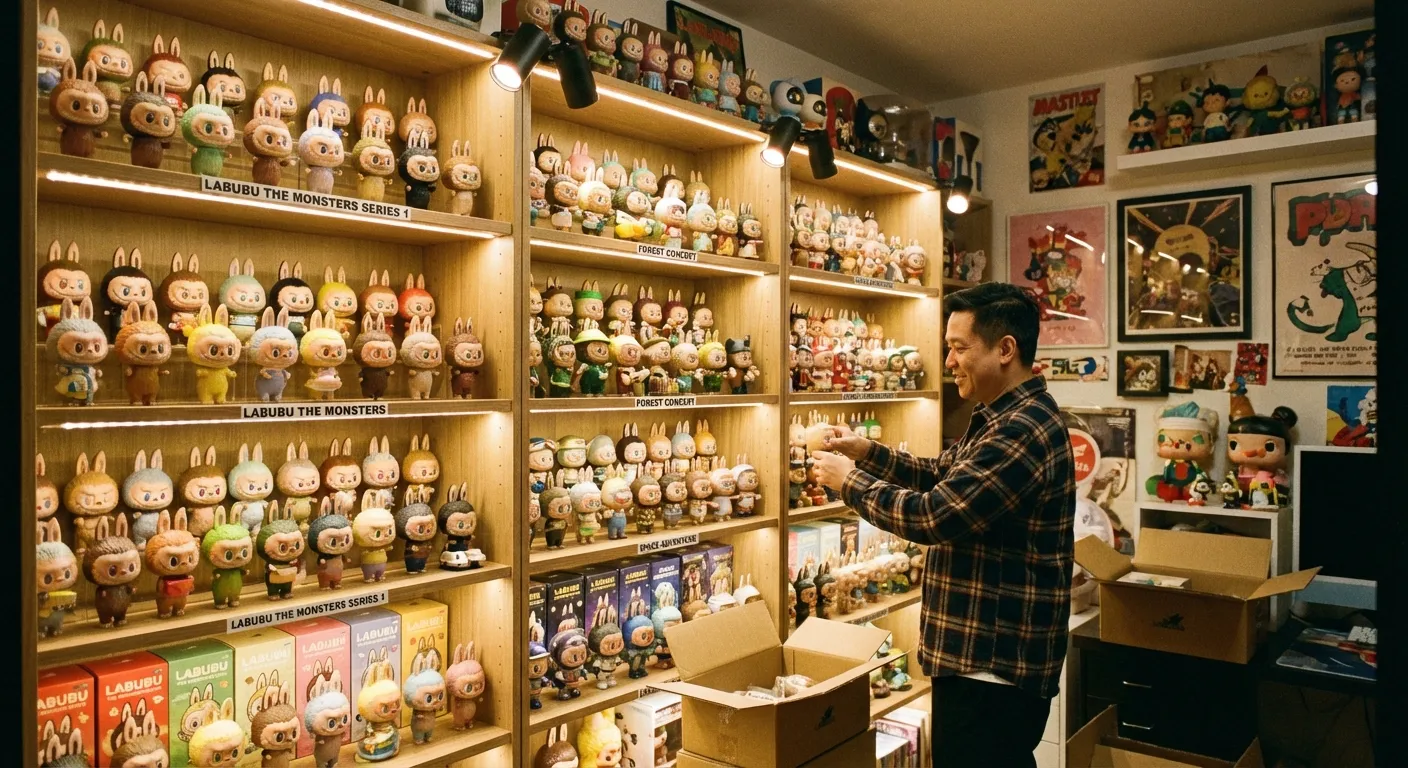
Social media has transformed collecting from a private hobby into a performance. Unboxing videos on TikTok and YouTube generate millions of views. The moment of tearing open a blind box, the suspense of discovering which variant is inside, creates content that is inherently shareable. Celebrity endorsements accelerated Labubu's crossover from niche interest to mainstream phenomenon. When Lisa of BLACKPINK was photographed with a Labubu keychain, Pop Mart's stock rose 12 percent in a single trading session.
There is something distinctly 2025 about the appeal. In an era of AI-generated perfection and algorithmically optimized design, Labubu's deliberate weirdness offers contrast. It is handmade-looking in an algorithmic age, imperfect by design in a world that optimizes everything. The teeth are the point. They signal that this object was made by a human artist with a specific, slightly subversive vision, not generated by a committee or a model trained on what focus groups prefer.
The Conversation
Pop Mart has structural advantages that previous collectible booms lacked. Beanie Babies relied on a single product line from a company with no retail infrastructure and no plan for what came after scarcity-fueled mania faded; when Ty Inc. flooded the market in 1999, resale values collapsed overnight. Funko Pops at their peak faced a similar overproduction problem, with the company shipping so many variants that warehouse gluts eroded the scarcity that collectors valued. Pop Mart, by contrast, owns its retail stores, controls production volumes through data-driven demand modeling, and has diversified beyond Labubu into dozens of character properties that reduce dependence on any single brand. That does not make it immune to a downturn, but it means a correction would more likely look like a cooling than a crash. For now, Labubu's toothy grin is one of 2025's most recognizable images, a character that millions find simultaneously strange and irresistible. What it reveals about consumer culture, about the gap between what people say they want and what actually captures their attention, may prove more interesting than the collectibles themselves.
Sources
- 'Labubu' is a plush toy that is causing a frenzy. Here's its origin story - NPR, June 2025
- Life-size Labubu doll sells for over $170,000 at Beijing auction amid global frenzy - NBC News, 2025
- Fever to fatigue? Pop Mart welcomes the fall in Labubu resale prices - CNBC, September 2025
- Labubu success demonstrates the benefits of the 'blind box' business strategy - University of Florida News, July 2025