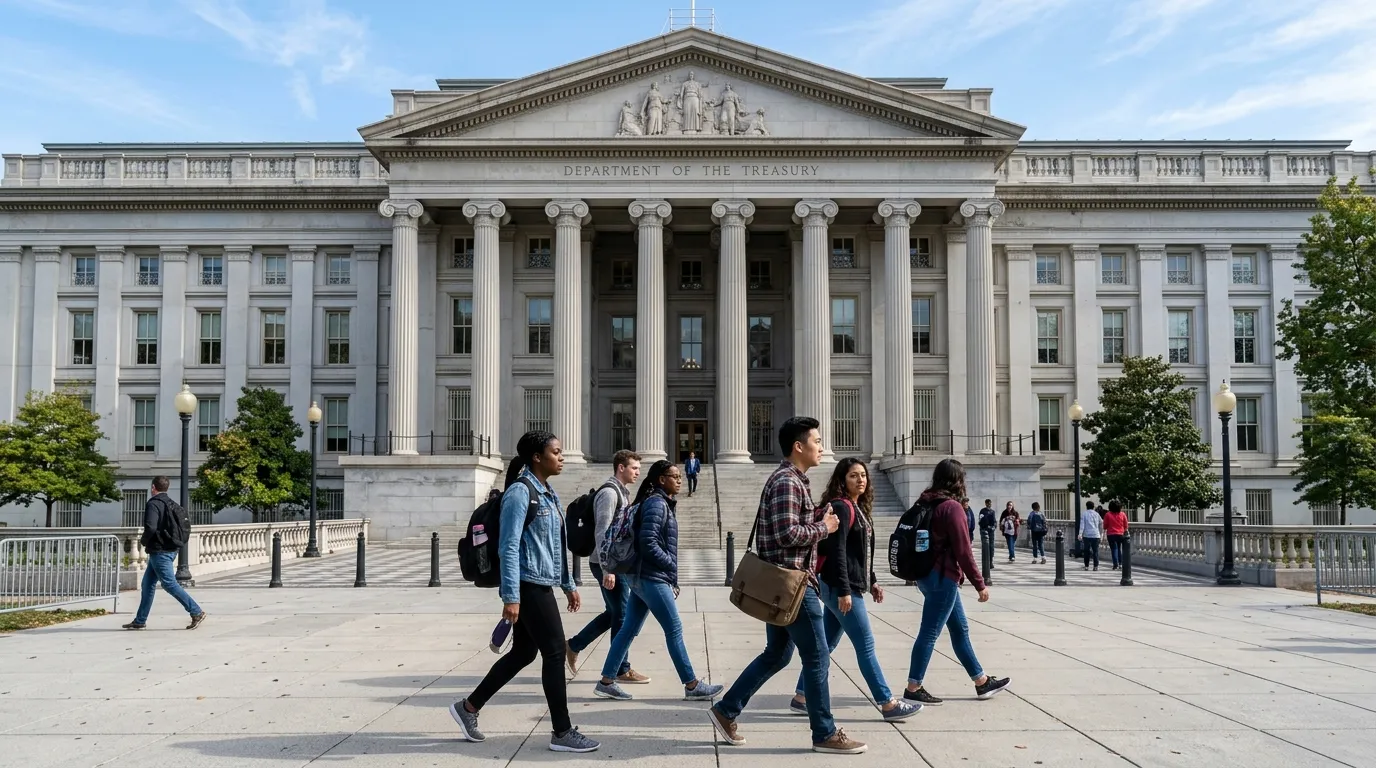
The Trump administration announced on Wednesday a three-phase plan to transfer the federal student loan portfolio, nearly $1.7 trillion in outstanding debt, from the Department of Education to the Treasury Department. The move, framed by officials as an administrative efficiency measure, is the most concrete step yet in the president's stated goal of dismantling the Education Department. Borrowers were told they do not need to take any action and should "see no change" in their experience. That assurance deserves scrutiny, because the two agencies involved have fundamentally different missions, and the structure of the transfer reveals priorities that do not align with borrower protection.
Phase 1, which takes effect immediately, moves responsibility for collecting on defaulted loans to Treasury. That covers approximately $180 billion in debt, roughly 11% of the total portfolio, affecting about 10 million borrowers. Of those, 9.2 million are currently in default, with another 2.4 million in late-stage delinquency. Phase 2 will shift servicing of non-defaulted loans to Treasury "to the extent practicable," a qualifier that does significant legal and logistical work. Phase 3 transfers administration of FAFSA, the Free Application for Federal Student Aid, to Treasury as well. No timeline has been announced for Phases 2 and 3.
Why Default Collections Come First
The sequencing of the transfer is not random. Starting with defaulted loans is the path of least political resistance, because borrowers in default have already missed payments and are already subject to aggressive collection actions including wage garnishment, tax refund seizure, and Social Security offset. Moving those accounts to Treasury, an agency whose core competency is revenue collection, does not require building new infrastructure. Treasury already runs the Bureau of the Fiscal Service, which handles government debt collection. The operational handoff is relatively straightforward.
But the sequencing also reveals a set of priorities. The administration chose to begin with the part of the student loan system that most closely resembles ordinary debt collection, not the part that involves borrower counseling, income-driven repayment plan administration, or Public Service Loan Forgiveness processing. That choice tells you something about how the administration views the student loan portfolio: primarily as a revenue asset, not a public service obligation.
"This is about efficiency and good stewardship of taxpayer resources," a senior Treasury official told NPR on Wednesday. What the official did not address is that the Education Department's Office of Federal Student Aid was specifically designed to balance collection with borrower advocacy, a function that has no obvious home within Treasury's organizational structure.

The Institutional Mismatch
The Treasury Department collects money. That is its primary function and the core of its institutional culture. It manages government revenue, issues bonds, enforces tax law, and operates the IRS. When Treasury encounters a debtor, its framework is transactional: money is owed, and Treasury's job is to recover it.
The Department of Education's approach to student loans, at least in design, operates on a different premise. Federal student loans exist as an investment in human capital, subsidized by taxpayers, with repayment structures intentionally built to accommodate the reality that not all educational investments produce immediate financial returns. Income-driven repayment plans cap monthly payments at a percentage of discretionary income. Public Service Loan Forgiveness eliminates remaining balances after 10 years of payments for borrowers working in government or nonprofit roles. Borrower defense provisions allow borrowers defrauded by their institutions to discharge their debt entirely.
These programs require an administering agency that sees itself as serving borrowers, not just collecting from them. Treasury has no institutional history of that role. Its expertise is in managing the government's balance sheet, not in evaluating whether a borrower qualifies for income-driven repayment adjustments or processing forgiveness applications that require case-by-case review.
Rachel Fishman, deputy director for research at New America's education policy program, told CNN that the transfer "fundamentally changes the relationship between the federal government and student borrowers. Treasury is not set up to be a borrower-services agency. It's set up to collect revenue."
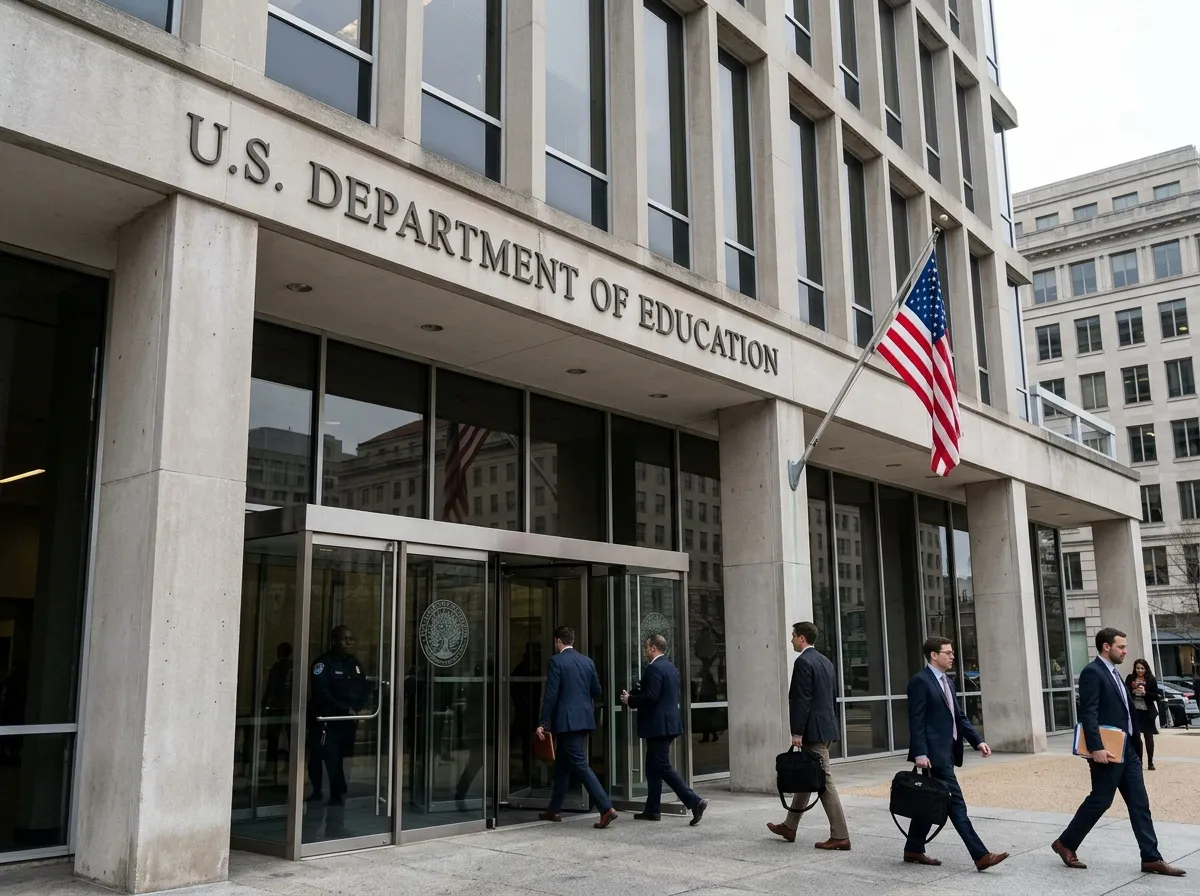
When Revenue Agencies Take Over Service Portfolios: A Historical Warning
The transfer of federal student loans to Treasury invites comparison to previous government restructurings where revenue-oriented agencies absorbed service-oriented functions, and those comparisons are not encouraging for borrowers.
The most instructive parallel is the IRS's own history with the Earned Income Tax Credit, a program that functions partly as a social benefit delivered through the tax code. The EITC requires the IRS to evaluate eligibility for a benefit, not just collect revenue, and the agency has struggled with that dual mandate for decades. Error rates in EITC claims have consistently exceeded 20%, largely because the IRS's systems and workforce are optimized for enforcement, not for helping low-income filers navigate complex eligibility requirements. The Government Accountability Office has repeatedly cited the mismatch between the IRS's institutional mission and the service-delivery requirements of the EITC as a structural problem that training and technology cannot fully resolve.
Student loan servicing is significantly more complex than the EITC. The federal loan portfolio includes at least nine distinct repayment plans, each with different eligibility criteria and calculation methods. It includes multiple forgiveness programs with overlapping but non-identical requirements. It includes provisions for deferment, forbearance, and consolidation that require individualized borrower assessment. Administering these programs requires not just data processing but substantive expertise in higher education finance, a knowledge base that Treasury does not possess and would need years to develop.
The second relevant parallel is the consolidation of federal debt collection under the Treasury Offset Program in the late 1990s and early 2000s. That program, which allows Treasury to seize tax refunds and garnish wages to collect delinquent federal debts, was effective at increasing collection rates. But "effective at collection" is precisely the concern. When the Treasury Offset Program was applied to student loan defaults, collection rates rose, but so did hardship complaints, because the program's automated systems did not account for borrowers' individual financial circumstances. An agency optimized for collection treats every dollar owed as equivalent. Student loan policy, by design, does not.
The risk is not that Treasury will fail to collect on defaulted loans. It is that Treasury will collect too aggressively on borrowers who should be in income-driven repayment, processing forgiveness applications, or receiving the kind of individualized attention that a revenue agency is not structured to provide. The $180 billion in Phase 1 defaulted loans includes borrowers who defaulted because they were never steered toward available repayment options, borrowers whose schools defrauded them, and borrowers who experienced temporary financial hardship but could resume payments with proper counseling. Treating that entire pool as straightforward revenue recovery would be efficient. It would also be unjust.

The Legal Architecture: Why Congress Matters
Administration officials have been careful to describe the transfer as an inter-agency agreement, not a reorganization requiring congressional approval. That framing is legally significant. Only Congress has the authority to abolish a Cabinet department, and any bill to eliminate the Department of Education would face a filibuster in the Senate. By transferring functions piecemeal through executive agreements between agencies, the administration is achieving the functional equivalent of closing the Education Department without the political cost of a congressional vote.
This strategy has legal vulnerabilities. The Higher Education Act assigns specific responsibilities to the Secretary of Education, not to the Secretary of the Treasury. Loan servicing contracts, borrower notification requirements, and due process protections are all codified under statutes that reference the Education Department by name. Transferring those functions to a different agency without amending the underlying statutes creates a mismatch between legal authority and operational responsibility that borrower advocacy groups are already preparing to challenge in court.
Sen. Patty Murray of Washington, the ranking Democrat on the Senate education committee, called the transfer "an end-run around Congress" in a statement Wednesday. "The president cannot dismantle a department created by Congress simply by handing its functions to another agency," Murray said. "This is legally dubious and practically reckless."
The administration's broader pattern of bypassing Congress on funding and policy decisions has already produced legal challenges in other contexts. The student loan transfer adds another front to a growing set of cases testing the limits of executive restructuring authority.
What Borrowers Should Actually Expect
The administration's guidance that borrowers "should see no change" and "don't need to take any action" is technically accurate in the short term. Phase 1 does not change the terms of any loan, the amount owed, or the identity of the loan servicer. Borrowers will continue dealing with the same private contractors, Nelnet, MOHELA, and others, who currently handle day-to-day servicing. The change is in which federal agency oversees those contractors.
But the medium-term outlook is less reassuring. When oversight shifts from an agency with a borrower-services mandate to an agency with a revenue-collection mandate, the priorities that guide contractor management shift as well. The Education Department has historically evaluated loan servicers partly on borrower satisfaction and successful enrollment in repayment plans. If Treasury applies its own institutional metrics, the emphasis is likely to shift toward collection rates and recovery efficiency.
For borrowers currently in income-driven repayment plans or pursuing Public Service Loan Forgiveness, the transfer creates a specific risk: that the processing of their applications will be deprioritized by an agency that does not view forgiveness as a core function. PSLF applications already face processing delays of six to twelve months. Under Treasury oversight, those delays could extend further if the agency does not allocate the specialized staff needed to evaluate eligibility.

The Impact
The transfer of federal student loans to Treasury is not an efficiency measure. It is a restructuring of the federal government's relationship with 43 million borrowers, executed without legislation, without public comment periods, and without any demonstrated failure in the Education Department's management of the portfolio. The administration is not fixing a broken system. It is replacing the system's underlying philosophy: from one that balances collection with borrower support to one that treats student debt primarily as a government receivable.
The concrete effects will emerge over the next 12 to 18 months, as Treasury assumes operational control and begins applying its institutional norms to a portfolio that was never designed to be managed by a revenue agency. Expect three specific developments. First, collection activity on defaulted loans will intensify, particularly wage garnishments and tax refund offsets, because Treasury's existing infrastructure makes those tools easy to deploy at scale. Second, processing times for forgiveness programs, especially PSLF and income-driven repayment recertification, will increase as Treasury's staff learns a domain they have no experience in. Third, legal challenges will be filed within weeks, arguing that the transfer violates the Higher Education Act's assignment of student loan responsibilities to the Secretary of Education.
For the 10 million borrowers in default or late-stage delinquency who are first in line, the most important action is to contact their loan servicer now and ask about rehabilitation or consolidation options that could move them out of default status before Treasury's collection infrastructure fully engages. The administration says nothing will change. The institutional incentives say otherwise.
Sources
- Student loans are moving from the Education Department to Treasury - NPR
- Trump administration to shift student loans to Treasury Department - CNN
- Federal student aid is being transferred to the Treasury Department - Washington Post
- Education Dept. hands federal student loan portfolio to Treasury - Federal News Network