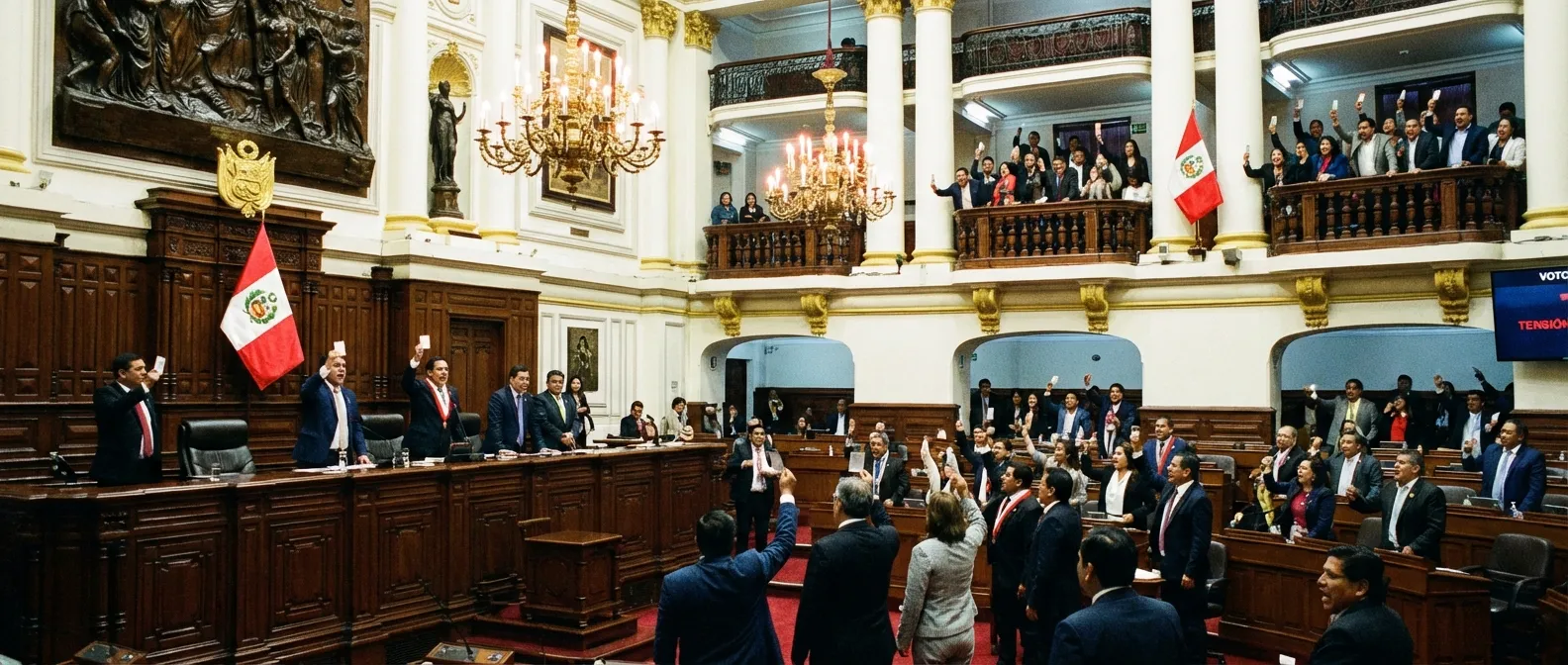
Peru's Congress voted 75-24 on Tuesday to remove interim President José Jerí from office, making him the seventh president to fall in a decade and the third consecutive leader ousted by lawmakers. Jerí lasted just four months. The scandal that brought him down, already dubbed "Chifagate" by Peruvian media, reads like something out of a political thriller: secret late-night meetings, Chinese businessmen with government contracts, and a president caught on camera in disguise.
But the real story isn't just one corrupt leader. It's a democratic system that has turned presidential removal into something closer to a routine congressional procedure, and a growing Chinese commercial presence that keeps showing up in the wreckage.
The Chifagate Scandal
The scandal centers on leaked footage showing Jerí arriving at a Lima restaurant late at night, wearing a deep hood partially obscuring his face, to meet with Chinese businessman Zhihua Yang. Peruvian law requires all presidential activities to be officially documented, and nothing about these meetings appeared on any public schedule.
Yang is no random acquaintance. He received a hydroelectric plant concession under Jerí's predecessor, Dina Boluarte, and operates wholesale stores across Peru. Additional images later surfaced of Jerí visiting Yang's store wearing sunglasses, a detail that became instant tabloid fodder. A third Chinese businessman present at the meetings, Jiwu Xiaodong, was subsequently placed under house arrest for involvement in an illegal logging operation.
Jerí's defense strained credibility. He claimed the meetings were to "organize a Peruvian-Chinese festivity," an explanation that satisfied essentially no one. Lawmaker Ruth Luque captured the congressional mood during debate: "We ask to end this agony so we can truly create the transition citizens are hoping for. Not a transition with hidden interests, influence-peddling, secret meetings, and hooded figures."
The corruption allegations extended beyond the Chinese connections. Jerí also faced questions about late-night meetings with women who subsequently received government contracts, plus sexual assault allegations dating to December 2024. In total, lawmakers filed seven censure motions against his presidency in four months, a pace that suggests Congress was looking for reasons to act long before Chifagate provided the final one.
Peru's Presidential Revolving Door
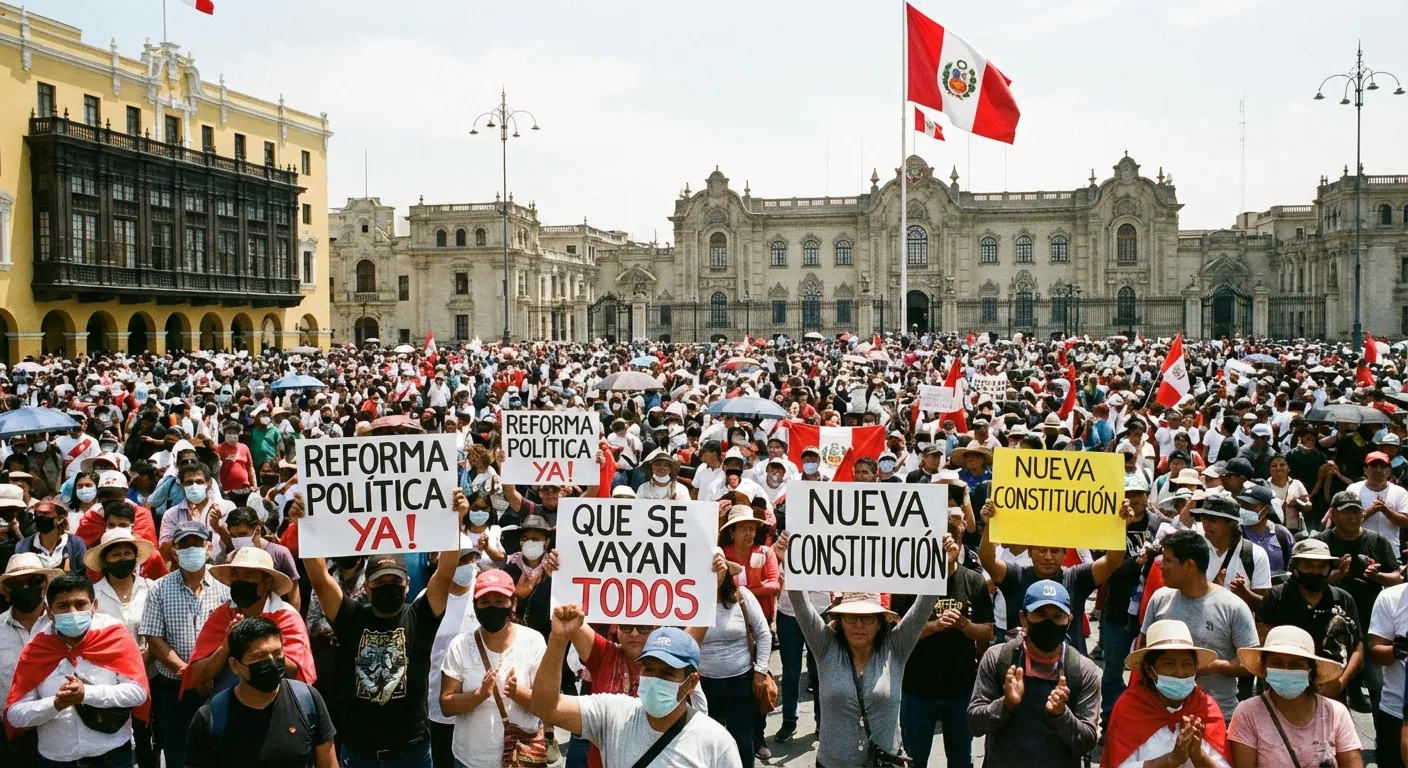
To understand how Peru arrived at this point, consider the timeline. Since 2016, the country has cycled through seven presidents. Only two were elected by popular vote. The rest were vice presidents who stepped in for deposed leaders or members of Congress selected by their peers. Pedro Pablo Kuczynski resigned in 2018 under threat of impeachment. Martín Vizcarra was removed in 2020. Pedro Castillo attempted a self-coup in December 2022 and was arrested. Dina Boluarte, his vice president, survived massive protests that killed dozens but was ultimately removed for "moral incapacity" in October 2025. Jerí, as head of Congress, automatically assumed the presidency under constitutional succession rules.
Michael Shifter of the Inter-American Dialogue think tank offered a blunt assessment of why Congress acted: "Enough lawmakers concluded their support for Jerí would hurt them in elections, so they had to act." With the April 12 general election approaching, keeping a scandal-plagued president in office became a political liability that outweighed any benefit of institutional continuity.
The economic numbers make Peru's political chaos even more puzzling. Despite the revolving door at the presidential palace, the economy grew 3.4% in 2025 with just 1.7% inflation. Peru's debt-to-GDP ratio sits at 32%, among the lowest in Latin America. The country's mining sector, its economic backbone, continues to perform strongly regardless of who occupies the presidency.
When Democracies Make Removal Too Easy
Peru's constitution contains a clause allowing Congress to remove a president for "moral incapacity," a term so vague that it has become arguably the most powerful weapon in Latin American legislative politics. The clause was originally intended for situations where a president became mentally or physically unable to govern. Over the past decade, Congress has reinterpreted it as a catch-all tool for removing any president who becomes politically inconvenient.
This matters beyond Peru because it represents an extreme example of a challenge facing democracies worldwide: how to balance accountability with stability. Compare Peru's experience with Brazil's impeachment of Dilma Rousseff in 2016. That process, while controversial, required formal charges of budgetary misconduct, months of proceedings, a two-thirds Senate vote, and resulted in a single transition. South Korea's removal of Park Geun-hye in 2017 went through the Constitutional Court, required judicial review, and also produced one transition. Both countries experienced political turmoil, but their systems forced the removal process to be slow, deliberate, and difficult to repeat.
Peru's "moral incapacity" clause inverts this logic. The threshold is low enough that any sufficiently motivated congressional majority can remove a president for almost any reason, and the evidence suggests that is exactly what keeps happening. The seven presidential changes in a decade are not seven independent failures of leadership. They are one systemic failure of institutional design, where removal has become easier than governance.
Election observers have already raised concerns that whoever wins in April will face the same dynamic. With dozens of candidates splitting the vote, the next president will almost certainly lack a congressional majority, making them vulnerable to the same removal mechanism that has claimed their predecessors. Peru has not solved its political instability problem. It has constitutionalized it.
Beijing's Commercial Diplomacy Under the Microscope
Chifagate also illuminates something broader about how Chinese economic influence operates in Latin America. The relationship between Yang, his hydroelectric concession, and the president didn't flow through official diplomatic channels. It flowed through commercial relationships, restaurant meetings, and personal connections, a pattern that researchers at the Center for Strategic and International Studies have documented across the region.
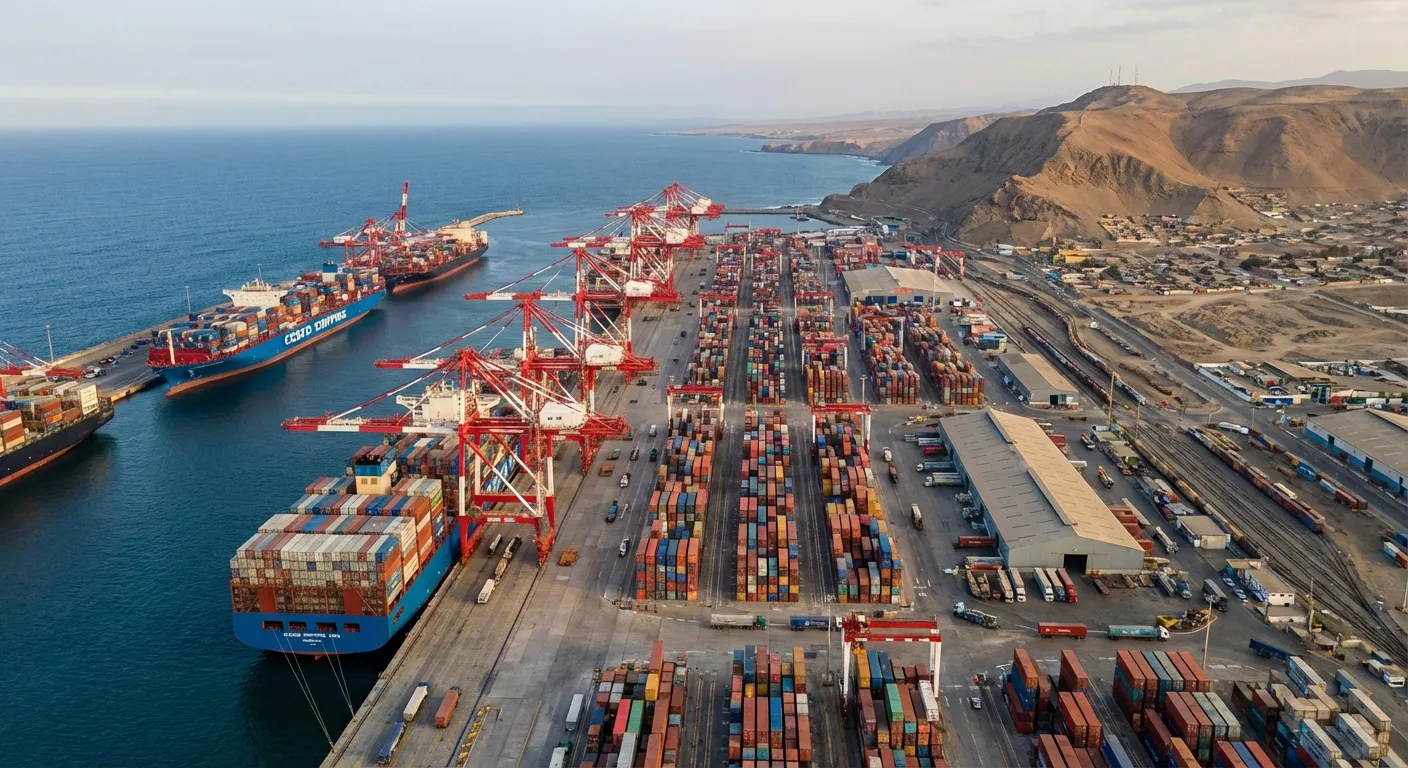
China-Peru trade hit $51 billion in 2025, a 17.8% annual increase driven largely by Peru's copper and gold exports. The Chancay mega-port, a $3.5 billion Chinese-financed project that began operations in late 2024, handled its first full year of activity in 2025. Peru's gold exports to China roughly quadrupled in the first half of 2025 alone, reaching nearly a billion dollars.
None of this is inherently problematic. Countries trade, and Peru's mineral wealth naturally attracts Chinese buyers. But Chifagate reveals the governance gap that makes these commercial relationships politically toxic. When a president meets secretly with a foreign businessman who holds government concessions, the issue isn't trade policy. It's the absence of transparency mechanisms that should make such meetings unnecessary. The scandal is less about China's intentions and more about Peru's inability to manage foreign commercial relationships through proper institutional channels rather than late-night restaurant meetings with hooded figures.
The April Election and What It Actually Solves
Congress was expected to select a new interim president from among its members on Wednesday evening, Peru's eighth head of state in eight years. That person will serve until July 28, when the winner of the April 12 election takes office.
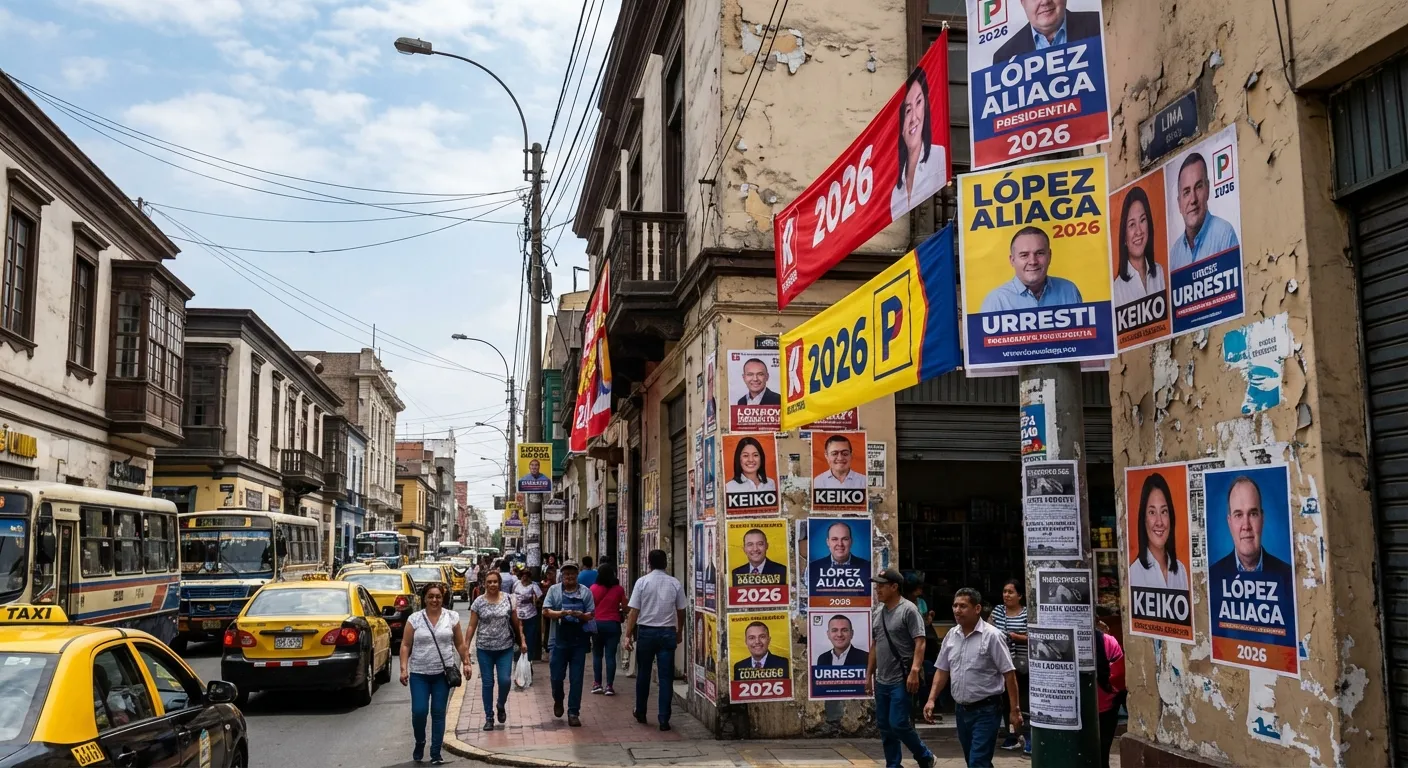
The candidate field is staggering. At least 36 contenders are running, including conservative businessman Rafael Lopez Aliaga and Keiko Fujimori, the daughter of former authoritarian president Alberto Fujimori. With votes split that many ways, the winner will likely secure a small fraction of the total vote, entering office with a weak mandate and no congressional majority.
This is the structural trap that Peru cannot seem to escape. A fragmented election produces a weak president. A weak president cannot build a congressional coalition. Without a coalition, Congress uses the "moral incapacity" clause to remove them when politically convenient. The cycle restarts. Peru's political system doesn't just tolerate instability. At this point, it actively generates it.
The one genuinely encouraging sign is the economy's resilience. Peruvian institutions below the presidential level, particularly the central bank and the mining regulatory framework, have proven remarkably durable. International investors continue to operate in Peru not because of confidence in its political leadership but because the technocratic infrastructure functions independently of whoever sits in the presidential palace. That decoupling between political chaos and economic stability is unusual in Latin America, and it may be the only thing preventing a deeper crisis.
What Happens Next
Peru's immediate future is predictable in the worst possible way. A new interim president will be chosen this week, will govern with minimal authority for two months, and will hand power to an April election winner who enters office already weakened. Based on the pattern of the last decade and the fragmented candidate field, the next elected president faces a realistic chance of removal within their first two years unless they either build an unprecedented congressional coalition or Peru undertakes constitutional reform of the removal mechanism itself.
The specific indicator to watch is the congressional composition after April 12. If any single party or coalition secures more than a third of seats, the incoming president has a blocking minority against removal. If the legislature is as fragmented as the presidential field suggests, the countdown to the next crisis will begin on inauguration day. Peru's economy can apparently survive anything its politicians do to it. The question is whether its democracy can say the same.
Sources
- Peru's Congress removes interim President José Jerí as he faces corruption probe - PBS News
- Peru's Congress votes to remove President Jose Jeri in latest shake-up - Al Jazeera
- Peru Congress ousts president because of China-linked secret meetings - NBC News
- Power Moves: How China's Energy Investments Provide Durable Influence in South America - CSIS