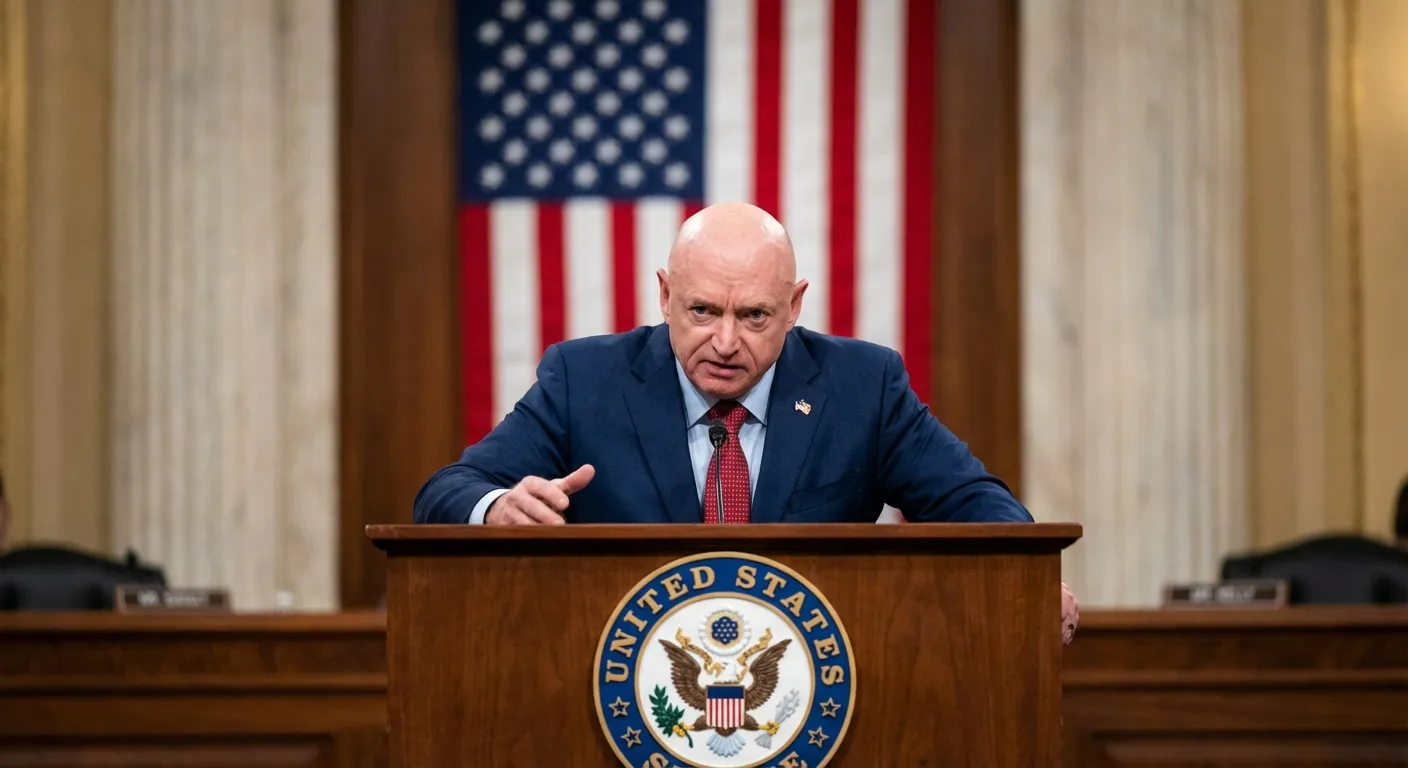
Senator Mark Kelly (D-Ariz.) filed a federal lawsuit Monday against Defense Secretary Pete Hegseth, challenging a censure and potential demotion that Kelly says violates his constitutional rights to free speech. The case does not merely test the limits of Pentagon authority over retired officers. It forces a federal court to decide whether the executive branch can use military discipline as a tool to silence a sitting member of Congress, a question with no direct precedent in American legal history.
The dispute stems from a 90-second video Kelly appeared in with five other Democratic lawmakers last November. All were veterans or intelligence community alumni, and the video called on service members to uphold the Constitution and reject any unlawful orders from the Trump administration. President Trump responded by accusing the lawmakers of sedition "punishable by DEATH" in a social media post. Within weeks, the Pentagon opened a formal investigation into Kelly alone.
The Censure and Its Consequences
Defense Secretary Hegseth formally censured Kelly on January 5, citing the video as a violation of military regulations governing retired officers' conduct. Hegseth called the censure "a necessary process step" toward proceedings that could reduce Kelly's retired rank from captain and cut his retirement pay.
Kelly is the only one of the six lawmakers facing investigation because he is the only one who formally retired from military service and remains under Pentagon jurisdiction. The others served but separated under different circumstances that place them outside the Defense Department's authority. That jurisdictional distinction is central to the legal battle: it means the Pentagon is selectively targeting one senator, using a technicality of his service record, for speech identical to what five of his colleagues delivered without consequence.
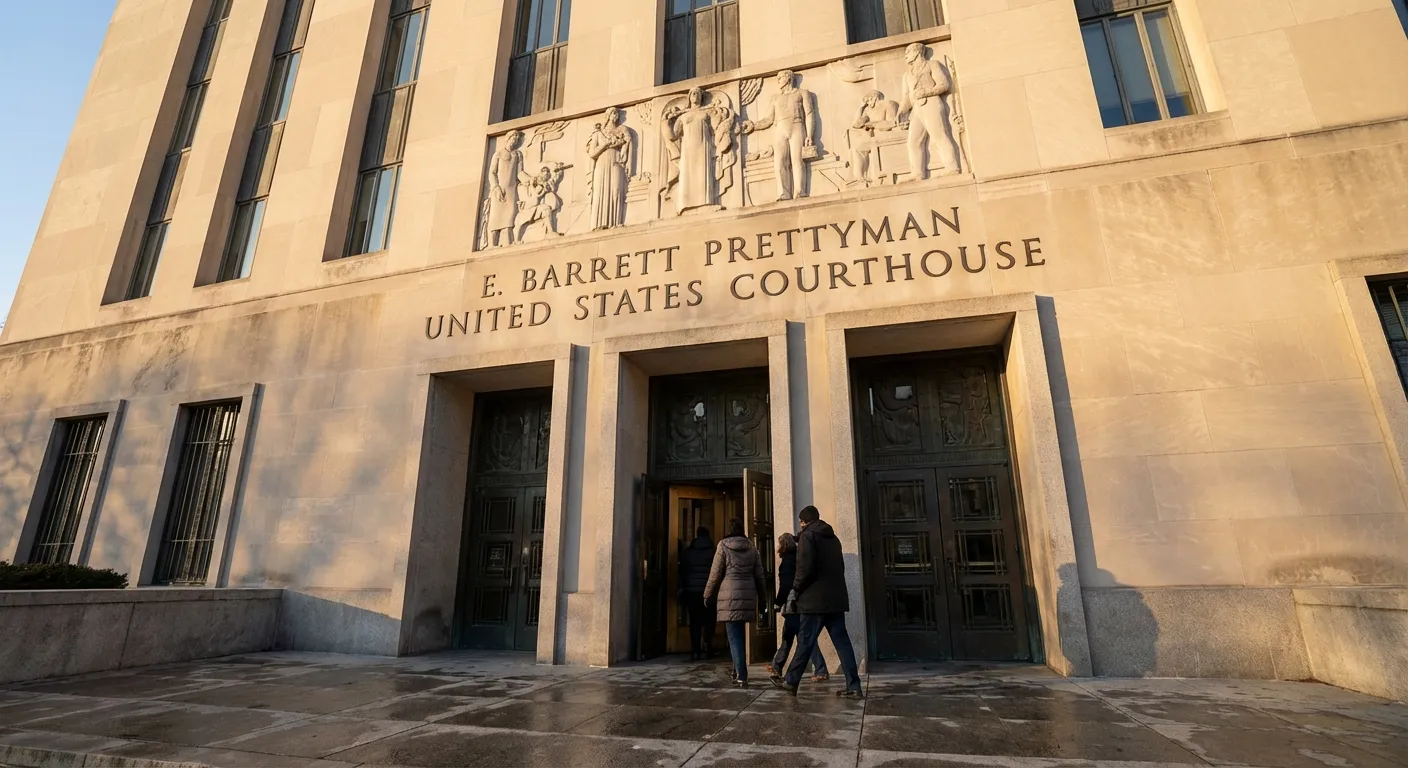
The censure itself has limited practical effect, essentially amounting to a formal letter of disapproval. But the potential demotion and pay reduction represent real consequences, and Kelly argues the entire proceeding is unconstitutional retaliation for protected speech. His lawsuit, filed in U.S. District Court for the District of Columbia, asks the court to halt the proceedings permanently.
The UCMJ's Quiet Authority Over Retirees
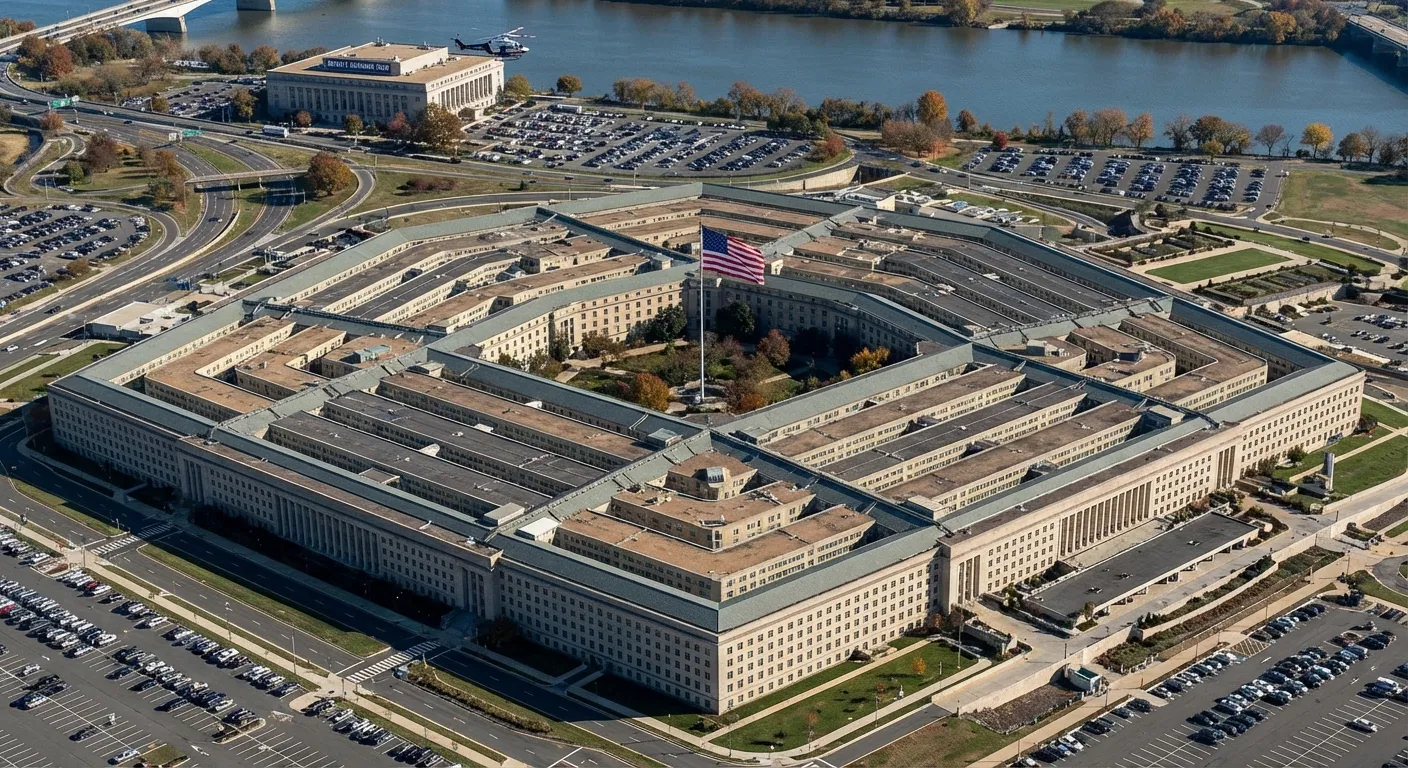
The legal foundation for the Pentagon's action rests on Article 2(a)(4) of the Uniform Code of Military Justice, which extends military jurisdiction to "retired members of a regular component of the armed forces who are entitled to pay." Congress included this provision because military retirees continue drawing pay from the federal government, and the theory holds that they remain part of the military community in a meaningful sense. But the provision's existence on paper and its actual enforcement are two very different things.
For decades, Article 2(a)(4) sat largely dormant. The military occasionally invoked it to prosecute retirees for serious criminal conduct, such as sexual assault charges brought years after retirement. The provision's constitutionality was challenged in the 2019 case Larrabee v. Del Toro, where a retired Marine contested a court-martial conviction by arguing that subjecting retirees to military justice violated due process. The Court of Appeals for the Armed Forces upheld the jurisdiction, ruling that the receipt of retirement pay maintained a sufficient connection to military service to justify UCMJ authority. But the Larrabee case involved a criminal conviction for sexual assault, not political speech. The court's reasoning turned on the nature of the offense and the ongoing military relationship, not on whether the UCMJ could be used to punish a retiree's public statements about government policy.
No case in UCMJ history has applied Article 2(a)(4) to punish a sitting member of Congress. No case has applied it to punish any retiree for political speech. Kelly's lawsuit argues that extending Larrabee's logic from criminal conduct to First Amendment-protected political commentary would represent a radical expansion of military authority, one that transforms a narrow jurisdictional provision into a political weapon.
Two Constitutional Claims
The lawsuit makes two primary constitutional arguments, each striking at a different aspect of the Pentagon's action. First, Kelly argues the censure violates his First Amendment rights by punishing him for political speech on matters of public concern. Courts have generally held that such speech receives the strongest constitutional protection, particularly when it comes from elected officials discussing matters of governance and military policy. The video's content, urging service members to uphold their oath to the Constitution, is precisely the kind of speech the First Amendment was designed to protect.
Second, Kelly invokes the Speech and Debate Clause, which grants lawmakers immunity from prosecution or penalty for their official legislative acts. This clause exists specifically to protect members of Congress from executive branch intimidation. Kelly's legal team argues that his statements about military policy and constitutional obligations fall within the scope of his legislative duties as a senator who sits on the Armed Services Committee.
Speaking on the Senate floor Monday, Kelly framed the stakes broadly: "If Pete Hegseth succeeds in silencing me, then he and every other secretary of defense who comes after him will have license to punish any retired veteran, of any political persuasion, for the things that they say."
He offered a pointed hypothetical: "By that logic, a 100-year-old World War II veteran could be hauled in and censured or court-martialed because he says something that Pete Hegseth disagrees with."
Executive Power and the Pattern of Institutional Weaponization
The Kelly case fits into a long and contentious history of executive branch attempts to use federal agencies against political opponents, and the parallels are instructive. The most relevant precedent is the Steel Seizure Case of 1952, Youngstown Sheet & Tube Co. v. Sawyer, in which President Truman ordered the federal seizure of steel mills to prevent a strike during the Korean War. The Supreme Court struck down the order, holding that the president cannot use emergency powers to override congressional authority. Justice Jackson's famous concurrence in that case established a framework still used today: executive power is at its lowest ebb when the president acts against the expressed or implied will of Congress.
Kelly's lawsuit invokes a similar structural argument. The Constitution vests in Congress the sole authority to regulate the armed forces, to set the rules governing military conduct, and to declare war. When the executive branch uses military disciplinary procedures to silence a member of Congress for speech critical of the president, it is arguably acting against the constitutional design that separates these powers. The Speech and Debate Clause exists precisely because the Founders anticipated that the executive would attempt to intimidate legislators.
The Nixon era provides a more direct parallel for the weaponization concern. During the Watergate investigations, the Nixon administration used the IRS, the FBI, and the CIA to target political enemies, journalists, and members of Congress who opposed the president. The Saturday Night Massacre of 1973, in which Nixon fired the special prosecutor investigating him after the Attorney General and Deputy Attorney General refused to carry out the order, demonstrated how quickly institutional norms collapse when agency leadership is willing to follow presidential directives aimed at political opponents. The Kelly case raises a version of the same question for the Pentagon: when a Defense Secretary acts on a president's public accusation of sedition against specific lawmakers, is the military disciplinary system functioning as intended, or has it been conscripted into a political operation?
Greg Lukianoff, president and CEO of the Foundation for Individual Rights and Expression, called the Pentagon's investigation "clear retaliation for something Sen. Kelly is entirely within his rights to say." The National Institute of Military Justice, a nonpartisan legal nonprofit, issued a statement in December concluding that "Senator Kelly's speech is not punishable under the UCMJ." The institute warned that the continued assertion of military jurisdiction over retirees creates the potential for "targeted, abusive, and politically motivated actions," calling Hegseth's pursuit of punishment a worst-case scenario of that problem.
The Bipartisan Vulnerability
The lawsuit asks a fundamental question: Can the executive branch use military discipline to punish a senator for criticizing the president? If so, the Pentagon gains significant leverage over any member of Congress who served in the military, a group that includes dozens of lawmakers on both sides of the aisle. Veterans make up roughly 17% of the current Congress, and many of them are retired officers who, like Kelly, remain technically subject to UCMJ jurisdiction. Republican veterans who support the administration's action against Kelly may want to consider what happens when a future Democratic president holds the same power over their speech.
This is not a hypothetical risk. The precedent Kelly is fighting would survive the current administration. Once a court affirms that the Pentagon can censure or demote a retired officer for political speech, that authority becomes available to every future Defense Secretary, regardless of which party controls the White House. The case arrives amid a broader pattern of federal agencies testing the boundaries of executive authority across multiple fronts, from the DOJ's unusual probe of the Federal Reserve chair to the systematic removal of inspectors general at multiple agencies.
The Pentagon said it was aware of the lawsuit but declined to comment on ongoing litigation.
The Legal Road Ahead
U.S. District Judge Richard Leon, a George W. Bush appointee, scheduled a hearing for Thursday on Kelly's request for a temporary restraining order. If granted, the order would halt any further proceedings against Kelly while the constitutional questions are litigated. Judge Leon has a record of ruling against executive overreach in national security cases, including a 2013 decision that found the NSA's bulk phone data collection program likely unconstitutional. That track record does not guarantee a favorable outcome for Kelly, but it suggests the court will take the constitutional claims seriously rather than deferring automatically to military authority.
The restraining order hearing will likely turn on whether Kelly can demonstrate irreparable harm and a likelihood of success on the merits. The irreparable harm argument is straightforward: a censure and demotion of a sitting senator for political speech would chill the speech of every veteran in Congress, an injury that cannot be undone after the fact. The merits question is more complex, requiring Judge Leon to weigh the Pentagon's Article 2(a)(4) authority against the First Amendment and the Speech and Debate Clause in a factual context no court has previously addressed.
If the restraining order is granted, the case will proceed to full briefing and likely oral argument over the following two to three months. Either side could appeal to the D.C. Circuit, and the constitutional significance of the questions involved makes eventual Supreme Court review plausible. The practical effect of a Kelly victory would be to establish that military retiree jurisdiction under the UCMJ cannot extend to political speech, particularly speech by sitting members of Congress. A loss, conversely, would confirm that every retired veteran who enters public life carries a permanent vulnerability to military discipline for their political statements, a result that would fundamentally alter the relationship between military service and democratic participation in American politics.
Sources
- Mark Kelly sues Pentagon's Pete Hegseth over censure, calling it 'political retaliation' - CNN, January 2026
- Kelly files federal lawsuit challenging military censure - The Washington Post, January 2026
- Former astronaut and senator takes Pentagon to court - NBC News, January 2026
- Constitutional clash over military authority and political speech - PBS NewsHour, January 2026