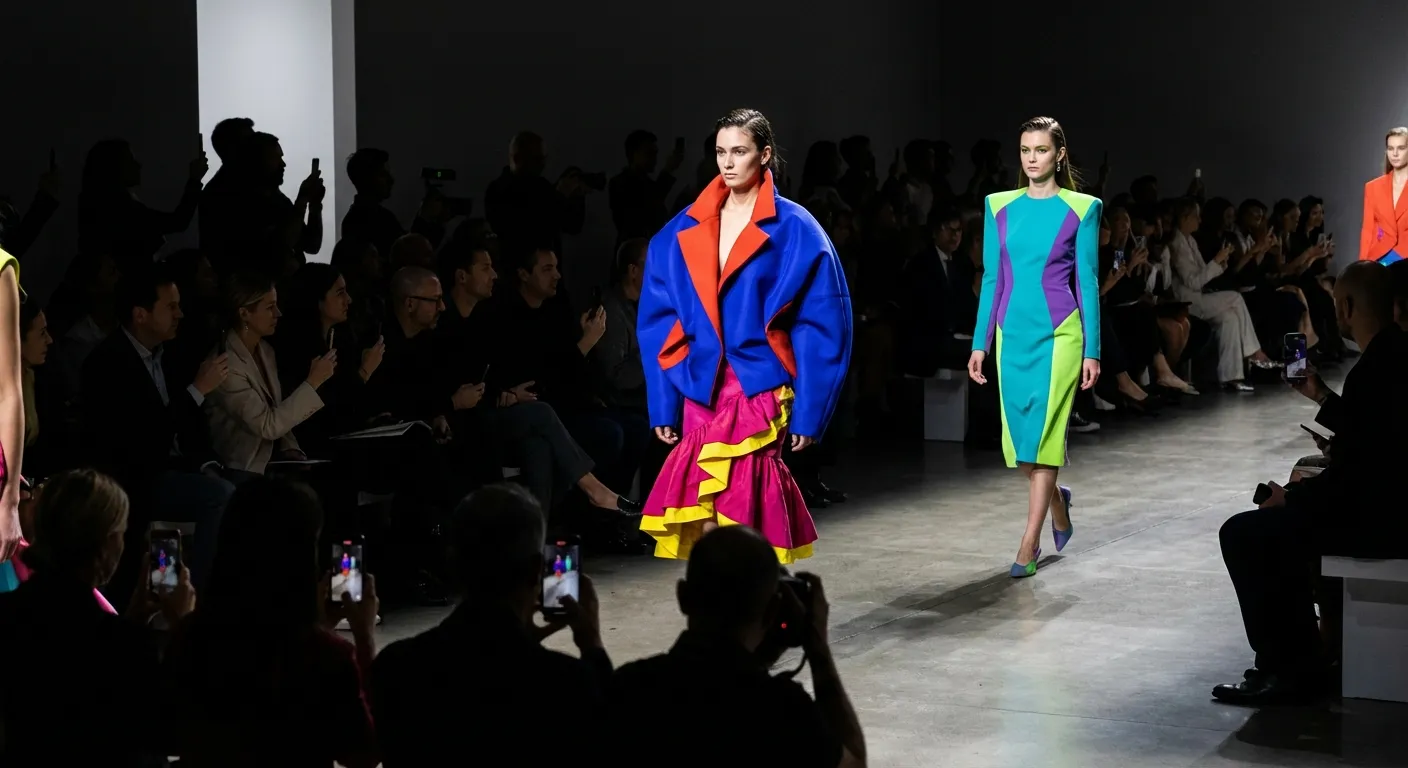
If you've spent the past three years building a wardrobe around beige, black, and understated designer logos, 2026 is about to make that closet feel like a relic. The fashion world has declared this the year of bold colors, unexpected proportions, and clothes that demand attention. But the more interesting question isn't what people are wearing. It's why the entire industry is pivoting at the same time, and what that pivot reveals about where we are culturally and economically.
The trends emerging from runway shows and stylist forecasts this season share a common thread: intentionality over invisibility. After years of "quiet luxury," where the goal was to signal wealth through what you didn't show, the pendulum has swung hard toward self-expression. That swing isn't random. It maps onto specific economic conditions, cultural exhaustion, and a generational desire to be seen rather than to blend in.
The Economics Behind the End of Quiet Luxury
The decline of quiet luxury isn't simply a matter of trend cycles running their natural course. It correlates with a measurable shift in consumer spending behavior. The pandemic-era savings glut that cushioned American households through 2023 and 2024 has largely evaporated. The Federal Reserve Bank of San Francisco estimated that excess pandemic savings were effectively depleted by late 2024, and the Bureau of Economic Analysis data through 2025 showed personal savings rates hovering well below pre-pandemic norms.
This might seem like it would push consumers toward restraint, not boldness. But economists who study consumer psychology have long documented the opposite pattern. Leonard Lauder coined the term "lipstick index" in 2001 to describe how cosmetics sales rise during recessions, as consumers substitute small luxuries for large ones. The same principle applies to fashion in 2026: when people can't afford the Loro Piana cashmere sweater that signaled quiet wealth, they opt instead for a boldly colored $60 blazer that signals personality. The statement shifts from "I can afford to be subtle" to "I choose to be noticed."
Xanthe Wells, VP of Global Creative at Pinterest, captured this mood shift in her assessment of the year's color trends. "Most of us aren't living in just one mood or style; instead we're balancing calm with chaos, and seriousness with play," she said. The colors of 2026, she observed, "really capture how layered life feels right now." What Wells is describing, whether she frames it in economic terms or not, is the aesthetic expression of financial precarity meeting psychological defiance. When the future feels uncertain, visible self-expression becomes an act of agency.
Color Clashing and the Return of Yves Klein Blue
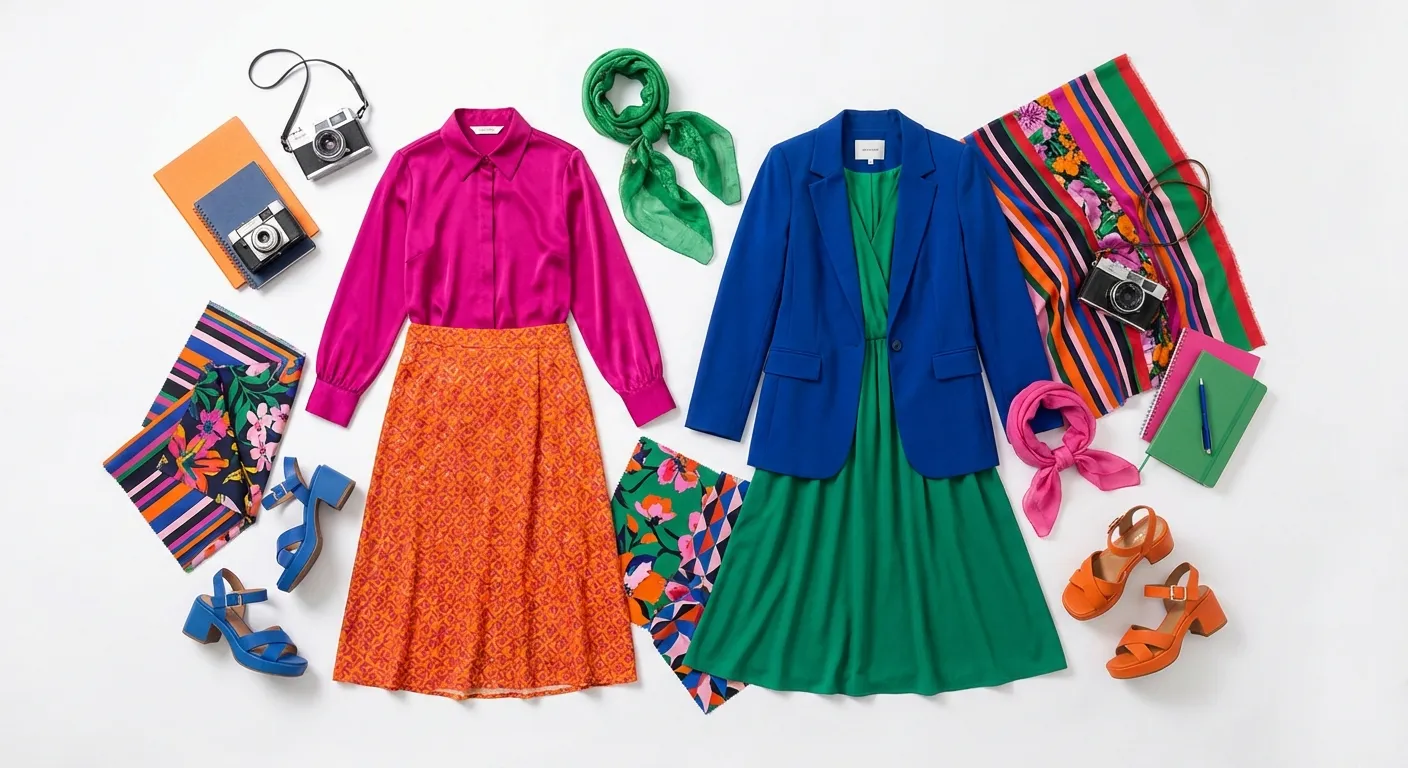
The defining visual signature of 2026 fashion is color clashing: wearing hues together that traditional style guides would reject outright. Orange with pink, purple with red, green with blue. The combinations feel electric, a deliberate inversion of the safe neutral palettes that dominated 2022 through 2025. Fashion forecasters have identified Yves Klein Blue, the intense electric shade named after the 1960s French artist, as the specific color of the moment. When this shade reappears in fashion, it historically arrives with force, saturating collections from couture houses to fast-fashion retailers alike.
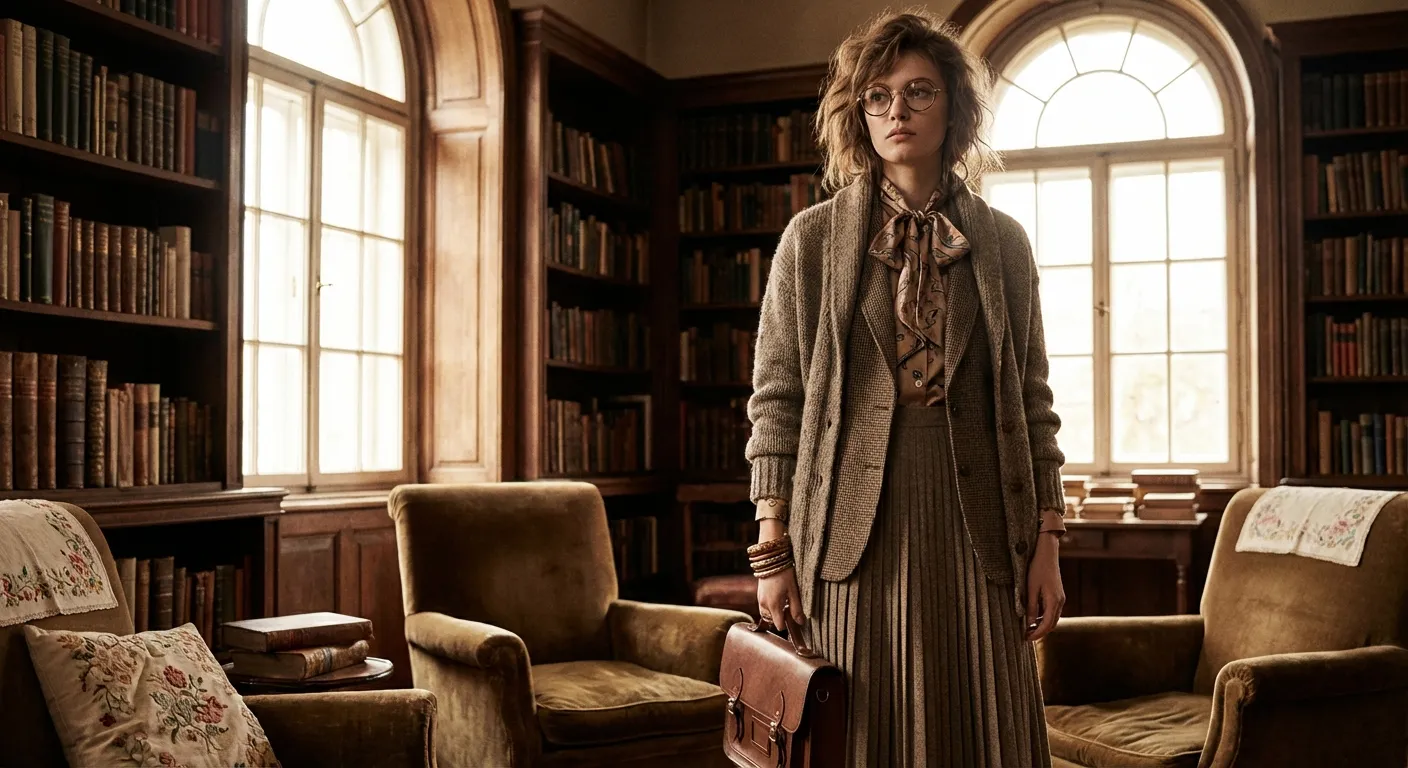
The move away from neutrals also carries a practical dimension. Celebrity stylist Sam Spector, known for styling Alan Cumming on "The Traitors," has described the emerging aesthetic as "librarian chic but with a fun twist," emphasizing the layering of patterns, textures, and colors that would have been considered clashing just two years ago. Spector's point is that sophistication in 2026 comes from the skill of combination, not from the restraint of monochrome. Pairing something glamorous on the bottom with a conservative cardigan on top, or mixing tartans with florals, reads as confident rather than chaotic.
For those who find full color clashing intimidating, stylists recommend starting with accessories. A bright bag or a statement shoe can inject energy into a neutral outfit without requiring a wholesale wardrobe replacement. But the broader direction is clear: color is no longer optional.
Fashion as a Cultural Barometer: A Historical Framework
The boldness of 2026 fashion isn't happening in isolation. It follows a pattern that has repeated throughout the past century, one worth understanding because it reveals something deeper than seasonal trend cycles. Fashion has consistently served as a cultural barometer, with shifts in color, silhouette, and ornamentation mapping onto broader social and psychological currents.
Consider the parallels. The conformist 1950s, defined by narrow silhouettes, muted tones, and rigid gender-coded dressing, gave way to the explosive color and experimentation of the 1960s as youth culture, the civil rights movement, and the sexual revolution demanded visible self-expression. The subdued earth tones and flowing silhouettes of the 1970s, reflecting post-Vietnam and Watergate disillusionment, were followed by the aggressive power suits and bold shoulder pads of the 1980s, when economic confidence (real or performed) reasserted itself through clothing. The minimalism of the late 1990s, all Calvin Klein neutrals and Jil Sander restraint, preceded the maximalist excess of early 2000s fashion.
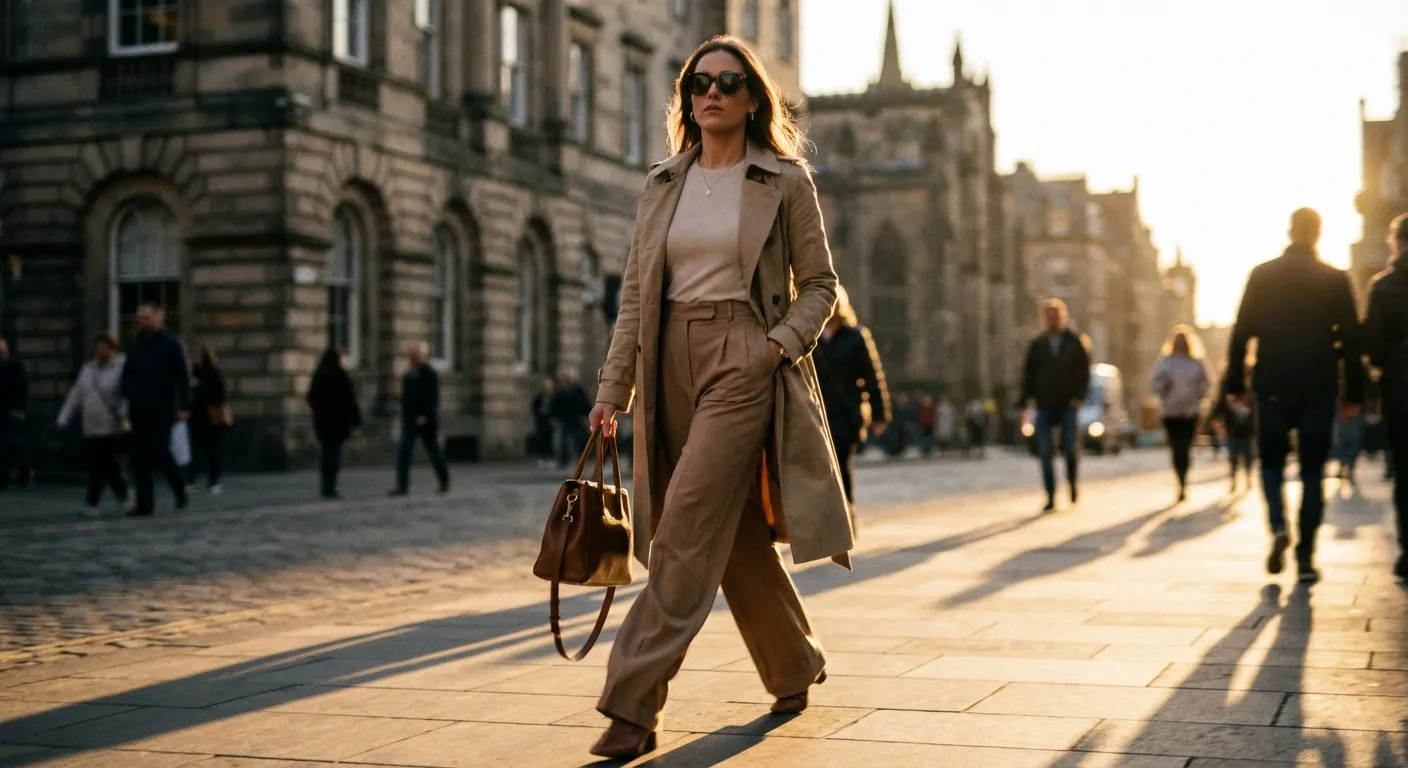
The pattern operates on a roughly five-to-seven-year cycle: a period of restraint or conformity triggers a reactionary wave of expressiveness. The quiet luxury era of 2022 to 2025 fits this model precisely. It emerged from pandemic-era comfort dressing, which itself was a response to lockdown conditions that made visible fashion irrelevant. Quiet luxury then extended the restraint into a post-pandemic context, rebranding it as sophistication. By 2025, that restraint had calcified into uniformity, with social media algorithms amplifying a narrow band of acceptable aesthetics (beige, cream, camel, oversized blazers, "clean girl" makeup) until the look felt more like a dress code than a choice.
The 2026 correction follows the historical script. The move from neutrals to bold color mirrors the broader cultural trajectory from pandemic restraint to post-pandemic expressiveness, from digital conformity to physical individuality, from performing wealth through subtlety to performing identity through visibility. This is not merely fashion being fashion. It is a population reasserting the physical, embodied self after years of screen-mediated existence, and the return to physical, in-person experiences across retail, entertainment, and social life reinforces this interpretation.
Sculptural Silhouettes and the Band Jacket
The shift isn't limited to color. Proportions are changing in ways that challenge what "flattering" has meant for the past decade of body-conscious, slim-fit fashion. Balloon jeans, sculptural sleeves, and voluminous dresses are replacing the fitted silhouettes that dominated recent years. The overall effect is architectural: clothes that create shapes rather than simply tracing the body's contours.
The band jacket has emerged as the specific statement piece of 2026. Military-inspired in structure, with braiding, tassels, and strong shoulders, it carries a theatrical quality that feels intentional rather than costumey. It signals a willingness to take up space, both literally through its exaggerated shoulders and figuratively through its refusal to be understated. Low-rise bootcut jeans are also returning, a silhouette many people assumed was permanently retired after the mid-2000s. For Gen Z, the cut feels novel. For millennials, it's a complicated nostalgia trip. Either way, the low-rise return underscores how aggressively 2026 fashion is breaking from the high-waisted, slim-leg uniformity of the past five years.
Chisel-toe ankle boots are replacing the rounded and pointed toes that defined recent seasons, offering a geometric sharpness that complements the sculptural direction of the broader trend. Faux fur continues its sustainability-driven rise, appearing in coats, bags, and unexpected trim details, with material quality improvements making the ethical option increasingly indistinguishable from the real thing.
New Aesthetic Movements: Poet-Core and Librarian Chic
Beyond individual garments, several cohesive aesthetic movements are crystallizing. "Poet-core" blends creative expression with a hint of academic style, favoring flowing blouses, textured fabrics, and pieces that suggest artistic sensibility without veering into full bohemian territory. It is romanticism with structure, referencing the wardrobes of writers and artists rather than the wardrobes of executives.
"Librarian chic" takes that academic foundation and layers in deliberate pattern mixing. The look pairs something glamorous on the bottom with conservative pieces like cardigans and tweed on top, creating tension between formality and playfulness. Both movements share an emphasis on thoughtful combination, where the outfit's intelligence lies in how pieces interact rather than in any single garment's price tag or logo. This represents a philosophical shift from the quiet luxury era, where value resided in the individual item (the $3,000 sweater, the "if you know, you know" handbag), to a new paradigm where value resides in the wearer's curatorial skill.
Hockey jerseys are also evolving beyond their athletic origins, with fashion brands reimagining the silhouette for streetwear contexts. Bright camo patterns are returning in tandem, satisfying the broader appetite for color after years of earth-tone dominance. The common denominator across all of these micro-trends is a preference for personality over polish, for individuality over conformity.
What This Tells Us
The fashion shifts of 2026 are not random oscillations in an industry that needs to sell new clothes every season, though that commercial incentive always exists. They reflect measurable forces. The depletion of pandemic savings has made the economics of quiet luxury untenable for most consumers, redirecting spending toward expressive pieces that deliver impact per dollar rather than per label. The cultural exhaustion with algorithmic sameness, where Instagram and TikTok compressed global style into a handful of approved looks, has created genuine demand for visual differentiation. And the historical pattern of post-restraint expressiveness, visible in every major fashion cycle of the past 70 years, is operating on schedule.
The most telling indicator will be whether bold fashion holds through 2027 or recedes quickly. Based on the historical parallels, periods of expressive fashion tend to sustain for three to five years once they take hold, as the 1960s color revolution lasted through 1969 and the 1980s power dressing persisted well into the early 1990s. If consumer confidence data stabilizes and the cultural appetite for physical self-expression continues to grow, the boldness of 2026 is more likely the beginning of a sustained cycle than a single-season correction. The entertainment landscape is undergoing its own parallel reset, with bold creative choices outperforming safe ones there as well, reinforcing that this expressiveness extends well beyond clothing.
The key metric to track is whether fast-fashion retailers commit to bold inventory through their fall and winter 2026 lines. If Zara and H&M, whose buying decisions are driven by real-time sales data rather than runway aspirations, maintain bold color and sculptural silhouettes into Q4, the cycle is confirmed. Early wholesale order data from the February and March buying seasons will provide the first concrete signal.
Sources
- Today: Fashion Trends for 2026: Color Clashing, Faux Fur, More
- Who What Wear: The 7 Emerging Fashion & Accessories Trends to Try in 2026
- Marie Claire: I'd Bet on These Becoming the Most Influential Fashion Trends of 2026
- Cosmopolitan: These 5 Fashion Trends Will Define 2026
- Who What Wear: Chisel-Toe Boots Are the 2026 Shoe Trend