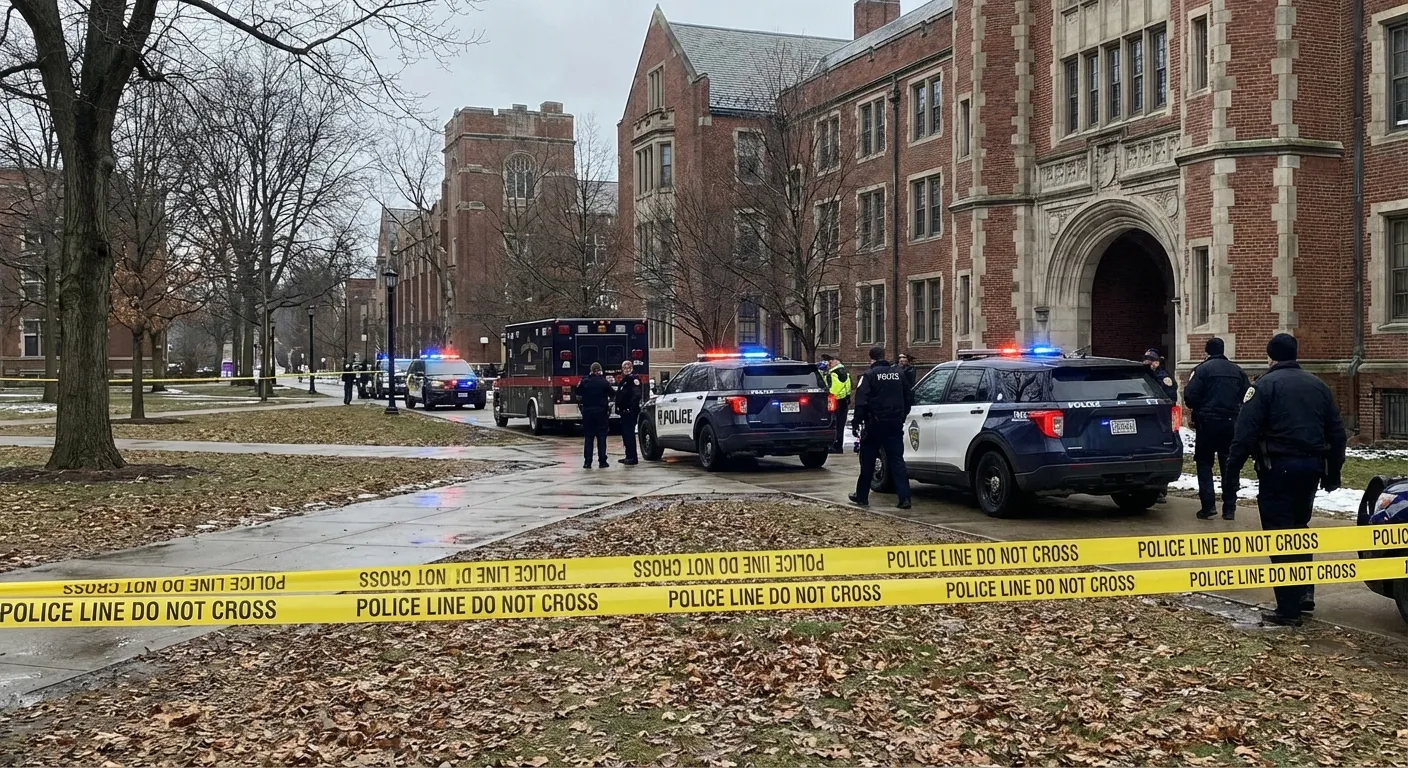
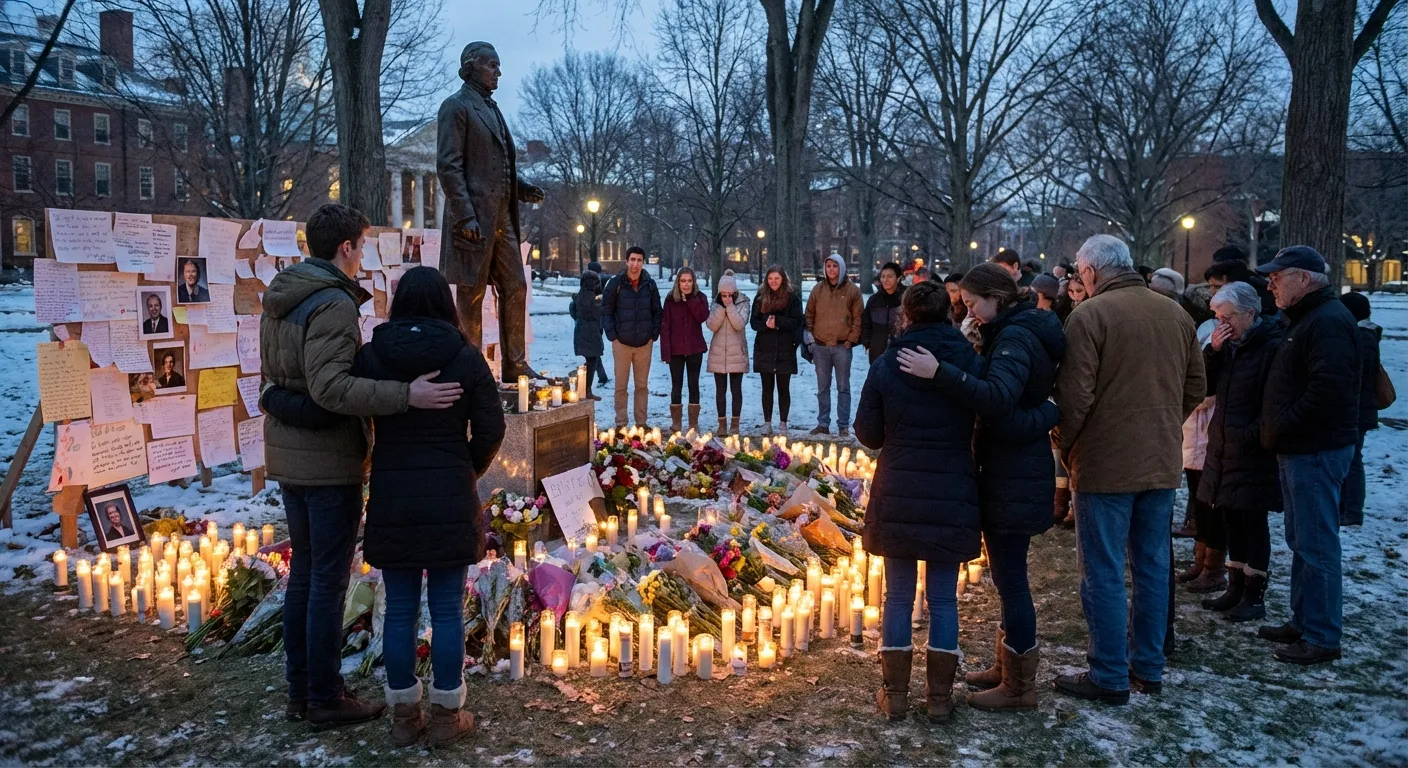
Four days after a gunman killed two students and wounded nine others at Brown University, the suspect remains at large despite a law enforcement mobilization that now involves more than 400 officers from local, state, and federal agencies. The FBI announced a $50,000 reward Tuesday for information leading to an arrest, and Providence Mayor Brett Smiley confirmed that the city has activated mutual aid agreements with police departments across Rhode Island and neighboring Massachusetts. The victims, first-year students Mukhammad Aziz Umurzokov, 18, and Ella Cook, 19, have been memorialized in growing vigils on the campus green. Three of the nine wounded students remain in critical condition at Rhode Island Hospital.
The attack, which occurred around 7:30 p.m. on Friday, December 12 in a campus building, lasted approximately three minutes before the shooter fled into the surrounding College Hill neighborhood, one of Providence's oldest residential areas. The maze of narrow streets, historic homes, and adjacent university properties provided multiple escape routes. Despite an immediate lockdown and helicopter-assisted search that continued through the weekend, no arrest has been made. Authorities have released limited suspect information, describing only a male figure captured on security footage, and have not disclosed whether they have identified the individual.
The Investigation's Challenges
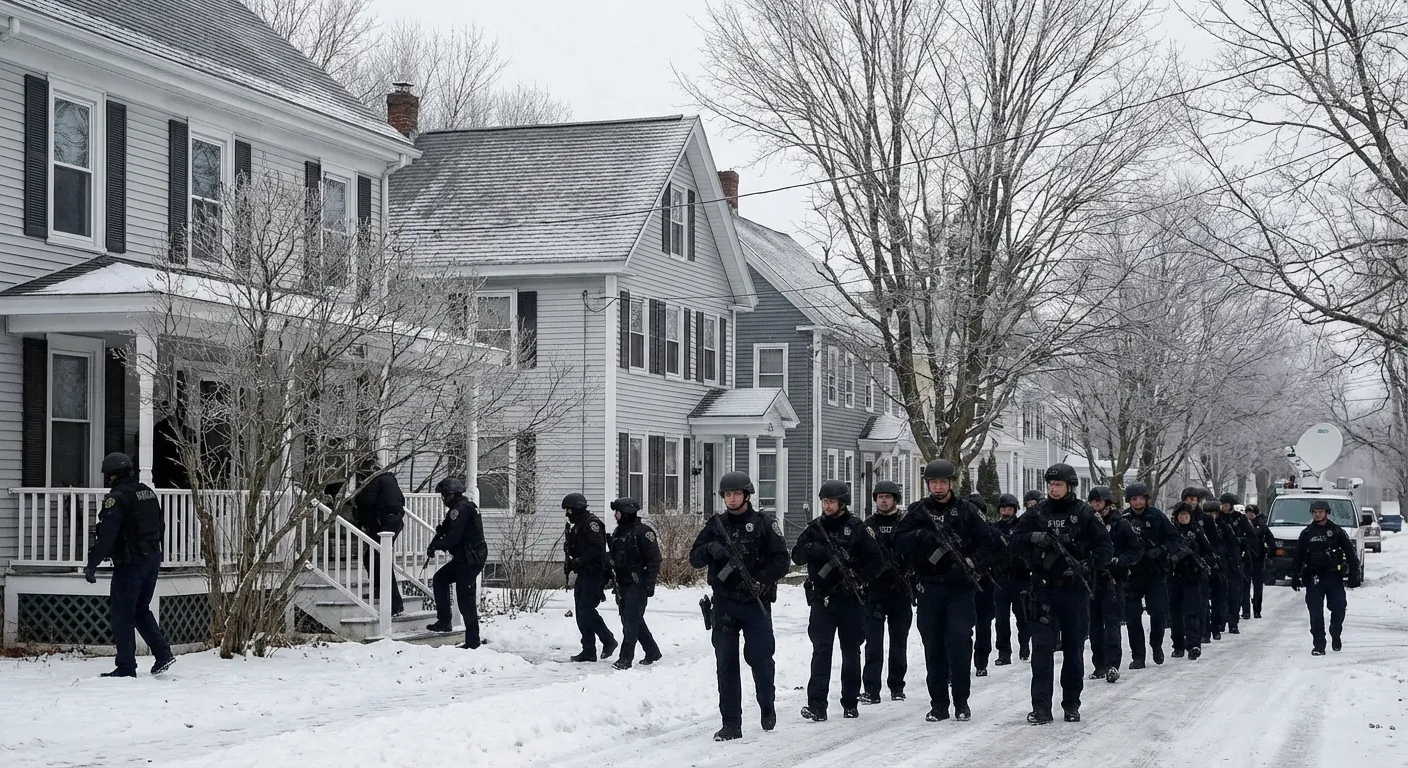
The manhunt's geography presents problems that investigators openly acknowledge. Unlike isolated campus settings where access points can be controlled, Brown sits embedded in a dense urban neighborhood. Andrew Lugo, the special agent in charge of the FBI's Boston Field Office, told reporters Monday that "the built environment here, hundreds of residential properties within walking distance of the scene, makes systematic search fundamentally different from what we'd face on a contained campus." The FBI's Behavioral Analysis Unit has been deployed to develop a suspect profile.
Providence Police Chief Oscar Perez addressed mounting public frustration at a Tuesday press conference, confirming that investigators have recovered physical evidence from the scene including ballistic material and biological samples that are being processed at the FBI's laboratory in Quantico, Virginia. Results could take days. Perez stressed that the absence of an arrest does not indicate the absence of progress, noting that "investigations of this complexity often produce breakthroughs that aren't visible to the public until they result in charges."
Community Response and Campus Safety Questions
Brown University president Christina Paxson addressed students and families Saturday in a statement that drew both praise and criticism, calling the shooting "a senseless act of violence that has shattered our community" and announcing that classes would be cancelled through winter break. The university has deployed additional counseling staff and partnered with local mental health organizations to offer support. Many students left campus immediately; those who remain describe an atmosphere of pervasive anxiety, with armed police visible on paths where students typically walk freely between classes.
The Providence community has rallied around the university. Local restaurants have provided meals for students sheltering in dormitories. Churches, synagogues, and community centers have organized vigils. A GoFundMe campaign for the victims' families raised over $1.2 million in its first 48 hours.
But there are pointed questions about whether the attack could have been prevented. Several students and parents have expressed frustration that classes continued on Thursday, December 11, after what they describe as threatening communications reported to campus security. Brown's administration has stated that those reports were evaluated by campus police and the Providence Police Department and "did not meet the threshold for a specific, credible threat," a determination that will almost certainly be re-examined in the investigation's aftermath.
The Gap Between Reporting and Response
Daniel Carter, president of the campus safety nonprofit VTV Family Outreach Foundation and a leading researcher on university security policy, told NPR that "the gap between reported concerns and actionable intelligence is where most campus shootings live. The question is never whether a threat was reported, but whether the system in place was capable of recognizing it."
Carter's observation points to a structural failure that has repeated itself across nearly every major campus shooting in the past two decades. The pattern is remarkably consistent: warnings surface before the violence, institutions evaluate those warnings using existing protocols, and the protocols prove inadequate. Virginia Tech in 2007 is the defining case. Seung-Hui Cho had been flagged by professors, referred to counseling, and even subject to a temporary detention order. Multiple people in multiple systems recognized danger. None of those systems communicated with each other in a way that produced intervention. The subsequent investigation found that at least 17 separate warning indicators went unconnected across campus police, student affairs, counseling services, and academic departments.
The pattern held at Michigan State University in 2023. The shooter had been investigated by police and had a history of mental health crises documented across multiple jurisdictions. At the University of Virginia in 2022, the gunman had been flagged to the university's threat assessment team months before the shooting, and a fellow student had reported concerns about his gun ownership. In each case, reports existed. In each case, the systems designed to act on those reports failed at the same critical juncture: the handoff between receiving a concern and initiating a coordinated institutional response.
The failure point is not awareness. It is architecture. Most campus threat assessment systems were built on a "gather and evaluate" model, where a central team collects reports and makes a determination about their severity. This model works well for discrete, clearly articulated threats ("I'm going to hurt someone on Tuesday"). It fails systematically when the warning signs are diffuse, behavioral, and distributed across multiple observers, each of whom holds only one piece of a larger picture. A roommate notices social withdrawal. A professor flags disturbing writing. Campus police log a noise complaint. A counseling center records a missed appointment. Individually, none of these clears the threshold of "specific, credible threat." Collectively, they may describe an escalating crisis.
The core problem is that threat assessment teams at most universities, including Brown prior to December 12, operate as passive receivers of information rather than active investigators. They wait for reports to arrive, then evaluate each report in relative isolation. They lack the mandate, staffing, and legal frameworks to pursue low-level concerns proactively, to knock on a door because three separate reports from three unrelated sources all point to the same individual. Federal privacy law, particularly FERPA, compounds the problem by creating genuine uncertainty about what student information can be shared and with whom, leading many administrators to err on the side of nondisclosure even when the law would permit sharing.
This is not a problem of negligence. It is a design flaw baked into how American universities conceptualize threat response. The schools that have made the most progress, notably the University of Texas system and several Virginia institutions reformed after Virginia Tech, have done so by shifting from passive collection to active case management, where any report above a minimal threshold triggers a structured follow-up process with mandatory information-sharing across departments. Brown's $4.2 million security upgrade in 2024 focused primarily on physical infrastructure: cameras, access controls, notification systems. Whether it also modernized the threat assessment pipeline is a question the coming investigation will need to answer.
The Pattern and Its Limits
Mass shootings on college campuses remain statistically rare but psychologically devastating in ways that extend far beyond the immediate victims. The Brown shooting follows incidents at Michigan State University in 2023, the University of Virginia in 2022, and a pattern that has made campus security one of the most scrutinized areas in American higher education. Universities have invested billions collectively in emergency notification systems, active shooter training, physical security infrastructure, and threat assessment teams since Virginia Tech in 2007. Brown itself had completed a $4.2 million security upgrade in 2024.
Those investments save lives and reduce response times, but they cannot eliminate risk in environments designed to be open. Jaclyn Schildkraut, a criminologist at the State University of New York at Oswego who studies mass shooting responses, told The Boston Globe that "we ask campuses to be simultaneously welcoming and secure, which is an inherent tension. No security system yet devised can completely reconcile those goals."
The Bigger Story
The Brown University shooting exposes a specific, recurring institutional failure: the inability of campus threat assessment systems to synthesize distributed warning signs into coordinated prevention. The FBI tip line (1-800-CALL-FBI) and the $50,000 reward represent law enforcement's assessment that someone in the community possesses information that could break the case open, and the immediate priority is apprehending the suspect. But the longer-term question is structural. If Brown's investigation follows the pattern established at Virginia Tech, Michigan State, and UVA, it will likely reveal that the December 11 reports were not the only warning signals, just the most explicit ones, and that earlier, subtler indicators existed in separate institutional silos that never connected.
For the families of Umurzokov and Cook, the coming days bring funerals and the impossible work of grieving while a manhunt continues. For the nine wounded students, recoveries that will take months. For Brown University and for every institution watching this unfold, the evidence from two decades of campus shootings points to a clear conclusion: physical security upgrades without corresponding reforms to threat assessment processes address the symptoms of campus violence rather than its preventable precursors. The schools that have reduced risk most effectively are those that rebuilt their assessment systems from passive reporting clearinghouses into active, cross-departmental case management operations. Brown's next steps will reveal whether this tragedy produces that kind of systemic reform or another round of hardware investment that leaves the deeper vulnerability intact.
Sources
- Brown University Shooting Leaves 2 Dead, 9 Injured - The Washington Post, December 2025
- What We Know About the Man Suspected in the Brown University Shooting - NPR, December 2025
- Seeking Information: Brown University Shooting - FBI, December 2025
- Following Identification of Shooting Suspect, Brown Begins 'Path of Repair, Recovery and Healing' - Brown University, December 2025
- Mass Shooting: Live Updates - The Brown Daily Herald, December 2025