The opening days of 2026 have delivered a verdict that few in the AI industry expected even six months ago: the three-way race between OpenAI, Google, and Anthropic has become genuinely competitive. After years of OpenAI maintaining a comfortable lead with ChatGPT, the release of Google’s Gemini 3 in December reportedly triggered what insiders described as a “code red” at OpenAI, prompting an accelerated launch of GPT-5.2. Meanwhile, Anthropic’s Claude Opus 4.5 has quietly emerged as the preferred choice for software engineering tasks. The AI model wars have entered their most intense phase yet, and the stakes extend far beyond Silicon Valley bragging rights.
This matters because the leading AI model increasingly determines which company captures the most valuable enterprise contracts, which platform developers build on, and ultimately which vision of artificial intelligence shapes our collective future. When Google’s Gemini 3 broke the 1500 Elo barrier on LMArena, a benchmark tracking model performance in head-to-head comparisons, it marked the first time any model had achieved that milestone. OpenAI responded within weeks with GPT-5.2, claiming superiority on reasoning benchmarks. The technology is advancing faster than most observers predicted, and the competition is driving that acceleration.
Where Each Model Excels
The interesting story isn’t which model is “best” overall but how dramatically they’ve diverged in their strengths. Each major lab has essentially chosen a specialization while trying to maintain competitiveness elsewhere, and those choices reveal different theories about what AI should ultimately become.
OpenAI’s GPT-5.2 has bet heavily on abstract reasoning. The model achieves a 52.9% score on ARC-AGI-2, a benchmark specifically designed to test genuine reasoning ability rather than pattern matching. Perhaps more impressively, GPT-5.2 scores a perfect 100% on AIME 2025, a mathematics competition for high school students that typically stumps even strong language models. OpenAI’s pitch is clear: they’re building AI that thinks, not just AI that generates plausible text.
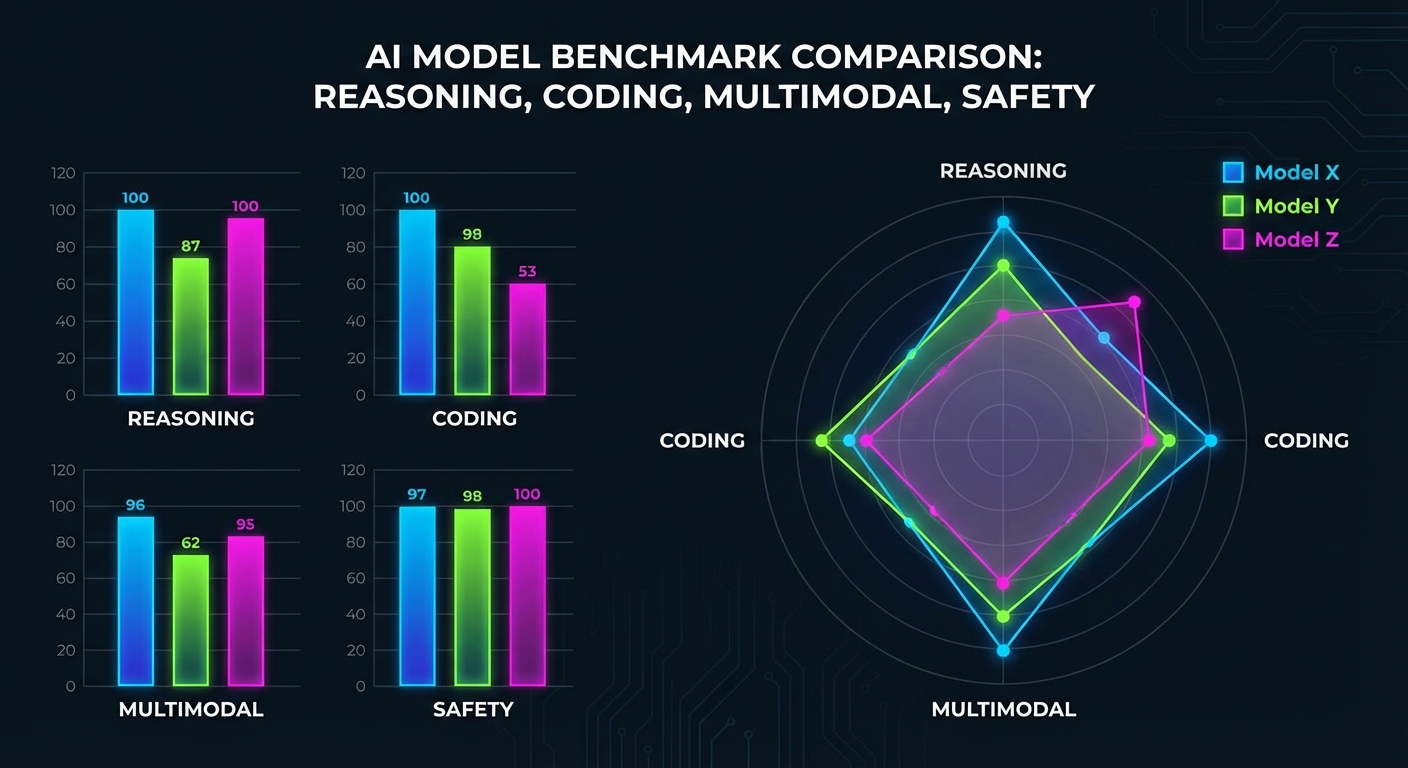
Google’s Gemini 3 has pursued a different path: multimodal excellence and raw scale. With a one million token context window, Gemini can process entire codebases, lengthy documents, or extended video content in a single query. The model achieved gold-medal performance at both the International Mathematical Olympiad and the International Collegiate Programming Contest World Finals. But Gemini’s most significant advantage may be its integration with Google’s broader ecosystem. When your AI can directly access Search, Maps, YouTube, and Gmail, the practical utility increases dramatically.
Anthropic’s Claude Opus 4.5 has become the dark horse success story of this generation. While less flashy in benchmark announcements, Claude dominates SWE-bench Verified, a test of real-world software engineering ability, with an 80.9% score that neither competitor has matched. Independent testing by METR, a safety research organization, found that Claude could complete software tasks with at least 50% success that typically took human developers nearly five hours. Perhaps more significant: Claude achieved a 4.7% prompt injection success rate, the best security performance in the industry compared to Gemini’s 12.5% and GPT-5.1’s 21.9%.
The Shift Toward Practical AI
Beyond the headline models, 2026 is shaping up as the year AI pivots from impressive demonstrations to practical deployment. Industry analysts describe this as moving from “hype to pragmatism,” and the signs are visible across the technology landscape.
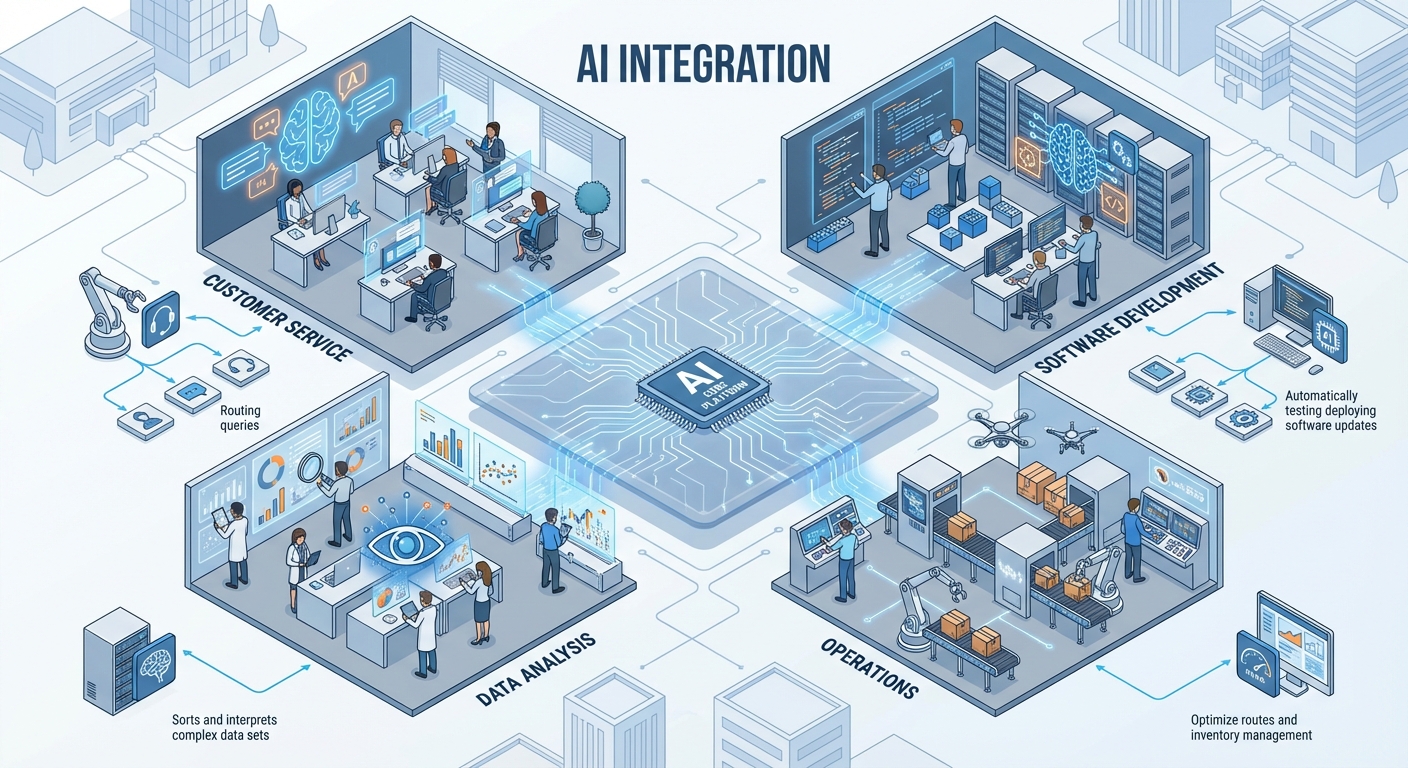
Small language models, fine-tuned for specific tasks, are emerging as the technology mature enterprises actually deploy. Andy Markus, AT&T’s chief data officer, predicted that “fine-tuned SLMs will be the big trend and become a staple used by mature AI enterprises in 2026, as the cost and performance advantages will drive usage over out-of-the-box LLMs.” The logic is straightforward: a model trained specifically for customer service costs less to run and performs better on that task than a general-purpose model trying to do everything.
Physical AI represents another frontier gaining momentum. At CES 2026, NVIDIA CEO Jensen Huang declared that “the ChatGPT moment for robotics is here,” unveiling a suite of open models for robotic applications. The company released updates to its Cosmos platform for physical AI, Isaac GR00T for robotics, and Clara for biomedical applications. World models, AI systems that learn how objects interact in three-dimensional space, are attracting massive investment. Yann LeCun left Meta to start his own world model lab reportedly seeking a $5 billion valuation, while Fei-Fei Li’s World Labs launched its first commercial world model called Marble.
The Chinese Open-Source Factor
The AI landscape has been complicated by the continued emergence of capable Chinese models, many of which are released as open source. DeepSeek’s R1 reasoning model, released in January 2025, demonstrated that relatively small teams with limited resources could produce frontier-competitive AI. This pattern has accelerated through 2025 and into 2026, with the lag between Chinese releases and Western frontier models shrinking from months to weeks.
The implications extend beyond technical competition. Silicon Valley applications are increasingly shipping on top of Chinese open models, often without prominently disclosing this to users. This creates regulatory uncertainty: export controls designed to limit AI capabilities flowing to China become harder to justify when Chinese models match or exceed American ones in key areas. It also raises questions about AI safety standards, as open-source models cannot easily be updated to patch vulnerabilities or remove harmful capabilities once released.
Enterprise software companies are watching this trend nervously. AlixPartners predicts that AI-driven disruption will cause M&A activity in the enterprise software sector to surge 30 to 40 percent year over year, reaching an estimated $600 billion in 2026. Mid-market software companies face particular pressure: their products compete with AI capabilities that improve monthly, and the traditional software development cycle cannot keep pace.
The Business of AI
The financial stakes have grown proportionally with the technology’s capabilities. OpenAI reports approximately 800 million weekly active users processing well over one billion prompts daily. No competitor approaches this scale of consumer engagement. OpenAI generated more than $13 billion in revenue during calendar year 2025 and is targeting $30 billion for 2026, an ambitious goal that would require significant enterprise adoption beyond the consumer ChatGPT product.
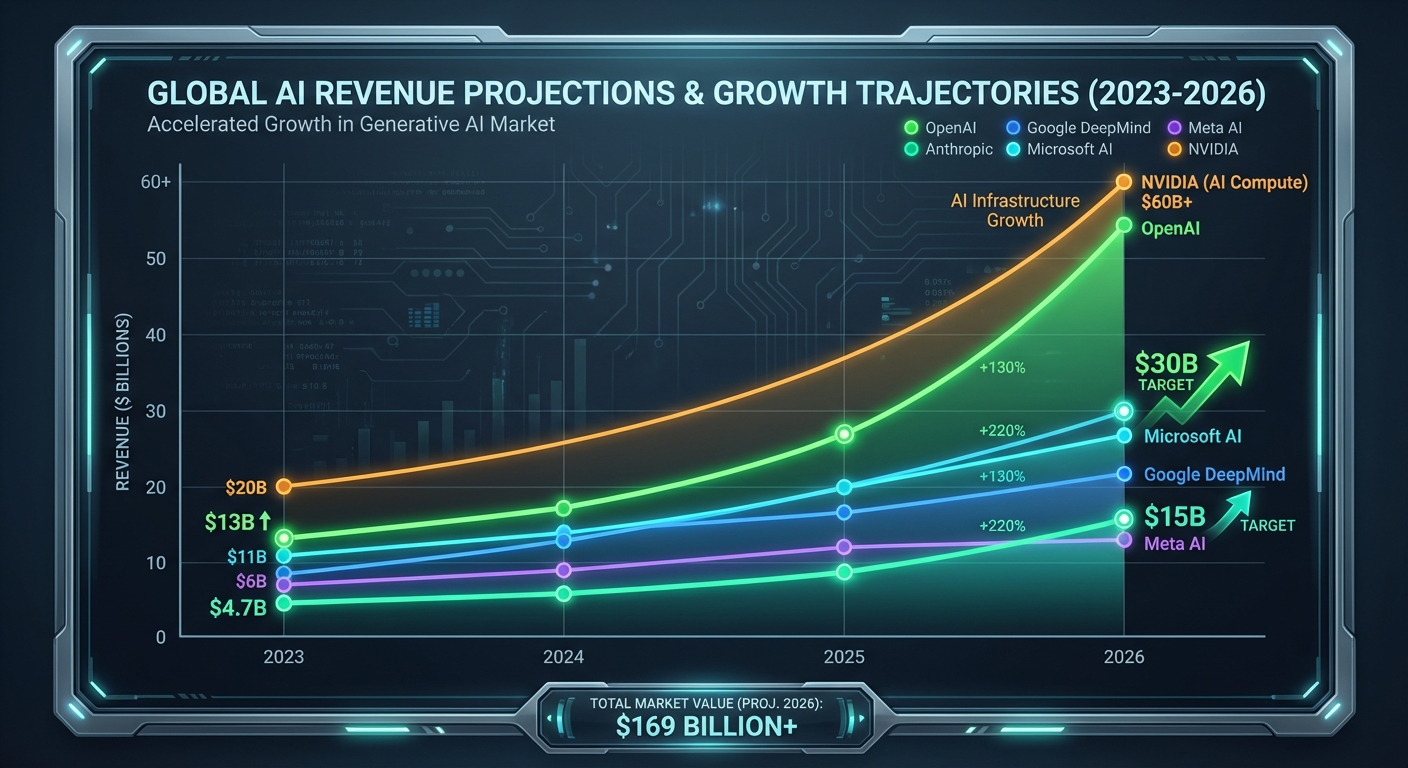
Anthropic’s trajectory has been equally striking. The company expects to generate around $4.7 billion in 2025 revenue and is targeting $15 billion for 2026. These numbers reflect something genuine: enterprises are willing to pay substantial sums for AI that works reliably. The shift from experimental pilots to production deployments is driving this growth, as companies move past the “let’s try ChatGPT” phase into structured AI strategies.
Google hasn’t disclosed comparable numbers for Gemini specifically, but the company’s AI-related revenue across cloud services and advertising has grown significantly. The advantage of integration cannot be overstated: when Gemini is built into Google Workspace, Search, and Android, the distribution channel is essentially free. This makes Google’s AI strategy fundamentally different from OpenAI’s or Anthropic’s, which must compete for every enterprise contract.
What Actually Matters
For most users and organizations, the benchmark wars matter less than practical considerations. Which model handles your specific use case best? What does integration with your existing tools look like? How reliable is the service, and what happens when it fails? These questions rarely make headlines but determine actual adoption decisions.
The good news is that competition has driven rapid improvement across all providers. Features that distinguished premium tiers six months ago are now standard. Response times have decreased. Pricing has become more competitive. The worst outcome for consumers would be a clear winner emerging and reducing competitive pressure.
The risks are also becoming clearer. AI safety concerns have evolved from theoretical discussions to practical considerations as models gain capabilities. When AI can write code, browse the web, and interact with external systems, the attack surface expands dramatically. The prompt injection vulnerabilities that make Claude’s 4.7% success rate impressive also highlight that even the best models can be manipulated. As AI moves into applications involving financial transactions, medical decisions, or physical systems, these vulnerabilities become more consequential.
The Bottom Line
The AI model race entering 2026 has no clear winner, and that’s probably good for everyone except the companies competing. OpenAI maintains scale advantages and benchmark leadership in reasoning. Google has integration depth and multimodal capabilities that nobody else can match. Anthropic has carved out a reputation for safety and software engineering that appeals to risk-conscious enterprises. Each model represents a different bet about what matters most in AI.
Watch for how enterprise adoption patterns shift. The companies that win the biggest contracts will reveal which capabilities actually matter to organizations spending serious money. Watch for how open-source Chinese models affect the competitive landscape and regulatory discussions. And watch for the first major incident involving these more capable systems, because the response will shape AI policy for years to come.
The age of AI as a novelty is ending. The age of AI as infrastructure is beginning, and the foundations being laid right now will determine who controls that infrastructure and how it shapes daily life. The model wars are ultimately about that control, and they’re just getting started.
Sources: MIT Technology Review, TechCrunch, NVIDIA Blog, R&D World, Euronews.