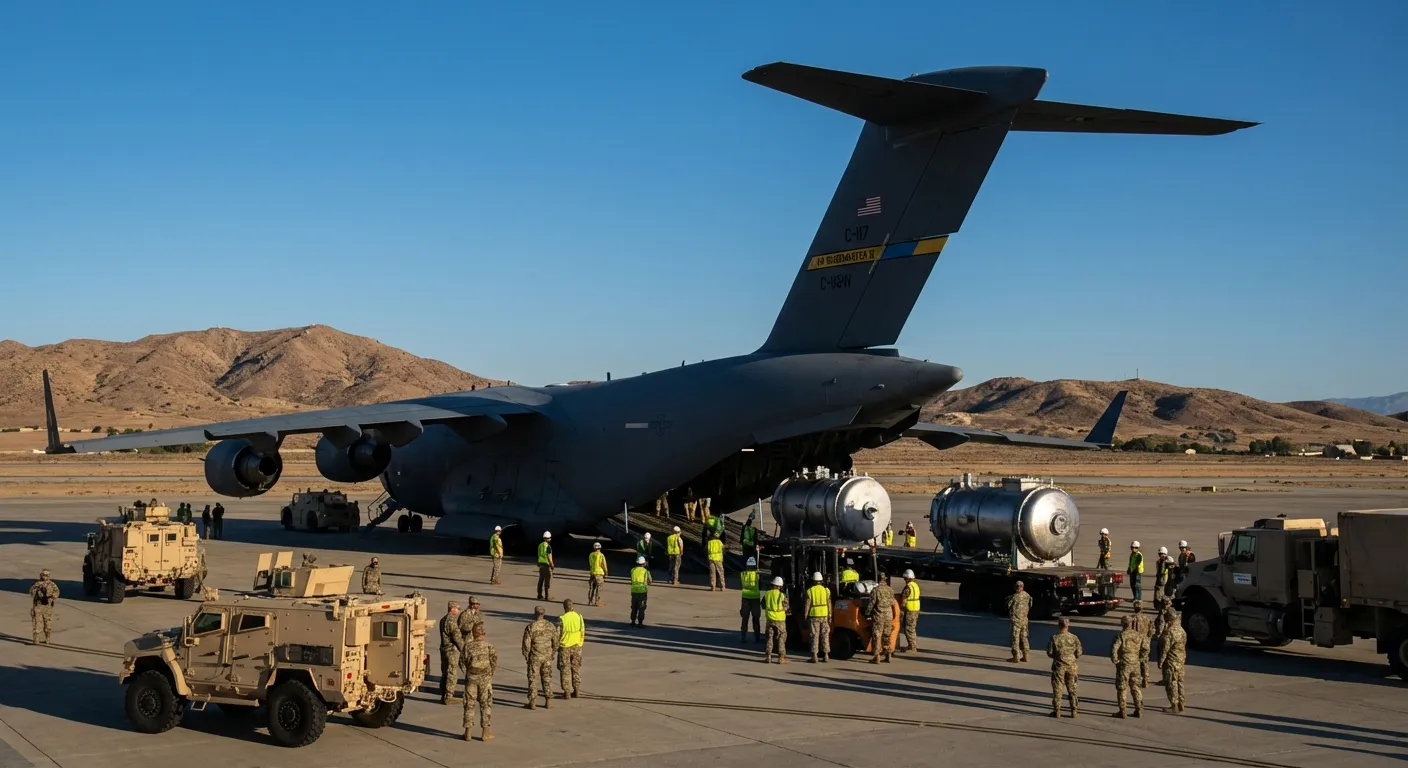
Three C-17 Globemaster III aircraft took off from March Air Reserve Base in southern California on Saturday carrying cargo that has never been loaded onto a military transport plane before: a nuclear reactor. Broken into eight modules and packed into the cavernous holds of America's primary strategic airlift jets, the Ward 250 reactor built by startup Valar Atomics was bound for Hill Air Force Base in Utah, about 30 miles north of Salt Lake City. From there, the modules will travel overland to the Utah San Rafael Energy Lab in Orangeville for assembly and testing.
The Pentagon dubbed the mission Operation Windlord. Secretary of Energy Chris Wright and Michael Duffey, Undersecretary of War for Acquisition and Sustainment, flew aboard one of the aircraft. The 62nd Airlift Wing, the only Air Force unit currently certified for routine nuclear weapons transport, handled the flight. If the timeline holds, the reactor is supposed to achieve criticality by July 4, 2026, the 250th anniversary of the Declaration of Independence.
It is a striking image: nuclear power, packed into a cargo plane, flown across the American West. It is also the kind of moment that raises as many questions as it answers.
What Is the Ward 250?
The reactor at the center of Operation Windlord is not the kind of nuclear plant most people picture. It is small, modular, and experimental. The Ward 250 is a high-temperature gas-cooled reactor (HTGR) that uses helium as its coolant instead of water and graphite as its moderator. Its fuel consists of TRISO particles, tiny spheres of high-assay low-enriched uranium encased in layers of silicon carbide that can withstand temperatures exceeding 1,600 degrees Celsius without melting.
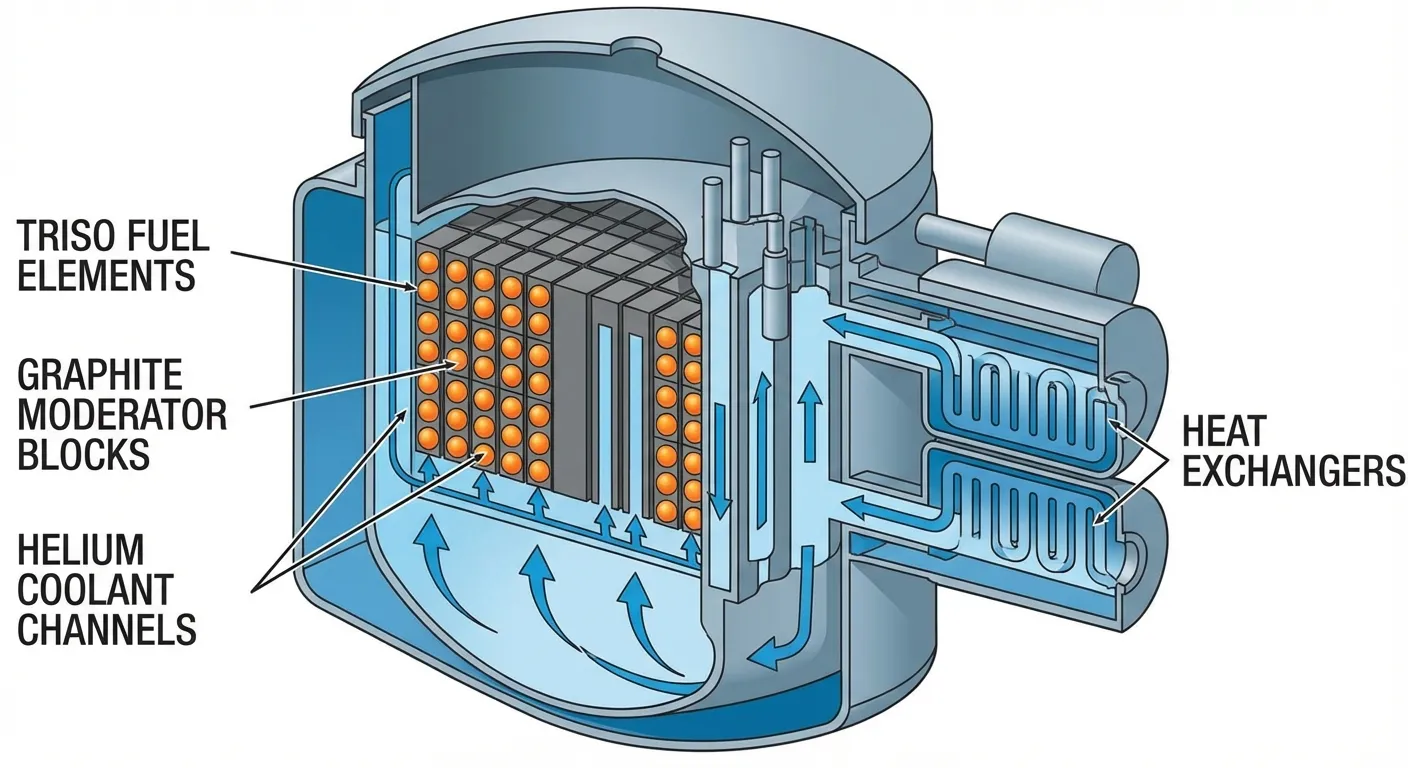
At the current test scale, the Ward 250 produces 100 kilowatts thermal, a fraction of a commercial power plant's output. This is not a reactor designed to light up cities. It is a proof of concept, a demonstration that a nuclear system can be manufactured in modules, transported by air, assembled at a remote site, and brought to criticality within months rather than decades.
Valar Atomics, the company behind the reactor, emerged from stealth in February 2025 with $19 million in funding. The startup has since raised $130 million, led by Palmer Luckey, the founder of Anduril Industries, and Shyam Sankar, the CTO of Palantir. CEO Isaiah Taylor framed the company's mission in blunt terms: "For four decades, the United States has underinvested in domestic energy production while exporting energy-intensive industries overseas."
The company hit a crucial technical milestone on November 17, 2025, when its NOVA Core achieved zero-power criticality at Los Alamos National Laboratory's National Criticality Experiments Research Center, becoming the first nuclear startup to sustain a controlled fission reaction. Taylor called it "a reactor's first heartbeat, proof the physics holds."
The AI Hunger Driving the Timeline
The urgency behind Operation Windlord is not primarily military. It is about electricity. Specifically, the staggering and growing amount of electricity required to train and run artificial intelligence systems.
Taylor put it directly: "Training a single large language model can consume as much electricity as a small city. Advanced manufacturing requires constant, reliable power measured in gigawatts." Industry projections estimate that data centers will consume over 200 terawatt-hours annually by 2030, a figure that has prompted every major tech company to scramble for dedicated power sources.
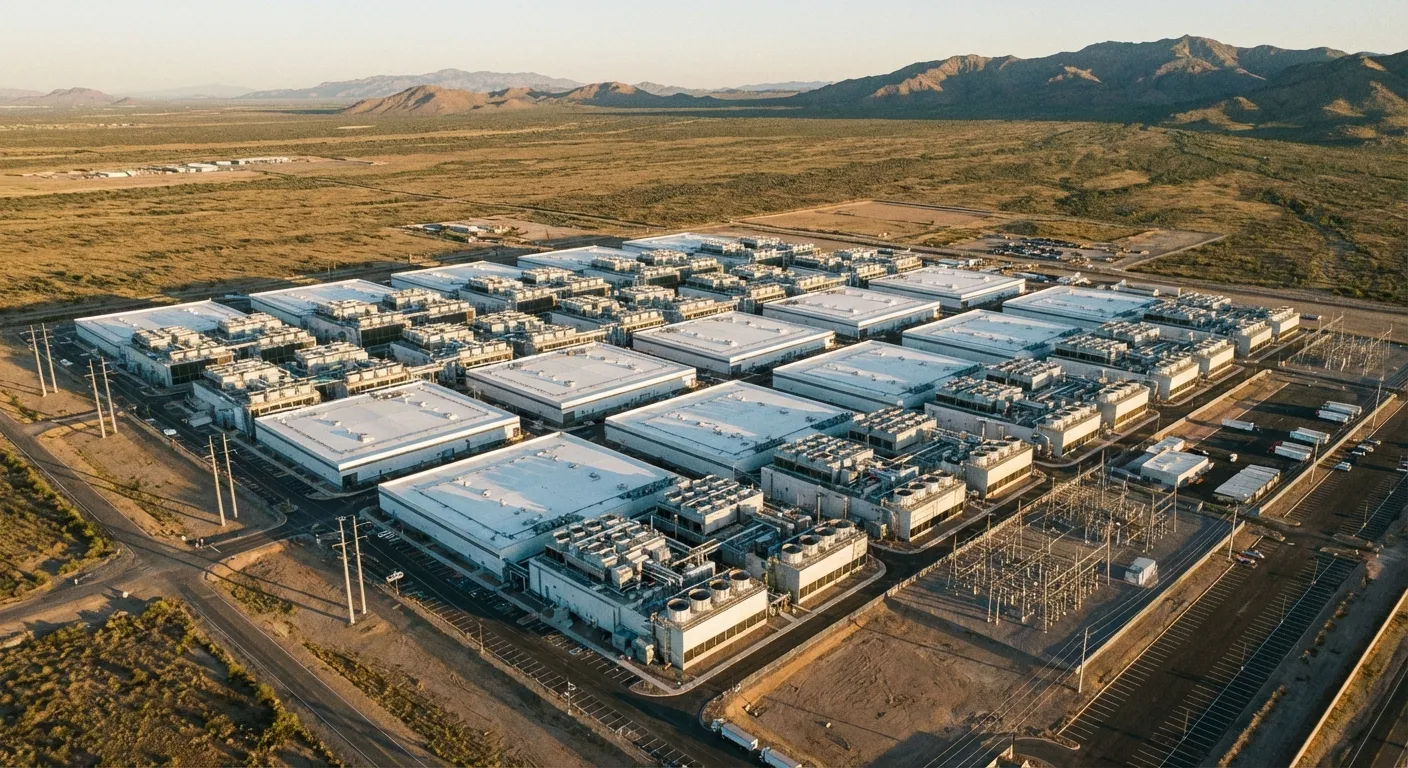
Valar's long-term vision extends well beyond the test reactor that flew to Utah on Saturday. The company wants to build standardized reactors manufactured at scale and deployed "by the hundreds" at what it calls "gigasites," energy campuses co-locating power generation with data centers, hydrogen production facilities, and advanced manufacturing. Meta has already committed billions to nuclear-powered AI infrastructure. Microsoft signed a deal to restart Three Mile Island's undamaged reactor. Amazon invested in nuclear power for its cloud computing operations. The pattern is clear: the tech industry has decided that renewables and natural gas alone cannot meet its trajectory, and nuclear is the supplement of choice.
The Department of Energy explicitly linked Operation Windlord to this demand, stating that the flight "advances President Trump's goals for nuclear energy, which include rapidly building reactors to power artificial intelligence data centers for defense."
Why This Time Might Actually Be Different (and Why It Might Not)
The most important context for understanding Operation Windlord is the graveyard of previous small modular reactor promises. The nuclear industry has been talking about SMRs for over a decade, and the track record is not encouraging.
NuScale Power held the only NRC-approved small modular reactor design in the United States. Its flagship project, the Carbon Free Power Project developed with Utah Associated Municipal Power Systems, was supposed to demonstrate that small reactors could deliver affordable, carbon-free electricity. After nearly a decade of development, the project collapsed in 2023 when the target price for power rose from $58 per megawatt-hour to $89 per megawatt-hour. No reactors were built. Billions in federal subsidies evaporated.
The Valar approach is structurally different from NuScale's in several ways that matter. First, the reactor is being built under the Department of Energy's own regulatory authority through the Nuclear Reactor Pilot Program, rather than through the Nuclear Regulatory Commission's years-long licensing process. Second, the nine-to-ten-month construction timeline (from the September 2025 groundbreaking to the July 4, 2026 target) is orders of magnitude faster than any previous nuclear project. Third, the military's direct involvement provides both funding and institutional urgency that civilian projects typically lack.
But the NuScale failure offers a specific cautionary lesson. The engineering challenge was never the primary obstacle. NuScale's reactor design worked. What killed the project was economics: the cost of building, licensing, and operating a novel reactor simply could not compete with alternatives. Valar's test reactor, at 100 kilowatts thermal, is not yet at the scale where economic viability can be meaningfully assessed. The gap between "the physics holds" and "this makes financial sense at gigawatt scale" is where previous nuclear ambitions have gone to die.
Kathryn Huff, former head of nuclear energy at the Department of Energy and now a professor at the University of Illinois, called the aggressive July 4 timeline "a pretty big understatement," noting that research reactors typically require at least two years to build.
The Regulatory Gamble
Operation Windlord exists within a broader and deeply contested regulatory restructuring that deserves scrutiny independent of the reactor's technical merits.
The Trump administration has rewritten DOE nuclear safety orders, cutting over 750 pages of regulations. Among the changes: the removal of the ALARA (As Low As Reasonably Achievable) radiation exposure standard, the consolidation of seven security directives into a single 23-page order, and a shift in language from "prohibited" to "should be avoided" for certain radioactive discharges. The DOE Pilot Program allows reactors to be built under DOE authority rather than NRC oversight, and DOE orders can be changed internally without public comment periods.
Edwin Lyman of the Union of Concerned Scientists called the deregulation effort equivalent to "taking a wrecking ball to the system of nuclear safety and security regulation oversight that has kept the U.S. from having another Three Mile Island accident." Christopher Hanson, the former NRC Chair who was fired by the Trump administration, warned that "the Department of Energy relaxing nuclear safety and security standards in secret is not the best way to engender public trust."
The DOE defended its approach: "Reduction of unnecessary regulations will increase innovation without jeopardizing safety." Valar Atomics is also part of a lawsuit challenging the NRC's oversight of small reactors, arguing that the disaster risks from compact, passively cooled designs do not warrant the same regulatory burden as traditional large-scale plants.
This is a genuine tension. TRISO fuel and helium-cooled designs are inherently safer than water-cooled reactors, with passive cooling capabilities that functionally eliminate meltdown risk. The question is whether streamlining regulation to match that lower risk profile is prudent engineering, or whether the speed of deployment is outpacing the institutional safeguards that make nuclear energy publicly acceptable.
The Global Race for Small Nuclear
The United States is not pursuing this path alone. China's ACP100 demonstration reactor is expected to start operations by the end of 2026. Romania has approved a final investment decision for a NuScale-based SMR, potentially the first in Europe. Canada is targeting a new SMR at Chalk River. Multiple American companies, including Holtec, Westinghouse, and X-energy, are all racing toward 2026 first units.
The Pentagon's own parallel program, Project Pele, offers a useful comparison. That reactor, built by BWXT with Rolls-Royce and Northrop Grumman, is designed to produce 1.5 megawatts of electricity, fit inside four standard shipping containers, and run for three years without refueling. It is being built at Idaho National Laboratory with a target of producing electricity by 2028.
The military's interest in portable nuclear power is straightforward: bases that can generate their own electricity are not vulnerable to grid attacks, and forward-deployed units in locations without power infrastructure need a reliable source. An executive order directs the DoD to operate a nuclear reactor at a domestic military base no later than September 30, 2028.
The convergence of military need, AI industry demand for unprecedented amounts of power, and political will to accelerate nuclear deployment has created a window of opportunity for the SMR industry that did not exist five years ago. Whether that window produces working reactors or another cycle of overpromise and underdelivery depends on what happens over the next twelve months.
What This Changes
Operation Windlord proved one narrow but meaningful thing on Saturday: a nuclear reactor can be manufactured in modules, loaded onto military aircraft, and transported across a continent in a single day. That logistical capability, regardless of what happens with the Ward 250's operational timeline, changes the calculus for how quickly nuclear power can be deployed to remote or underserved locations.
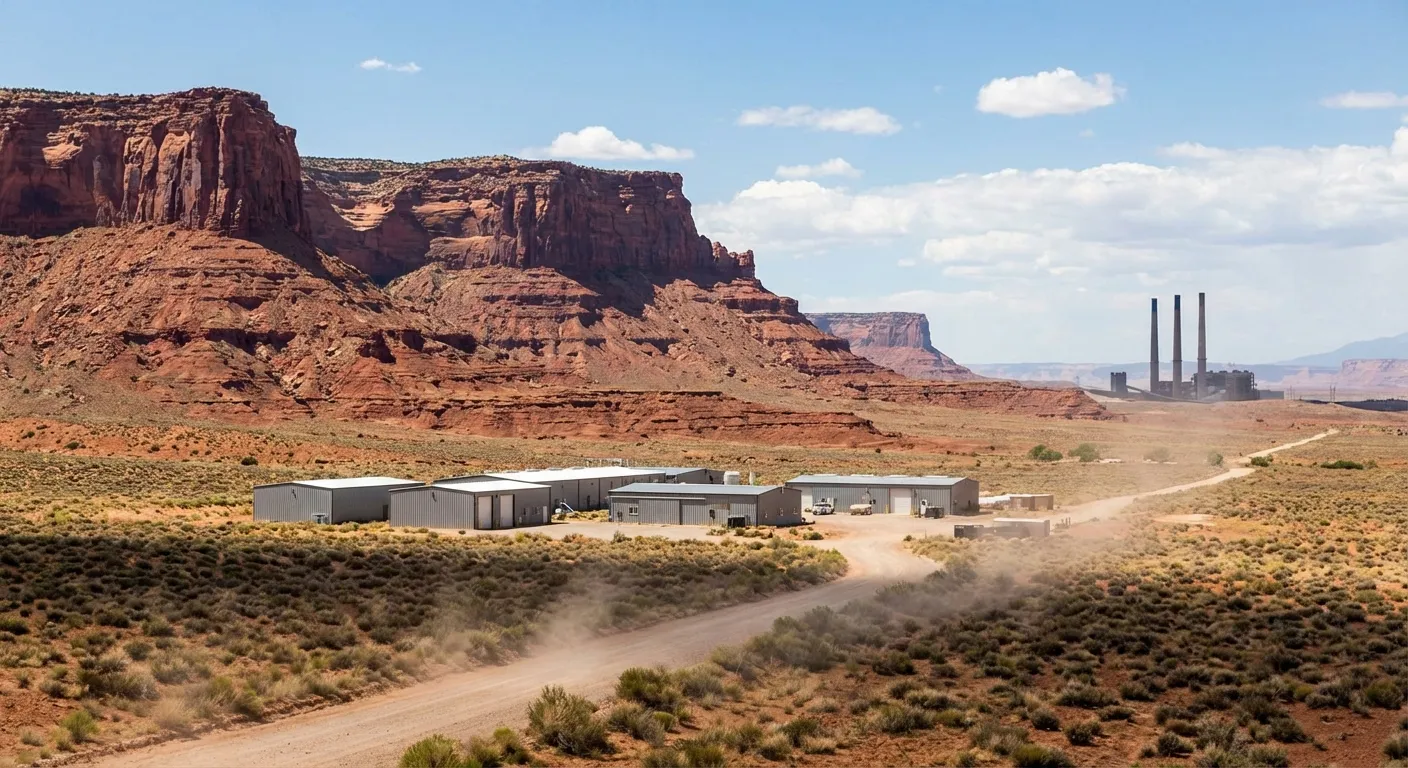
The July 4 target is ambitious to the point of skepticism, given that the nuclear industry's history of missed deadlines could fill volumes. But the combination of proven TRISO fuel technology, a successful criticality test at Los Alamos, direct Pentagon and DOE backing, and $130 million in private capital makes this more than a publicity stunt. The Utah San Rafael Energy Lab, located near existing coal power infrastructure, represents exactly the kind of energy transition site where success would have outsized symbolic and practical impact.
The key metric to watch is not whether the reactor achieves criticality by Independence Day, but whether the cost projections for scaled-up versions of the Ward design can undercut the economics that killed NuScale. If Valar can demonstrate a path to power generation at competitive rates, the airlift on Saturday will look like the beginning of something consequential. If the economics do not work at scale, it will be remembered as an impressive piece of theater in a long history of nuclear ambitions that flew high and landed short.
Sources
- Orange County Register: Nuclear reactors at March base head for Utah in a first-of-its-kind airlift
- The War Zone: This is a nuclear reactor packed into a USAF C-17 cargo jet
- NPR: The Trump administration has secretly rewritten nuclear safety rules
- ANS Nuclear Newswire: Valar Atomics breaks ground in Utah
- TechCrunch: Valar Atomics comes out of stealth with $19M and a pilot reactor site