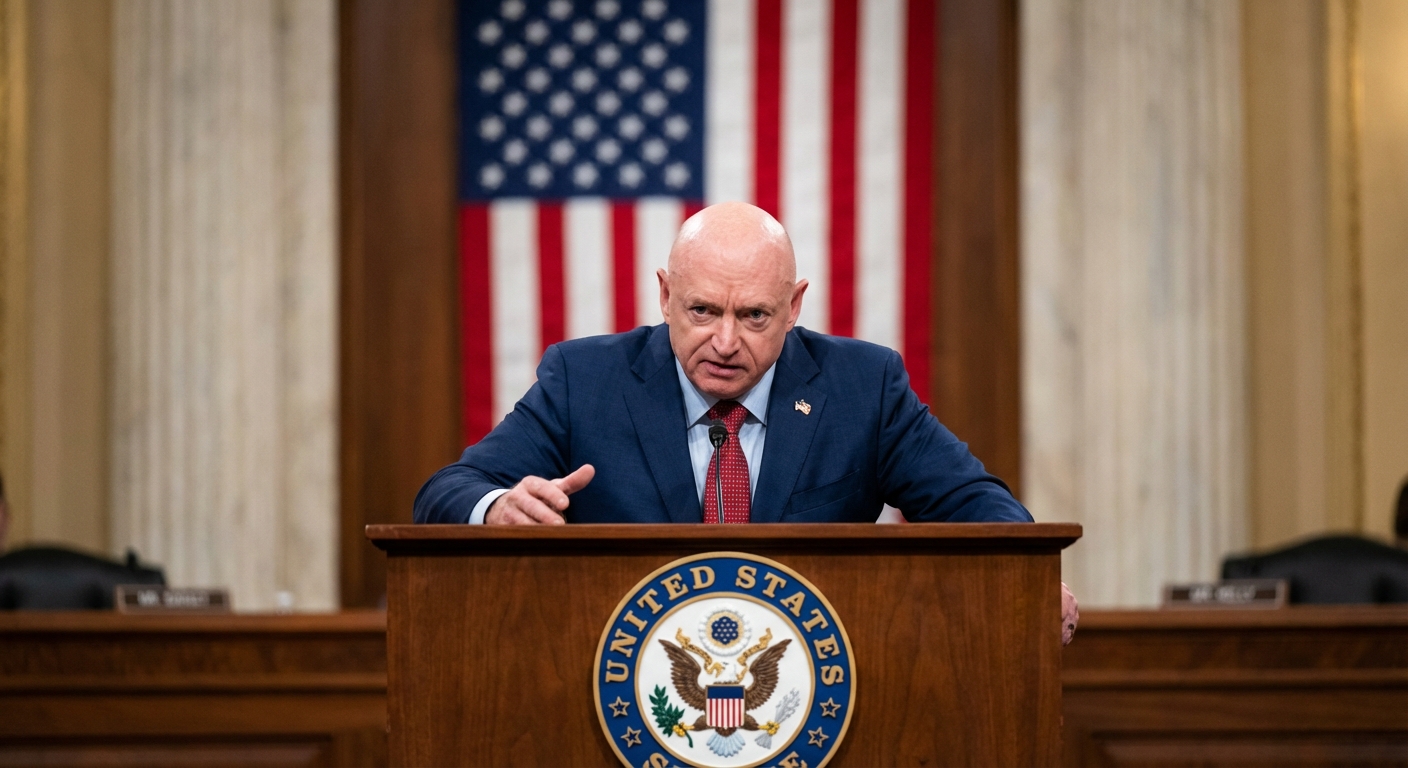
Senator Mark Kelly (D-Ariz.) filed a federal lawsuit Monday against Defense Secretary Pete Hegseth, challenging a censure and potential demotion that Kelly says violates his constitutional rights to free speech. The case tests whether the Pentagon can punish retired service members for political speech, with implications that extend far beyond one senator.
The dispute stems from a 90-second video Kelly appeared in with five other Democratic lawmakers last November. All were veterans or intelligence community alumni, and the video called on service members to uphold the Constitution and reject any unlawful orders from the Trump administration. President Trump responded by accusing the lawmakers of sedition “punishable by DEATH” in a social media post.
What Triggered the Lawsuit
Defense Secretary Hegseth formally censured Kelly on January 5, citing the video as a violation of military regulations governing retired officers’ conduct. Hegseth called the censure “a necessary process step” toward proceedings that could reduce Kelly’s retired rank from captain and cut his retirement pay.
Kelly is the only one of the six lawmakers facing investigation because he is the only one who formally retired from military service and remains under Pentagon jurisdiction. The others served but separated under different circumstances that place them outside the Defense Department’s authority.
The censure itself has limited practical effect, essentially amounting to a formal letter of disapproval. But the potential demotion and pay reduction represent real consequences, and Kelly argues the entire proceeding is unconstitutional retaliation for protected speech.
Kelly’s Legal Arguments
The lawsuit, filed in federal court in Washington D.C., makes two primary constitutional claims. First, Kelly argues the censure violates his First Amendment rights by punishing him for political speech on matters of public concern. Courts have generally held that such speech receives strong protection, particularly when it comes from elected officials.
Second, Kelly invokes the Speech and Debate Clause of the Constitution, which grants lawmakers immunity from prosecution or penalty for their official legislative acts. This clause exists specifically to protect members of Congress from executive branch intimidation.
Speaking on the Senate floor Monday, Kelly framed the stakes broadly: “If Pete Hegseth succeeds in silencing me, then he and every other secretary of defense who comes after him will have license to punish any retired veteran, of any political persuasion, for the things that they say.”
He offered a pointed hypothetical: “By that logic, a 100-year-old World War II veteran could be hauled in and censured or court-martialed because he says something that Pete Hegseth disagrees with.”
The Precedent Problem
The case raises questions about how far military authority over retirees extends. Retired officers technically remain subject to the Uniform Code of Military Justice and can be recalled to active duty. But that authority has rarely been used against sitting members of Congress, and never in circumstances this explicitly tied to political speech.
The lawsuit asks a fundamental question: Can the executive branch use military discipline to punish a senator for criticizing the president? If so, the Pentagon gains significant leverage over any member of Congress who served in the military, a group that includes many lawmakers on both sides of the aisle.
The Pentagon said it was aware of the lawsuit but declined to comment on ongoing litigation.
What Happens Next
U.S. District Judge Leon, appointed by President George W. Bush, scheduled a hearing for Thursday on Kelly’s request for a temporary restraining order. If granted, it would halt any further proceedings against Kelly while the constitutional questions are litigated.
The case could take months to resolve fully, but the restraining order hearing will provide an early signal of how the court views the legal issues.
Watch for reactions from other veterans in Congress. The precedent Kelly is fighting would apply to any retired service member who enters politics, regardless of party. Republicans who served might have reason to worry about future administrations using similar tactics against them.
Sources: CNN, Washington Post, NBC News, PBS, Federal court filings.