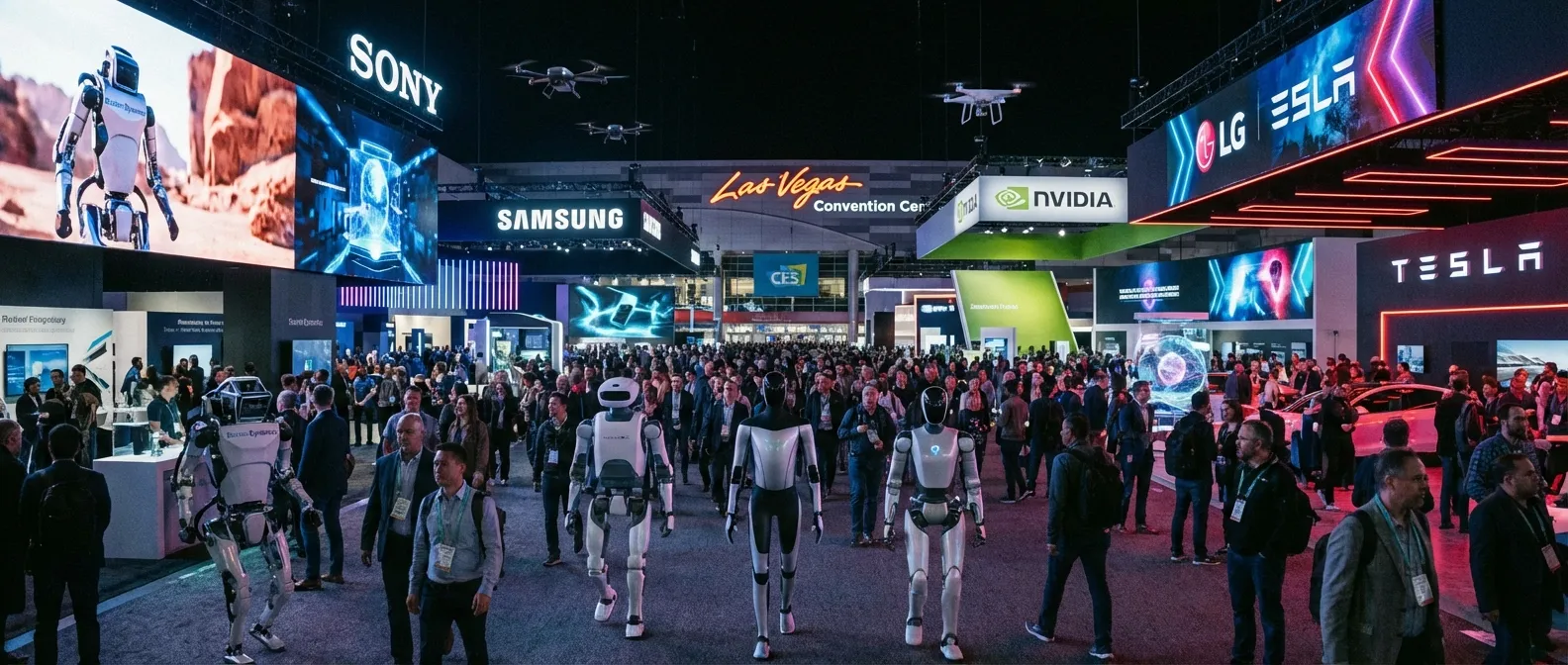
CES has always been better at generating hype than predicting the future. The show that once crowned 3D televisions as the next revolution (CES 2010-2013), anointed smart home hubs as essential (CES 2016-2018), and declared consumer VR headsets a done deal (CES 2015-2017) returned to Las Vegas this week with a new thesis: robots are finally ready. Thousands of them filled the exhibition halls, from household assistants to industrial machines, alongside AI companions, health longevity devices, and the familiar parade of smart gadgets. The demos were impressive. But CES demos are always impressive. The harder question is which of these products will actually ship, and which will join the graveyard of trade show promises.
The headline moment came early when Siemens CEO Roland Busch and NVIDIA CEO Jensen Huang announced an expanded partnership they called the foundation of a new AI-driven industrial revolution. That framing deserves scrutiny. Huang is a gifted showman whose keynotes routinely produce stock-moving proclamations, and NVIDIA has a direct financial interest in convincing every industry that it needs more GPU compute. The underlying technology, combining NVIDIA's AI chips with Siemens' industrial automation to create "industrial digital twins" (virtual replicas of factories for production optimization), is genuinely interesting. But "industrial digital twins" have been a consulting-deck staple since at least 2018. The question is whether this partnership delivers measurable manufacturing gains or becomes another enterprise software initiative that sounds transformative in press releases and underdelivers in practice.
The CES Vaporware Index
Before evaluating the specific announcements, it helps to understand CES's track record. The show has a pattern: a technology category dominates the floor, media coverage treats it as inevitable, and then reality intervenes. Consider the historical record.
3D televisions were CES royalty from 2010 through 2013. Every major manufacturer showed them, reviewers praised them, and analysts projected tens of millions in annual sales. By 2017, Samsung, Sony, and LG had all quietly stopped making them. Total market penetration never exceeded single digits. Smart home hubs followed a similar arc. Amazon, Google, Samsung, and dozens of startups showed integrated platforms at CES 2016-2018, promising a single system to control every device. Most of those platforms are now discontinued or limping along with minimal user bases. Consumer VR headsets, the darlings of CES 2015-2017, were projected to be a $45 billion market by 2025. Meta has spent over $50 billion on its Reality Labs division and still hasn't achieved mainstream adoption, reporting fewer than 20 million Quest headsets sold cumulatively.
With that context, here is a confidence-level framework for the major CES 2026 announcements:
- Shipping now or within 90 days (high confidence): NVIDIA's updated Cosmos, Isaac GR00T, and Clara AI platforms (these are developer tools, not consumer products, and NVIDIA has a strong track record of shipping its software platforms). Waymo's expansion plans to Washington, New York, and London, backed by confirmed regulatory agreements and existing operational infrastructure.
- Confirmed ship date, 2026 (moderate confidence): Select industrial robots from established manufacturers with named corporate customers and announced pricing. Several AI-enhanced wearables from companies already selling previous-generation products (iterative, not revolutionary).
- "Coming soon" with no specifics (low confidence): The majority of household assistant robots shown on the floor. Most longevity-focused health devices. Consumer companion robots from startups without established manufacturing or distribution.
- Concept only (minimal confidence): Humanoid robots performing unstructured household tasks autonomously. Consumer-priced general-purpose home robots. Several "AI health" devices making claims about biological age reversal.
This breakdown reveals something important: the announcements most likely to ship are developer platforms and industrial tools, not the consumer robots generating the splashiest coverage.
The Robot Moment, Examined
Jensen Huang declared from the CES stage that "the ChatGPT moment for robotics is here," and it is worth parsing what that claim actually means. NVIDIA unveiled a suite of open models for robotic applications, including updates to Cosmos for physical AI, Isaac GR00T for humanoid robots, and Clara for biomedical applications. These are real, useful tools for robotics developers. But calling this "the ChatGPT moment" conflates making better development tools with achieving consumer breakthrough. ChatGPT's moment was not when OpenAI released better APIs; it was when 100 million people started using the product in two months. No consumer robot is remotely close to that adoption curve.
The robots on display ranged from genuinely useful to aspirational. Home assistance robots that can navigate real living spaces, avoid obstacles, and perform simple tasks like fetching items or monitoring elderly family members have improved noticeably. Industrial robots capable of handling variable tasks rather than repetitive motions represent a significant capability upgrade. But the consumer robotics industry has been making similar claims for over two decades. iRobot's Roomba, launched in 2002, remains the only consumer robot to achieve true mass-market adoption, and it does exactly one thing: vacuum floors. Jibo, the "social robot" that raised $73 million and was named one of Time's best inventions of 2017, shut down in 2019. Anki's Vector, another CES favorite, saw its parent company go bankrupt the same year. Kuri, the adorable home robot from Bosch spinoff Mayfield Robotics, was canceled before it ever shipped to customers despite strong CES buzz.
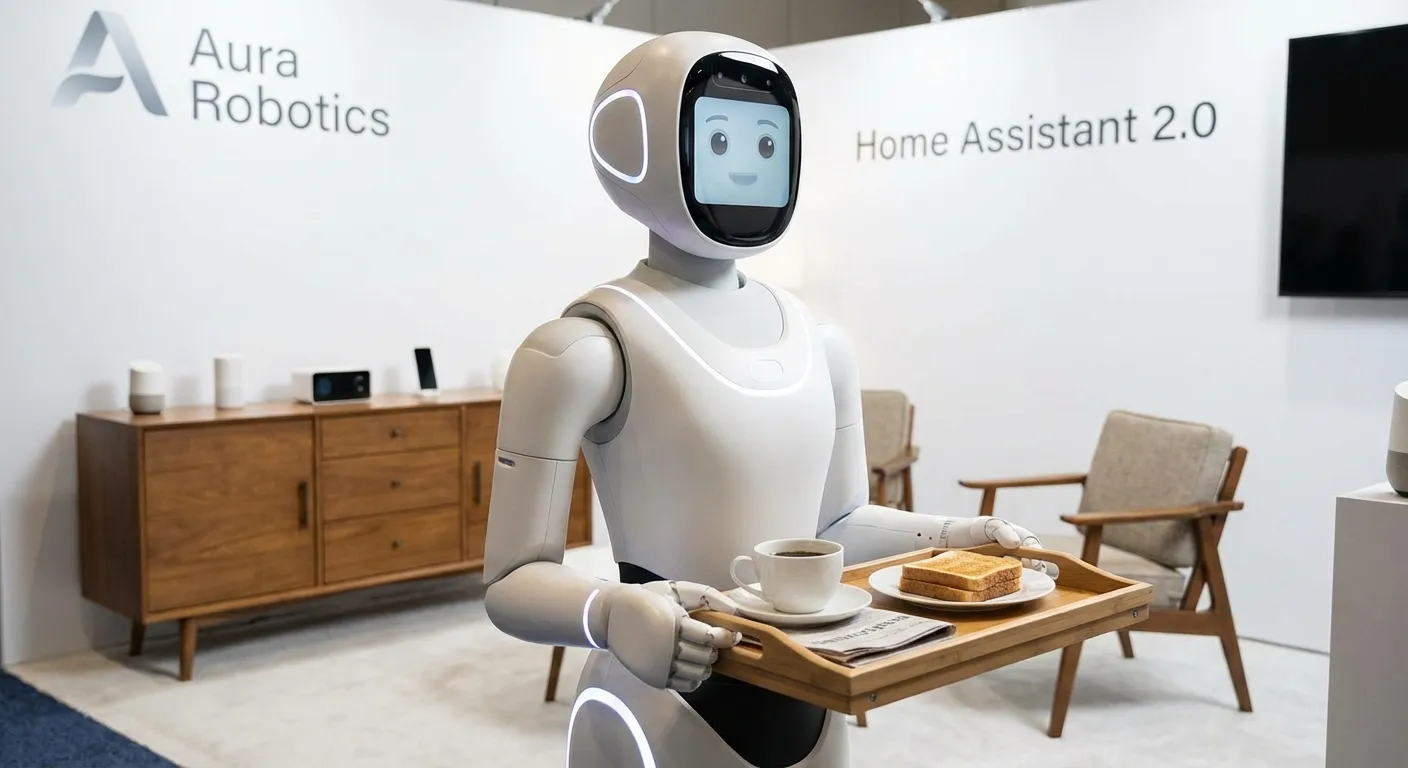
The actual adoption data tells a sobering story. The global consumer robotics market (excluding industrial applications) was approximately $12 billion in 2025, and the overwhelming majority of that revenue comes from robot vacuums and lawn mowers, not the general-purpose assistants that dominate CES coverage. Household robots have been "five years away" for so long that the promise has become a running joke in the robotics research community. MIT roboticist Rodney Brooks, who co-founded iRobot, has repeatedly noted that controlled demos bear almost no relationship to reliable performance in the messy, unpredictable environments of real homes.
That said, there are genuine capability improvements worth acknowledging. The underlying AI models for spatial reasoning, object manipulation, and natural language interaction have improved substantially. The question is not whether the technology is better than last year (it clearly is) but whether it has crossed the threshold from impressive demo to reliable product. Based on the gap between what was shown on scripted CES stages and what robots can do in uncontrolled environments, that threshold has not been crossed for consumer applications.
AI Gets Physical
Beyond robots specifically, the broader theme of CES 2026 was AI moving from software into the physical world. Yann LeCun, the AI researcher who left Meta, has been building world models (systems that learn how objects interact in physical space) with backing reportedly seeking a $5 billion valuation. Fei-Fei Li, another AI pioneer, launched World Labs' first commercial world model called Marble at CES. These systems enable applications from better robotics to improved AR/VR to more realistic gaming environments.
The less meaningful developments are the predictable "AI inside" labeling now appearing on everything from refrigerators to toothbrushes. Some of these integrations are useful; many are marketing. A washing machine that genuinely optimizes water and energy usage through sensor data and machine learning provides real value. A coffee maker that uses "AI" to remember your preferred settings is just a database with better branding.
CES attendees learned to ask what specific AI capabilities a product offers rather than accepting the label at face value. The companies with genuine integrations were happy to explain; the ones with marketing-driven AI claims often could not articulate what their AI actually does differently from previous technology. This pattern mirrors the "blockchain" labeling epidemic of CES 2018, when dozens of products slapped the term onto existing technology to ride the hype cycle. Most of those blockchain integrations quietly disappeared within two years.
Health Tech: Marketing vs. FDA Pathways
Health technology at CES 2026 reflected the growing mainstreaming of longevity science, and it also reflected the growing gap between what companies claim and what regulators have approved. Wearables have evolved beyond step counting into continuous health monitoring, and several companies demonstrated devices claiming to track biological age markers. That phrase, "biological age markers," deserves close examination. While research into epigenetic clocks and aging biomarkers is legitimate and advancing (work by researchers like Steve Horvath has established that DNA methylation patterns correlate with aging), the consumer devices at CES claiming to measure "biological age" are making a significant leap from laboratory research to wrist-worn gadgets. None of the biological age tracking devices shown at CES have FDA clearance for diagnostic claims, and the FDA has not established a regulatory category for consumer biological age measurement.
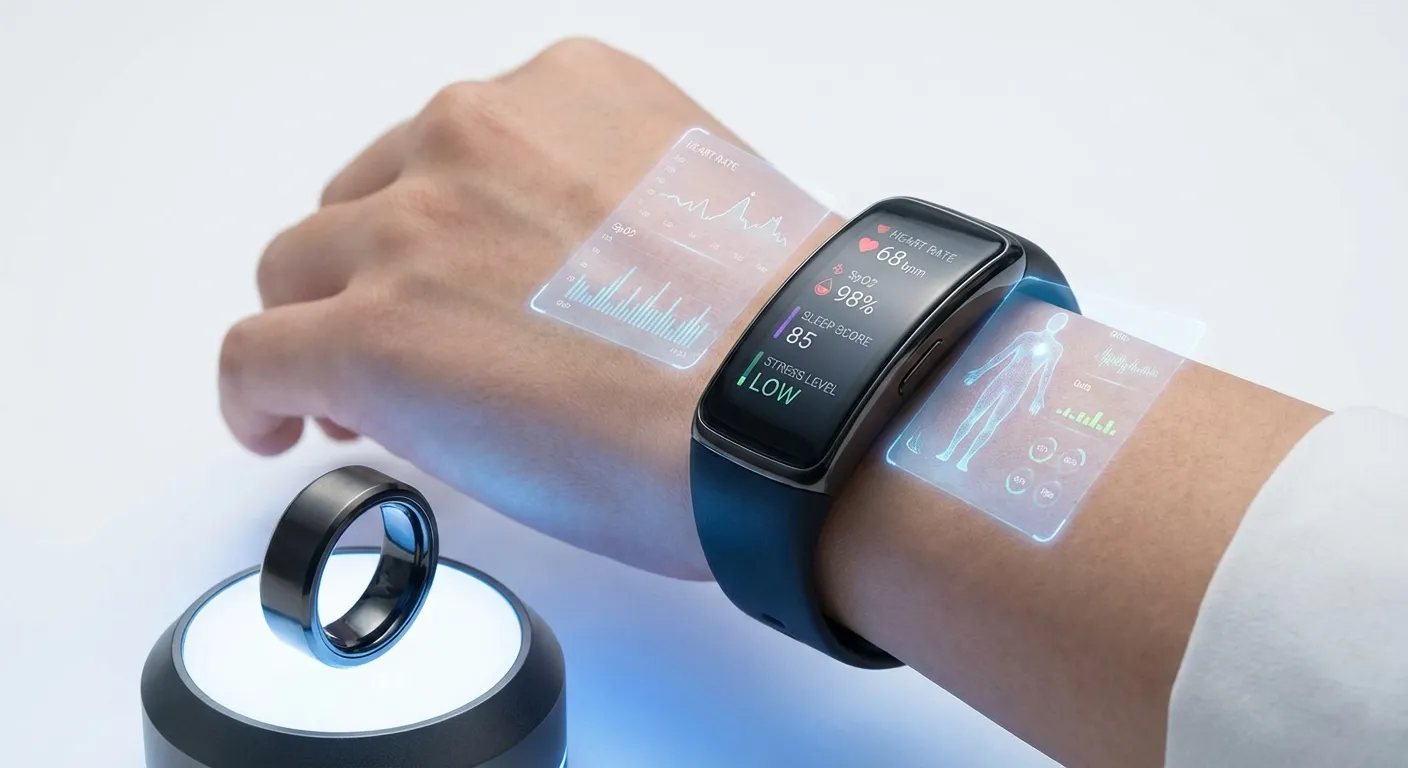
The AI-assisted diagnostics announcements split into two distinct categories. The first includes systems analyzing medical images and predicting health risks from wearable data within clinical settings. Several of these have active FDA De Novo or 510(k) submissions, meaning they are pursuing the regulatory pathway required to make medical claims. Companies like Viz.ai (stroke detection) and IDx (diabetic retinopathy screening) have already received FDA clearance for AI diagnostic tools, establishing a genuine precedent. The second category includes consumer "wellness" devices that carefully avoid making diagnostic claims while implying medical-grade insights through their marketing. These products occupy a regulatory gray area: by framing themselves as "wellness" rather than "medical" devices, they avoid FDA oversight entirely, which also means their accuracy claims face no independent verification.
Longevity-focused supplements and devices had a significant presence, and these require the most skepticism. The science of aging intervention is advancing rapidly in research settings, but the consumer products at CES making claims about reversing biological aging are, in nearly every case, extrapolating far beyond the supporting evidence. Several exhibitors referenced studies on NAD+ precursors, senolytics, or rapamycin analogs without noting that these studies were conducted in mice, at dosages not translatable to their consumer products, or in controlled clinical environments nothing like daily supplement use. The gap between "promising research direction" and "product you should buy" is measured in years of clinical trials, not trade show demos.
What the NVIDIA-Siemens Partnership Actually Means
Returning to the headline announcement: the NVIDIA-Siemens industrial digital twin partnership deserves evaluation separate from the stage theatrics. The concept of simulating factory operations digitally before implementing changes physically is sound, and both companies bring genuine capabilities. Siemens has deep manufacturing expertise and an installed base of industrial automation. NVIDIA's GPU computing and AI models are well-suited to the simulation workloads involved.
The critical question is scale and timeline. Previous enterprise partnerships announced at CES with similar fanfare, including Intel's smart factory initiatives (CES 2019) and Qualcomm's industrial IoT platform (CES 2020), produced real but modest results far below the "revolution" language used on stage. Huang's framing of this as a new industrial revolution serves NVIDIA's narrative that every industry needs to buy more of its chips. The partnership will likely produce useful tools for large manufacturers. Whether it fundamentally changes how things get manufactured, as both CEOs claimed, depends on adoption rates among mid-size manufacturers who lack the engineering teams to implement complex digital twin systems. Enterprise software rollouts of this complexity typically take 3 to 5 years from announcement to meaningful market penetration, not the immediate transformation implied by CES keynotes.
What This Changes
CES 2026 presented a technology landscape where the gap between demos and products has narrowed in some areas (industrial AI, developer platforms, iterative wearable improvements) and remains vast in others (consumer robotics, longevity tech, general-purpose home AI). The announcements most likely to affect how things are manufactured and developed are the least photogenic: updated SDKs, enterprise partnerships, and incremental sensor improvements. The announcements generating the most media coverage, household robots and biological age trackers, face the steepest path from show floor to shipping product.
Based on CES's historical pattern, here are specific projections. Roughly 60-70% of the consumer robots shown this week will never ship in the form demonstrated, based on failure rates from the 2015-2020 CES robot cohorts. The "AI inside" labeling trend will peak within 18 months and then quietly fade from products where it adds no measurable function, following the same lifecycle as "blockchain-enabled" consumer products. The NVIDIA-Siemens partnership will produce its first publicly documented manufacturing case studies by late 2026, but the productivity gains will be in the single-digit percentage range, not the revolutionary figures implied on stage.
The health tech sector faces a reckoning: the FDA is actively developing frameworks for AI medical devices, and companies currently hiding behind the "wellness" label will face increasing pressure to either pursue regulatory approval or stop implying clinical accuracy. The key indicator to track is FDA De Novo submissions for consumer AI health devices. If that number does not increase substantially by mid-2026, the biological age tracking category shown at CES will follow the same trajectory as the AI-powered everything trend: real for enterprise, mostly marketing for consumers.
The direction of technology is genuinely moving from software into the physical world. But CES has always been better at identifying directions than timelines. The robots are coming, but they are coming slowly, expensively, and with far more limitations than this week's demos suggested.
Sources
- The coolest technology from Day 2 of CES 2026 - ABC News, January 2026
- Tech Trends 2026 - Deloitte Insights, 2026
- NVIDIA keynote and industry announcements, CES 2026