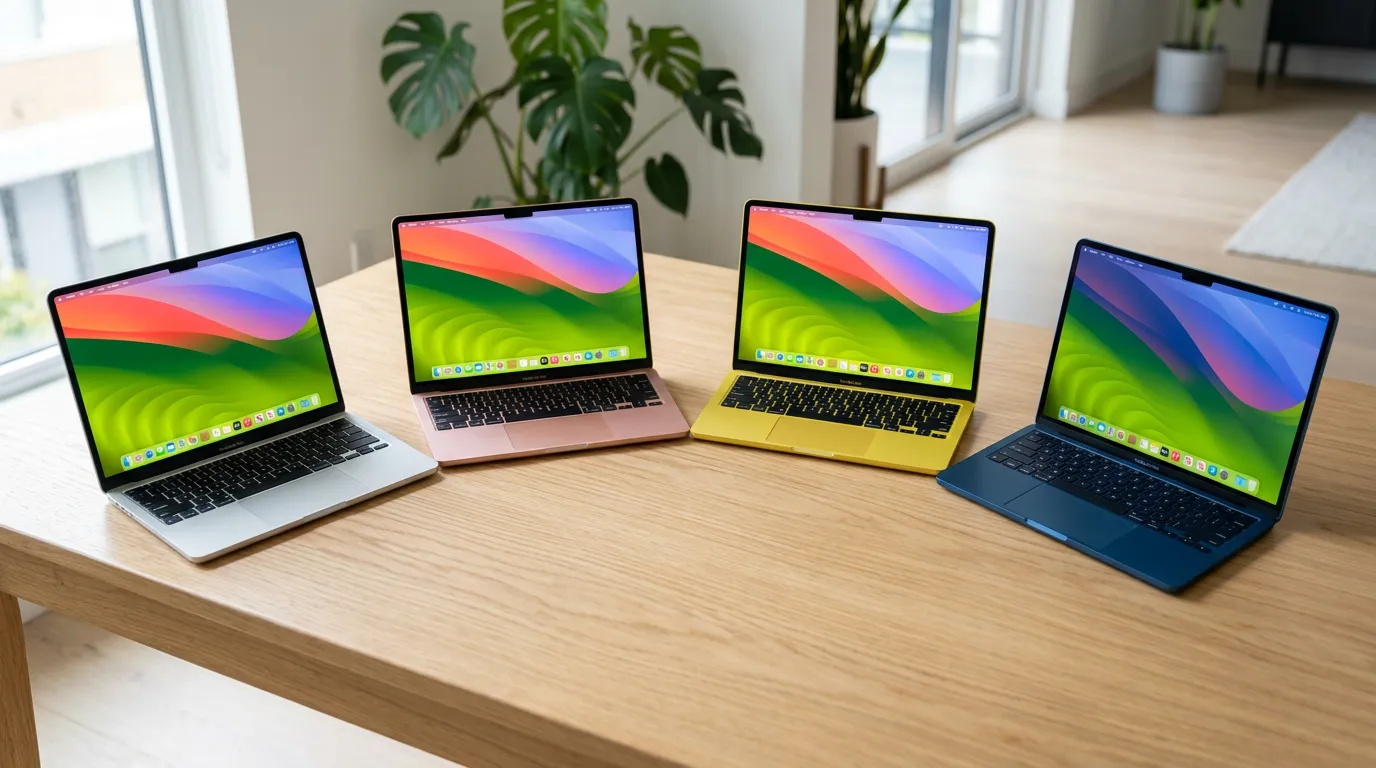
Apple has done something it almost never does: compete on price. The MacBook Neo, which hit shelves on March 11 at $599 ($499 for students), sold out its first production run within hours. Delivery estimates for new orders have already slipped to late March, and TrendForce projects the device will move 4 to 5 million units in 2026 alone. For a company that has spent decades cultivating premium pricing as a brand identity, building a laptop that costs less than most people's monthly car payment is not a minor product launch. It is a strategic reorientation.
The reaction from the PC industry has been blunt. Asus CFO Nick Wu told Fortune the device is "a shock to the entire market," and that rivals including Microsoft, Intel, and AMD are "seriously discussing" how to respond. Dell, HP, and Lenovo have reportedly begun internal reviews of their budget laptop strategies. None of them saw this coming, at least not at this price, and that lack of preparation tells you something about how thoroughly Apple kept its margins and supply chain math under wraps until announcement day.
The Engineering Trick That Makes It Work
The MacBook Neo exists because Apple had an insight its competitors couldn't easily replicate: it already mass-produces a chip that's powerful enough for laptop use and cheap enough to keep the price below $600. The A18 Pro, the same processor inside the iPhone 16 Pro, powers the Neo with a 6-core CPU, 5-core GPU, and 16-core Neural Engine. Rather than designing a new silicon product for the budget laptop segment, Apple repurposed billions of dollars in existing R&D.
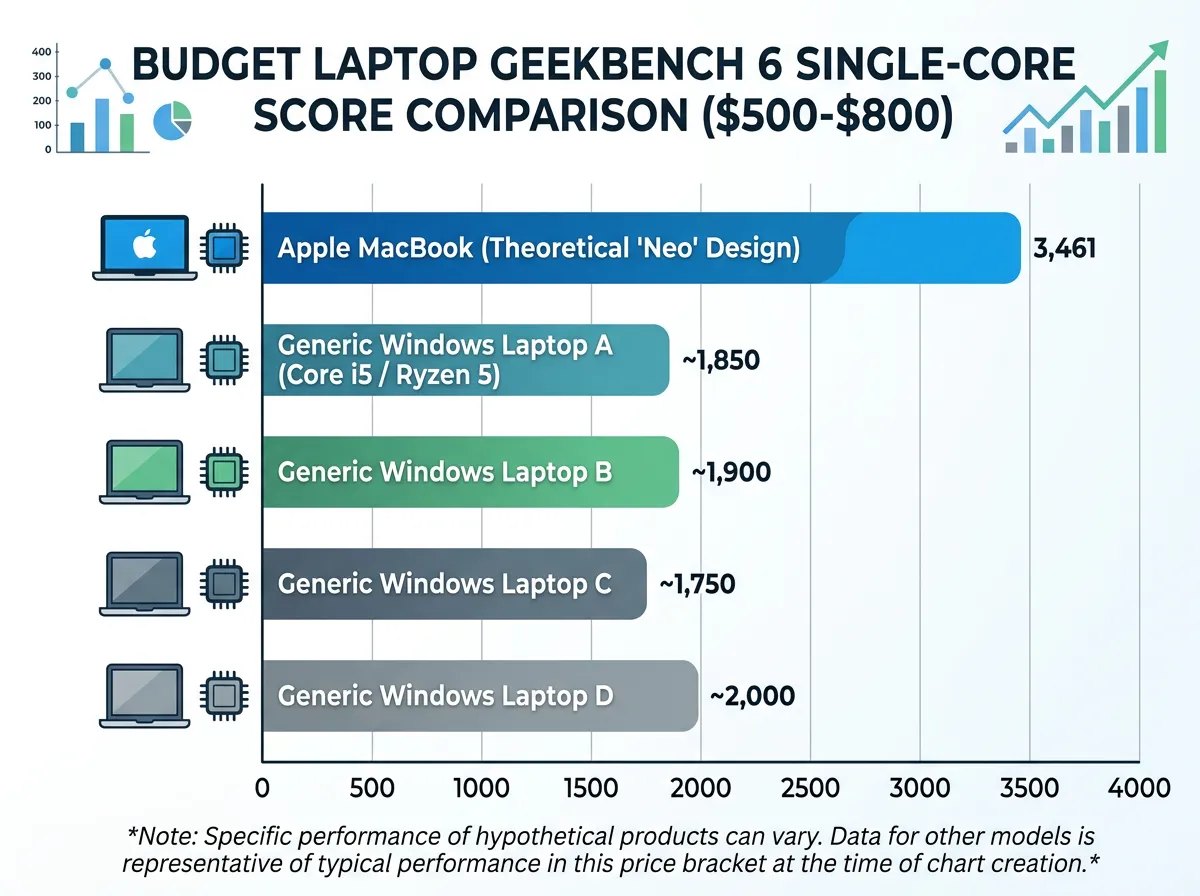
The benchmark results bear this out. In Geekbench 6, the Neo scores 3,461 on single-core tests, which puts it ahead of every x86 mobile processor in Cinebench 2024 single-core testing, including chips from Intel and AMD that cost several times more. Multi-core performance lands roughly on par with the 2020 M1 MacBook Air, a machine that still handles everyday computing comfortably in 2026. Tom's Hardware called it "a budget-priced game-changer," noting that the aluminum build quality feels indistinguishable from Apple's premium lineup.
The tradeoffs are real but carefully chosen. Eight gigabytes of non-upgradeable RAM limits heavy multitasking. The base 256GB SSD feels tight for power users. Gaming performance tops out around 20 FPS in demanding titles like Cyberpunk 2077. But Apple is betting, probably correctly, that the Neo's target buyer doesn't need more. They need a laptop that handles web browsing, documents, video calls, and streaming without lag, without fan noise, and without needing a charge before dinner. The Neo delivers 16 hours of battery life on that workload.
Why PC Makers Can't Just Match the Price
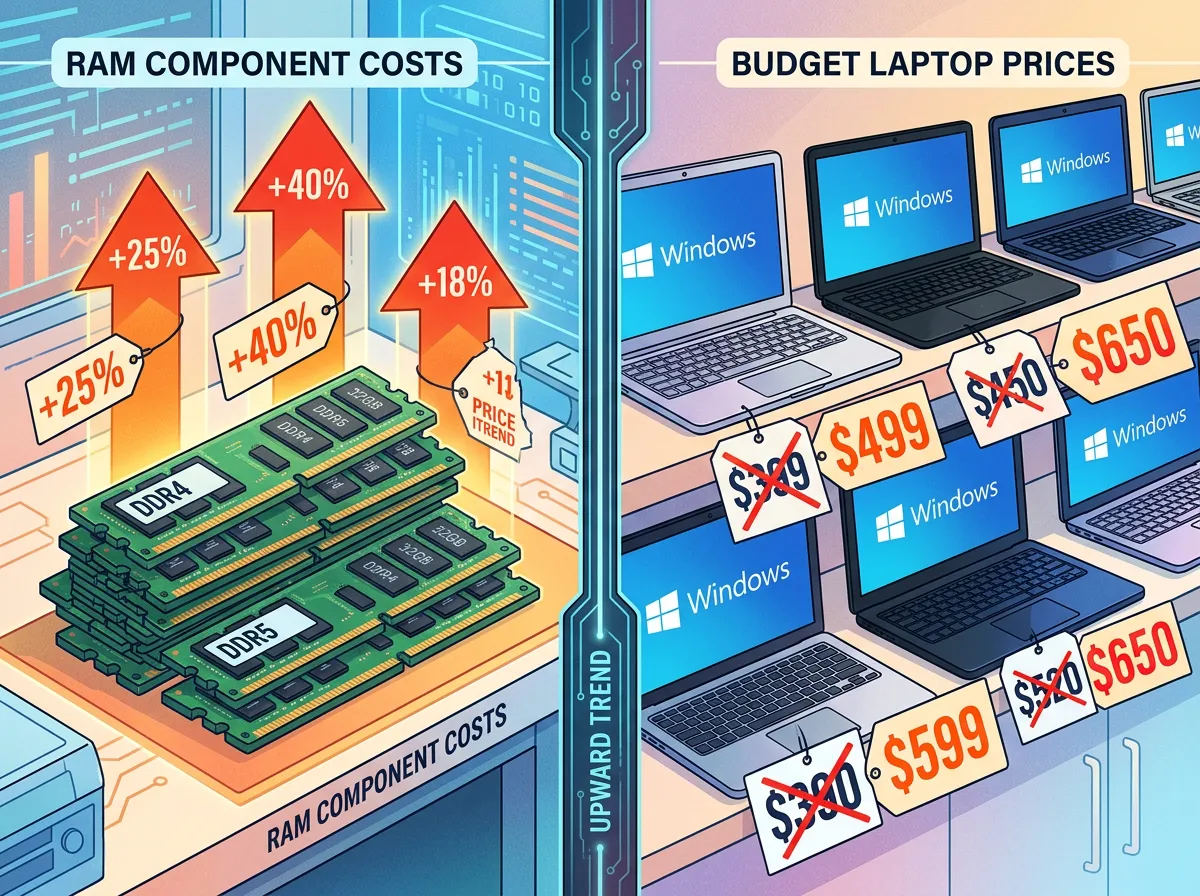
Here is where the story gets more interesting than a standard product review. Apple's timing has turned what could have been a competitive annoyance into something closer to an existential problem for budget PC manufacturers. The global memory shortage known as "RAMageddon" has sent DRAM contract prices up 90 to 95 percent in the first quarter of 2026, with NAND flash climbing 55 to 60 percent in the same period. Lenovo, Dell, HP, Acer, and Asus have all warned of 15 to 20 percent PC price increases for the year.
The math is punishing. Entry-level Windows laptops that sold for $400 to $500 in 2024 are now projected to cost $550 to $650, and the memory shortage is expected to worsen before it improves. Tom's Guide reported that the era of cheap PCs "may be over," with entry-level laptops under $500 expected to disappear from the market within two years. Apple, with its vertically integrated supply chain and massive purchasing power, has apparently insulated the Neo from the worst of these cost pressures. Its competitors, who buy chips from Intel or AMD and memory from Samsung or SK Hynix at market rates, don't have that luxury.
The advantage extends far beyond one product cycle. Apple controls its own silicon, its own operating system, and increasingly its own component supply. When memory prices spike, Apple can absorb the cost or renegotiate terms that smaller buyers cannot. When competitors need to respond with a "Neo-killer," they have to coordinate across at least three companies (a chip maker, an OS provider, and a hardware OEM), each with its own margin requirements. The structural advantage is architectural, and it compounds over time.
The iBook Precedent and What Apple Learned from Failure
Apple's budget laptop ambitions have a longer history than most people realize. The company has been trying to crack the affordable portable market for 35 years, starting with the PowerBook 100 in 1991. Most of those attempts failed. The machines had compromised displays, underpowered processors, and plastic construction that undermined the Apple brand promise. The 1999 iBook was the closest Apple came to success in this category, a colorful consumer laptop that started at $1,599 (about $3,000 in today's dollars) and proved that people would pay a modest premium for distinctive design.
The lesson Apple extracted from three decades of budget experiments is the one embedded in the Neo's DNA: you can't build a cheap laptop by removing features from an expensive one. You have to engineer from the ground up with a different cost structure. The iBook tried to be a cheaper PowerBook. The Neo is not a cheaper MacBook Air. It is a laptop built around an iPhone chip, iPhone manufacturing economics, and iPhone-scale volume. That distinction matters because it means Apple isn't sacrificing margin on the Neo the way it would if it were simply discounting its existing lineup. Multiple analysts, including Counterpoint Research, have estimated that the Neo's bill of materials leaves Apple with healthy, if not spectacular, margins.
This historical context reveals a pattern that business analysts have largely missed. Apple doesn't enter a price tier unless it can do so profitably and sustainably. The company abandoned the netbook trend of 2008 entirely. It watched the Chromebook revolution from the sidelines for over a decade. The fact that Apple chose this moment to enter the sub-$600 market with a product it can manufacture at scale and at margin suggests the company believes it has solved the engineering puzzle that defeated every previous attempt. The convergence of mobile chip performance with laptop expectations, something that wasn't true even three years ago, is what made the Neo possible.
The Chromebook Question: Education Is Not the Easy Win
Much of the initial coverage positioned the Neo as a Chromebook killer, particularly in education. The $499 student price certainly invites the comparison. But the reality of the K-12 education market makes disruption far more difficult than price alone would suggest.

Chromebooks currently hold over 60 percent of the global education market. Ninety-three percent of U.S. school districts plan to purchase Chromebooks this year, up from 84 percent in 2023, according to Counterpoint Research. Google's Chrome Education Upgrade license costs roughly $38 per device and enables zero-touch deployment, allowing IT administrators to enroll hundreds of machines in minutes. Apple has nothing comparable for fleet management at that scale and cost.
The real opportunity, as Counterpoint's analysis noted, is in higher education. University students buy their own laptops. They care about build quality, battery life, and software ecosystem compatibility. A $499 MacBook that runs the same apps as the $1,200 MacBook Air is a compelling proposition for a college freshman on a budget. Apple's education play with the Neo is likely a long game: capture students in college, build brand loyalty, and let that preference ripple into corporate IT purchasing over the next decade. It mirrors what Google did with Chromebooks in K-12 starting in 2013, building a generation of users who were already comfortable with the ecosystem before they entered the workforce.
What This Tells Us About Where Tech Is Heading
The MacBook Neo is a data point in a larger shift that extends well beyond Apple. The convergence of mobile and desktop computing, predicted for years and perpetually deferred, appears to be arriving. The A18 Pro chip in the Neo consumes between 3.5 and 4 watts under single-core load while outperforming desktop-class x86 processors that draw ten times more power. As AI infrastructure investment accelerates and the demand for compute reshapes the semiconductor industry, the economics of repurposing mobile silicon for new form factors become increasingly attractive.
For consumers, the immediate implication is that brand-name laptop quality at the $500 to $600 price point is no longer a contradiction. For the PC industry, the implication is more uncomfortable. The companies that have relied on Intel and AMD for chips, Microsoft for an operating system, and various Asian ODMs for manufacturing are facing a competitor that controls all three layers of the stack and is willing to use that control to undercut them at a price tier they assumed was beneath Apple's interest.
The competitive response will take time to materialize. Asus, Dell, and HP cannot build their own silicon. Intel and AMD cannot match Apple's per-chip economics at this performance tier, at least not yet. Microsoft's Windows on ARM initiative remains a work in progress. The most likely short-term response is a wave of marketing campaigns emphasizing the Neo's limitations (8GB RAM, limited storage, no upgradeability) while positioning their own products as better values for "serious" users. Whether that messaging lands with a consumer who can hold both a $599 MacBook Neo and a $650 Windows laptop and feel the build quality difference with their hands is another question entirely.
The Outlook
The MacBook Neo is projected to account for roughly 20 percent of Apple's total notebook shipments in 2026, according to TrendForce, which forecasts overall MacBook shipments growing 7.7 percent year-over-year. If those projections hold, the Neo alone will ship more units than several PC manufacturers' entire laptop lines.
The key indicator to watch is not Apple's sales numbers but its competitors' pricing decisions over the next two quarters. If Dell and HP raise entry-level laptop prices by the projected 15 to 20 percent while Apple holds the Neo at $599, the price gap will widen from inconvenient to decisive. Based on the current trajectory of memory prices and the structural advantages Apple holds in vertical integration, the most likely outcome by late 2026 is that Apple captures significant share in the $500 to $800 laptop segment for the first time in its history, while Chromebooks retain their grip on K-12 education and Windows PCs retreat further upmarket into enterprise and gaming.
Sources
- Apple's $599 MacBook Neo is a 'shock to the entire market' - Fortune
- First MacBook Neo Benchmarks Are In - MacRumors
- MacBook Neo review: a budget-priced game-changer - Tom's Hardware
- Apple's MacBook Neo: Targeting Higher Education - Counterpoint Research
- MacBook Neo may win the budget laptop war before it even starts - Tom's Guide