
OpenAI wants to move past chatbots. The company announced Frontier, its dedicated platform for deploying AI agents in enterprise environments, at a launch event in San Francisco on February 3. The product lets businesses build, deploy, and manage AI agents that can take actions across their software systems, not just answer questions but complete tasks like processing invoices, triaging support tickets, and coordinating multi-step workflows.
The announcement represents OpenAI's most direct move yet into enterprise software, a market dominated by companies like Salesforce, Microsoft, and ServiceNow. It also marks a strategic shift. Where ChatGPT turned OpenAI into a consumer brand, Frontier is designed to turn it into an enterprise infrastructure company, the kind of business that generates predictable, recurring revenue at the scale investors expect from a company valued at over $300 billion.
What Frontier Actually Does
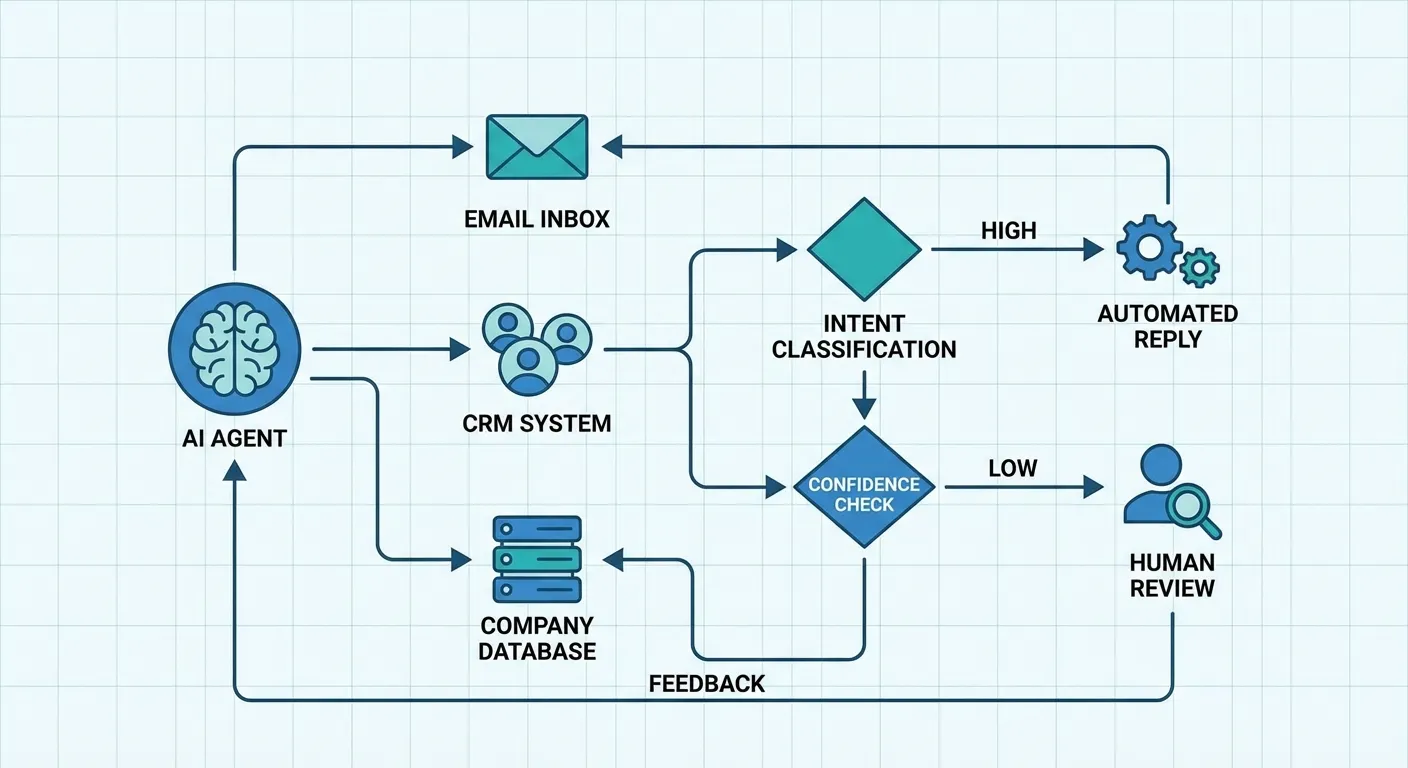
At its core, Frontier provides a managed environment for running AI agents built on OpenAI's models. Companies define workflows, such as "when a new support ticket arrives, classify it, pull relevant customer data, draft a response, and route complex cases to a human." The agent handles the execution, connecting to existing tools through APIs and making decisions based on the workflow logic.
The platform includes three key components. An agent builder lets teams design workflows without writing code, using a visual interface that maps out decision points and actions. A monitoring dashboard tracks what agents are doing, how often they escalate to humans, and where errors occur. And a governance layer provides audit trails, permission controls, and compliance logging for industries with regulatory requirements.
OpenAI CEO Sam Altman described the product as "the operating system for AI work" during the launch keynote. Brad Lightcap, OpenAI's COO, provided more practical framing, telling reporters that Frontier is "designed for the CIO who needs to justify AI spending to their board," emphasizing measurable outcomes like reduced processing time and lower error rates.
The pricing model reflects the enterprise focus. Frontier operates on a per-agent, per-action pricing structure, meaning companies pay based on how much work their agents actually do rather than a flat subscription. OpenAI claims this makes the cost directly tied to value delivered, though critics have noted that usage-based pricing can become unpredictable at scale.
The Competitive Landscape Just Got Tighter
Frontier enters a market that is already crowded. Microsoft, OpenAI's largest investor and closest partner, has its own Copilot platform with increasingly agentic capabilities. Salesforce has Agentforce. Google has been building agent features into its Workspace and Cloud platforms. Dozens of startups, from Adept to Sierra AI, have raised billions to pursue variations on the same idea.
The hype-to-reality transition for AI agents has been a defining story of early 2026, and Frontier's launch lands squarely in that conversation. The question isn't whether companies want agents but whether the technology is reliable enough to deploy at scale and whether the economics justify the investment.
OpenAI's advantage is model capability. Its GPT-series models remain among the most capable for complex reasoning and instruction-following, the qualities that matter most for agents making autonomous decisions. The disadvantage is that OpenAI is a model company trying to become a platform company, competing against firms like Salesforce and Microsoft that have decades of experience selling to enterprise IT departments.
Arvind Krishna, IBM's CEO, was characteristically blunt at a recent investor conference when asked about the competitive dynamics. "Everyone wants to be the agent platform. The question is who understands the customer's actual workflow," he said, adding that "building a demo and running production are very different problems."
Not everyone in the enterprise space is convinced Frontier changes the calculus. Nadia Hewett, a former JPMorgan Chase technology executive who now advises Fortune 500 companies on AI procurement, told Fortune that "the platform looks polished, but every enterprise CTO I talk to is asking the same question: what happens when an agent makes a $2 million mistake at 3 a.m. and nobody catches it until Monday?" She added that most large companies she works with are still struggling to get basic chatbot deployments to meet internal accuracy thresholds, let alone trusting autonomous agents with real business operations.
Why Enterprise AI Spending Is Surging
Frontier's launch coincides with a dramatic acceleration in corporate AI budgets. Gartner's January forecast projects global AI spending will reach $2.52 trillion in 2026, up from $1.8 trillion in 2025. Enterprise software, cloud infrastructure, and consulting services account for the bulk of that spending, with agent platforms emerging as one of the fastest-growing subcategories.
The spending surge reflects a shift in corporate attitude. In 2024 and early 2025, most companies were experimenting with AI, running pilots, and evaluating vendors. By late 2025, the narrative changed. CEOs increasingly see AI not as an optional innovation project but as a competitive requirement. Companies that don't deploy AI agents risk falling behind those that do, or at least that's the fear driving procurement decisions.

But the spending comes with scrutiny. CFOs want ROI data, not promises. The AI bubble debate that dominated tech discussions last year hasn't gone away. It has simply evolved from "Is AI overhyped?" to "Which AI investments will actually pay off?" Frontier's usage-based pricing is designed to answer that question directly: if the agent saves your company money, you keep using it; if it doesn't, you stop.
The Trust and Safety Questions
Deploying agents in enterprise environments raises questions that chatbots mostly avoided. When an agent takes an action, such as sending an email to a customer, modifying a database record, or approving a purchase order, mistakes have real consequences. A chatbot that gives a wrong answer can be ignored. An agent that takes a wrong action might not be caught until the damage is done.
OpenAI's governance layer is designed to address this, but the details matter. Companies in regulated industries like finance and healthcare need audit trails that satisfy regulators. They need the ability to constrain what agents can do and to intervene before irreversible actions. They need confidence that the agent won't leak sensitive data to other systems or users.
Frontier includes configurable "guardrails" that let administrators set boundaries on agent behavior, specifying which systems an agent can access, what actions require human approval, and what data can be shared across workflows. Whether these controls prove sufficient for heavily regulated environments will determine how far the platform can penetrate industries like banking, insurance, and healthcare.
What This Changes
OpenAI's Frontier launch marks the moment AI agents stopped being a research concept and became a product category with enterprise pricing and sales teams. The technology still needs to prove itself in production environments, and the competitive landscape will narrow as companies discover which platforms deliver measurable results. But the direction is clear: the AI industry's center of gravity is shifting from consumer chatbots to enterprise workflows, and the companies that control that infrastructure will shape how work gets done for the next decade.
Sources
- Introducing OpenAI Frontier - OpenAI, February 2026
- Gartner Says Worldwide AI Spending Will Total $2.5 Trillion in 2026 - Gartner, January 2026
- OpenAI launches new enterprise platform in bid to win more business customers - CNBC, February 2026
- OpenAI launches Frontier, an AI agent platform that could reshape enterprise software - Fortune, February 2026